Outdoor Lights - PIR Switch

Joined
13 Feb 2018
Messages
2
Reaction score
0
Country
United Kingdom
Hi,

My house has some lights on the outside which are wired in series and connected to a single switch inside the house by the front door.

I would like to set these up so that when the switch is set to one position (L2) the lights simply all turn on, and when it is set to the other position (L1) the lights will be all off unless one of two PIR sensors are triggered. Either of the sensors will trigger all of the lights to come on.

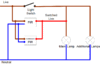
I've found a couple of wiring diagrams online which appear to do what I want. I've attached both as Example_Circuit1.gif and Example_Circuit2.png

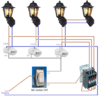
I've re-drawn this for the configuration that I think I need for my house and attached it as PIR_Sensor.png. The bit that I'm unsure on is the two neutral connections circled in red. The example diagrams that I found online suggest that these neutral connections are needed but I'm not sure what these are doing. They appear to be dead ends which serve no function

Can anyone explain what it is that I'm missing or what it is in my diagram that I've done wrong?

Thanks very much
 

Attachments

  • Example_Circuit1.gif
    Example_Circuit1.gif
    24.8 KB · Views: 117
  • Example_Circuit2.png
    Example_Circuit2.png
    78.6 KB · Views: 128
  • PIR_Sensor.png
    PIR_Sensor.png
    55.8 KB · Views: 120
My house has some lights on the outside which are wired in series and connected to a single switch inside the house by the front door.
No, they will be wired in parallel.

I would like to set these up so that when the switch is set to one position (L2) the lights simply all turn on, and when it is set to the other position (L1) the lights will be all off unless one of two PIR sensors are triggered. Either of the sensors will trigger all of the lights to come on.
You just need a switched live from permanent live at the switch to the lamps (assuming this will not affect the PIR innards) - as in circuit 1.
Circuit 2 is unnecessarily complex.

I've re-drawn this for the configuration that I think I need for my house and attached it as PIR_Sensor.png. The bit that I'm unsure on is the two neutral connections circled in red. The example diagrams that I found online suggest that these neutral connections are needed but I'm not sure what these are doing. They appear to be dead ends which serve no function
They are required for the PIRs to work.

Can anyone explain what it is that I'm missing or what it is in my diagram that I've done wrong?
It looks correct.
Can you not do away with the junction boxes and connect the wires directly to the relevant terminals?


Some (most) PIRs allow the light to be permanently on by turning the power off and on twice quickly.
In this case it is usual to wire the switch so that the power is either off, or on to PIR (sensor mode).
 
This is very helpful thanks very much.

The neutral connection to the PIRs was the bit that was confusing me. I didn't realise that a neutral connection was required by the switch itself!

The junction boxes aren't strictly required for this circuit but the actual arrangement involves some quite long distances between components. I've drawn it out with all of the distances involved and I think that this arrangement will make it simplest for me to install.

I hadn't heard of PIRs that can be permanently switch on by switching on and off twice quickly. That would be much more straightforward. I'll see if I can find some.

Thanks

Edit: I've just seen you're updated circuit. That is much more simple. The Switch, PIR1 and the lights are within a few metres of each other but PIR2 is about 15m away. I'll draw out both options and see which needs the least cable. Thanks again. You've been very helpful
 
I hadn't heard of PIRs that can be permanently switch on by switching on and off twice quickly. That would be much more straightforward. I'll see if I can find some.

The down side of these is that a transient break ( short power cut ) can result in the lamps being switched on and remaining on until someone notices the lights are on and turns them off.
 
The down side of these is that a transient break ( short power cut ) can result in the lamps being switched on and remaining on until someone notices the lights are on and turns them off.
That's true, but I have to say that I have experienced that problem (resulting from very brief power cuts) even with PIRs that do not claim to have that functionality.

Kind Regards, John
 
The neutral connection to the PIRs was the bit that was confusing me. I didn't realise that a neutral connection was required by the switch itself!
It's not required by the switch, but the PIR.

The junction boxes aren't strictly required for this circuit but the actual arrangement involves some quite long distances between components. I've drawn it out with all of the distances involved and I think that this arrangement will make it simplest for me to install.
Yes but the circuit works already so you only have to get an extra wire to the nearest PIR or light.

I hadn't heard of PIRs that can be permanently switch on by switching on and off twice quickly. That would be much more straightforward. I'll see if I can find some.
You never know, it may do it already.


Edit: I've just seen you're updated circuit. That is much more simple. The Switch, PIR1 and the lights are within a few metres of each other but PIR2 is about 15m away. I'll draw out both options and see which needs the least cable. Thanks again. You've been very helpful
:)
 

If you need to find a tradesperson to get your job done, please try our local search below, or if you are doing it yourself you can find suppliers local to you.

Select the supplier or trade you require, enter your location to begin your search.


Are you a trade or supplier? You can create your listing free at DIYnot Local

 
Back
Top