stupid question - infraRed

Joined
22 Jul 2016
Messages
6,189
Reaction score
1,165
Country
United Kingdom
Ok so maybe daft but....

what is the difference between infra red heaters and 'old fashioned' electric fires?
I remember as a kid we had the classic log effect, single plus double element/bar heater that was bloody useless.

I know that an infra red is supposed to be more efficient than old skool heaters but how?
 
The old style ones warm up the air. Infra red ones warm up objects. I had a couple of big infra red heaters in my old workshop and you didn't lose the heat when you opened the doors to move cars about. I believe many restaurants use them for outdoors heating these days too.
 
ta.
Just a thought really, as it's a tad cold in my garage despite a well sealed up and over.
if you are moving, it's not too bad.
it's the sitting for delicate stuff that makes you feel the cold
 
Ok so maybe daft but.... what is the difference between infra red heaters and 'old fashioned' electric fires? .... I remember as a kid we had the classic log effect, single plus double element/bar heater that was bloody useless. .... I know that an infra red is supposed to be more efficient than old skool heaters but how?
"Infra red" radiation IS heat.

Different types of heating distribute the heat in different ways (or, inevitably, a combination thereof) - conduction, convection or radiation. Most heat sources we are used to work primarily by conduction and convection, heating up the air in the room in question, and 'radiate' relatively little heat (even the 'radiators' we have in CH systems work primarily by convection). The heaters that these days are called 'infra red' ones do not get significantly hot, hence do not producing much heating of the air by convection or conduction, but the 'radiated' heat (infra red radiation) will heat an solid body it hits - like a human body.

An 'infra red' heater will therefore primarily heat objects (like people) it is 'pointing at', but will leave everything else, including the sir in the room, cold. They are used, for example, in the ('extravagant'!) outdoor 'patio heaters' - heating the people they are pointed at but withiout significantly attempting to heat all of the air in the UK!

The 'bar' heaters of old to which you refer worked primarily by radiation (since they were 'red hot'), but did not markedly heat the air by conduction/convection.

Kind Regards, John
 
@JohnW2 has given a good explanation, if you can see some thing red hot or hotter it is inferred, the problem with inferred is control, it is no good using a mark/space ratio to modulate the output, it needs more or less bars turning on, and also no good measuring air temperature to control them.

But unlike convection the heater does not need to be low down, heaters just below ceiling height still work, basic line of sight.

They are very good at heating areas used for a short time, in the church, or in the bathroom, as heat is near enough instant but also instant cooling as well.

In the main we used a combination, so the inferred heats area as you walk in, for first ½ hour, but air heating then takes over, allowing thermostatic control.
 
But unlike convection the heater does not need to be low down, heaters just below ceiling height still work, basic line of sight.
That's the theory. In practice, if they are low down they are in your sight and it's like looking at the sun! Well, ours were - a couple of 9Kw ones I think they were.
 
But unlike convection the heater does not need to be low down, heaters just below ceiling height still work, basic line of sight.
In theory, things that heat by convection do not need to be 'low down', either - the warmed air will rise to the top of the room even if the heater is low down. That's one of the 'inefficiencies' of heating (human beings) by convection, since one has to heat nearly all the air in the room (even that above human height) before the benefit is enjoyed by human occupants.

Kind Regards, John
 
In theory, things that heat by convection do not need to be 'low down', either - the warmed air will rise to the top of the room even if the heater is low down. That's one of the 'inefficiencies' of heating (human beings) by convection, since one has to heat nearly all the air in the room (even that above human height) before the benefit is enjoyed by human occupants.

Kind Regards, John
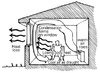
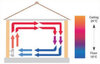
We have all seen the diagrams circulation2.jpg circulation.jpg and to some extent valid, although today with double glazing think the losses through windows is much reduced, but it is really not that simple. My first house cost a fortune to heat, it was gas hot air, and because fans moving the air whole house was same temperature.

However with my mothers house I had a collection of thermometers in the room, and within the same room they could show 18°C to 32°C, OK mainly due to sun in the bay window, but air does not circulate that well.

First made a mistake and put the thermostat 90° to radiator, and the hysteresis was massive, placed on opposing wall and the outside wall was clearly cooling the thermostat, ended up free standing on a tea trolley centre of room.

It went faulty and replaced with electronic TRV heads, and must say they worked very well, that was with a gas modulating boiler, worked but no where near as well when we moved house and had an oil boiler. However we are not so worried about being a little too hot or cold like my mother was.

I have two radiators in the same room 90° to each other, both with electronic TRV heads that report to the PC, very common for there to be 2 or 3°C difference between the two heads.

This circulation.jpg may be the theory, but in practice we do get warm and cool spots within a room.
 
Ok so maybe daft but....

what is the difference between infra red heaters and 'old fashioned' electric fires?
I remember as a kid we had the classic log effect, single plus double element/bar heater that was bloody useless.

I know that an infra red is supposed to be more efficient than old skool heaters but how?

IR is rather like light, or a beam of light - it only lights up (warms up) what it strikes - though there is still some air warmed up in the process, most of the heat from IR warms up bodies.
 
We have all seen the diagrams .... and to some extent valid, although today with double glazing think the losses through windows is much reduced, but it is really not that simple. My first house cost a fortune to heat, it was gas hot air, and because fans moving the air whole house was same temperature.
You don't need to tell me - it also costs a fortune to heat (the air in) the ground floor rooms of my house (with CH 'radiators'), where the rooms are about 3.5 metres high. During cold weather, there is usually at least 5°C difference, often a lot more, difference between air temp at floor and ceiling level - that means that we often have to get the air temp near ceiling well over 30°C for the temp to be reasonably comfortable at 'sitting level' in the rooms.
However with my mothers house I had a collection of thermometers in the room, and within the same room they could show 18°C to 32°C, OK mainly due to sun in the bay window, but air does not circulate that well. This ... may be the theory, but in practice we do get warm and cool spots within a room.
Yes, of course, but the 'vertical' temperature variations are much more inevitable (reliant primarily on the Laws of Physics), and much less easy to do anything about, than is the case (e.g. by double glazing/curtains, positioning of radiators, closing doors etc.) with the 'horizontal' temperature variations which are what I think you are mainly talking about.

However, none of this alters the general point I made, that when one uses heating methods (e.g.CH 'radiators') which rely primarily on convection, it doesn't make much difference whether the radiators are low down, half way up the wall or even 'near the ceiling'. In all cases, the air in the room will essential heat up 'from top down'.

Kind Regards, John
 
IR is rather like light, or a beam of light - it only lights up (warms up) what it strikes - though there is still some air warmed up in the process, most of the heat from IR warms up bodies.
Very much so - although I think you're probably understating the situation by merely saying that "IR is rather like light". Infra-red and visible light are both electromagnetic radiation, the only (slight) difference being a slight difference in wavelength.

In fact, I would think that the amount of heating (e.g. "of bodies") produced by a beam of red (visible) light would be only slightly less than that produced by a comparable beam of IR radiation.

Kind Regards, John
 
You don't need to tell me - it also costs a fortune to heat (the air in) the ground floor rooms of my house (with CH 'radiators'), where the rooms are about 3.5 metres high. During cold weather, there is usually at least 5°C difference, often a lot more, difference between air temp at floor and ceiling level - that means that we often have to get the air temp near ceiling well over 30°C for the temp to be reasonably comfortable at 'sitting level' in the rooms.
Yes, of course, but the 'vertical' temperature variations are much more inevitable (reliant primarily on the Laws of Physics), and much less easy to do anything about, than is the case (e.g. by double glazing/curtains, positioning of radiators, closing doors etc.) with the 'horizontal' temperature variations which are what I think you are mainly talking about.

However, none of this alters the general point I made, that when one uses heating methods (e.g.CH 'radiators') which rely primarily on convection, it doesn't make much difference whether the radiators are low down, half way up the wall or even 'near the ceiling'. In all cases, the air in the room will essential heat up 'from top down'.

Kind Regards, John
That's why we use ceiling fans.
 
That's why we use ceiling fans.
Interesting theory. However, I wonder who this "we" are, since I can't recall having ever seen a ceiling fan used for that purpose in a domestic property - - do i take it that you have?

kind Regards, John
 
However, none of this alters the general point I made, that when one uses heating methods (e.g.CH 'radiators') which rely primarily on convection, it doesn't make much difference whether the radiators are low down, half way up the wall or even 'near the ceiling'. In all cases, the air in the room will essential heat up 'from top down'.

Ceiling fans help with that.
 
Very much so - although I think you're probably understating the situation by merely saying that "IR is rather like light". Infra-red and visible light are both electromagnetic radiation, the only (slight) difference being a slight difference in wavelength.

I was trying to avoid over complicating the explanation, for the benefit of the OP.
 

If you need to find a tradesperson to get your job done, please try our local search below, or if you are doing it yourself you can find suppliers local to you.

Select the supplier or trade you require, enter your location to begin your search.


Are you a trade or supplier? You can create your listing free at DIYnot Local

 
Back
Top