Testing my plumbing - first go with capillary fittings

Joined
4 Jan 2012
Messages
351
Reaction score
7
Country
United Kingdom
Hi guys
So Ive extended my heating system aka stage 1 using Yorkshire fittings and wanted to fill and test. Given its only connected to the system at one end without any radiators on I was thinking to cap a branch and connect another branch with 2 speedfit elbows and a small piece of copper effectively shorting the run but completing the flow. Would this be the best way to test as Im not ready to connect to the radiators yet.

Thanks
 
Assuming your heating system is standard 2 pipe and you have connected up both flow and return just cap off all ends and test.
Any leaks will show themselves!
I would have installed full bore lever valves to isolate new section for ease of further work.
 
Hi
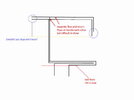
Thanks for answering and its probably just me over thinking but surely if I just cap off all ends only the flow will get the water from the old system (even though both flow and return will be connected to the old system) as the water circulates how will it get to the return side of the new pipework? Will it just run via the old return effectively the wrong way until it hits the stop end?
 

Attachments

  • Image.jpg
    Image.jpg
    16.1 KB · Views: 79
Is your system sealed and pressurised or gravity fed?

If the former, any leak will show over time on the pressure gauge.

If the latter, gently ease off the push fit caps (without removing them) to allow air out until water appears. Push cap fully back on and. Dry up the wet and then monitor.

You can do the same on a sealed system but have to ensure the pushfit stopend doesn't shoot off and catch you out.
 
Assuming your heating system is standard 2 pipe and you have connected up both flow and return just cap off all ends and test.
Any leaks will show themselves!
I would have installed full bore lever valves to isolate new section for ease of further work.
Not a bad idea - I can splice the new section and add a couple of lever vales :)

I pressurised to .5 bar and no leaks yet so will add another .5 and see what happens! :D
 
Boiler off. Stick 3 bar in.
Go on... Dare ya! (y)
You're kidding right? The boiler only when working sits just over 1 bar and will build when on (Ive only ever filled a boiler to 1 bar as sufficient)
 
Last edited:
1. Normal test pressure is 1.5 times working pressure.
2. While working pressure is, say 1.3 bar, with fault condition can go to 3 bar.
3. My practice is to:
3a. Isolate / disconnect any appliance which can't take 5 bar.
3b. Test at 5 bar (being 3 x 1.5 plus 0.5 for luck).
3c. Wet (water) test only. Under no circumstances air test at 5 bar - it can be lethal.
 
I might push to 2 ;)

Read this and weep! :ROFLMAO:

"What is the general rule of thumb for pressure testing a system?
First carry out a low pressure water test at 0.5 – 1 bar when the system is just demountable fittings, then a pressure test at 1.5 x the normal working pressure with a recommended minimum of 10 bar for a minimum of 45 minutes. However, if any of our slimline fittings are included with the system, then an 18 bar test for minimum of 45 minutes should be carried out."
https://blog.wavin.co.uk/push-fit-h...minutes should be carried out.,-Why does 15mm
 
You're kidding right? The boiler only when working sits just over 1 bar and will build when on (Ive only ever filled a boiler to 1 bar as sufficient)

Systems are set to release via the PRV at 3 bar. So you should take the test to that level. Boiler off means it won't go past that, in which case it would just lift the PRV and vent.
 

If you need to find a tradesperson to get your job done, please try our local search below, or if you are doing it yourself you can find suppliers local to you.

Select the supplier or trade you require, enter your location to begin your search.


Are you a trade or supplier? You can create your listing free at DIYnot Local

 
Back
Top