• Looking for a smarter way to manage your heating this winter? We’ve been testing the new Aqara Radiator Thermostat W600 to see how quiet, accurate and easy it is to use around the home. Click here read our review.

Fluoresent or LED

Well the facts are LED tubes give less light than florescents of the same size. Just look up the specs. But old florescents can be dim especially if you have never taken them out and cleaned them. The same thing will happen with LEDs if you don’t clean them.
You can get LED tubes with same output as fluorescent, however not it seems in high street shops, but I when replying to another thread found “According to the UCC, you must support products for a minimum of seven years after last customer ship!” so we should be able to get replacement tubes for some time. Remember a LED tube will not work in a lamp with an electronic ballast.
 
Since in the main the tube is fitted without removing the magnetic ballast the 50 watt version is normally sold as a complete lamp the one linked is 4150 lumen which for 50 watt is not very good.

This one however 6000 lumen and this is the problem, LED lamps vary hugely as to how efficient they are. With a GU10 at 2.8 watt be it 365 lumen (note 10 - 30 volt this one) or 2.5 watt[/URL]
[url=https://www.diydirect.com/gu10-15-led-bulb-2-5w-warm-white?gclid=Cj0KCQiAvqGcBhCJARIsAFQ5ke5TKHM7JuBD8bd1eM-ks64kiAHLhmD47KSP9JPsfJcHQXS2hMDNZmUaAsVbEALw_wcB]at 200 lumen [/url]it hardly matters, but we have had it drummed into us LED is efficient, and some are, but also some are not.
 
Given your information that makes the LED bulb at 167 lumens/watt and the florry only 86 lumens/watt.

But that means that most of Winston’s posts above are wrong.
Or is my calculator broken?
Gulp. Stop the press. It’s the end of days…
My posts are not wrong. So a non typical tube has turned up which claims an unusually high output.
Manufacturers have made false claims before though I am not saying this is a false claim. I would like however to see evidence of this rather unusual claim.
 
Since in the main the tube is fitted without removing the magnetic ballast the 50 watt version is normally sold as a complete lamp the one linked is 4150 lumen which for 50 watt is not very good.

This one however 6000 lumen and this is the problem, LED lamps vary hugely as to how efficient they are.
As it happens I have 4 of the 300mm version https://www.mygreenlighting.co.uk/b...V_aPXOl6LbIWkEOsTxV8ujSvCEqq8RZkaAmy8EALw_wcB which were quoted as 980 lumen, however I see the later versions are quoted as 1200Lumen, which I purchaced to install three in a 9ft x 9ft fibreglass hut to replace the 4ft 40W ballast fitting (that's a ballast from when ballast meant 4 terminal unit and not choke - 2 terminal). containing a tube of 40 years old and in the 5th location - it was a scrap unit from work, used in my workshop 1985- 1991, garage 1992- 1994 next workshop 1994 - 2009, hut 2009 - 2021, dates approximate.

2 weeks later they were replaced with a new 1200mm fluo. The main complaints were the glare of the 'point source' fittings in a ceiling height of 2m and the shadows. However the perceived light level; initially there were not really any comments but the replacement 36W fluo was instantly seen as brighter (not surprisingly) and changed for a warmer colour.
 
Last edited:
In our local church hall the Fluo fittings, consisting of 2 4ft tubes in a fitting resting in the ceiling grid, have recently been replaced with LED panels.
replacements are much brighter to look at and cool white, however they are 90W vs 72W so 25% increase and some regulars, mostly elderly, are commenting they are not as bright and also complaining of headaches.
View attachment 287362
Similar to these but 2 tubes

So... I was using this hall last night for the annual quiz, 28 months after the 18 twin 36W fluo fitting were replaced with 90W LED equivalents and the conflicting opinions on which is better or worse, I found 4 panels not working and speaking with the person letting us in/locking up (Despite knowing I have a key) says they have already replaced at least that many.

Yeah 8 out of 18 in 28 months sure seems like a reliable and cheaper system to me. We used to do a tube replacement every 6 months (March and September) and more if required of failed and blackened tubes (as a significant hall user I assisted as younger than most of the 'officials' involved) I checked the record on the box of 25 still on the top of the cupboard in the store room starting March 2016: 3,1,2,3,1,3,1,1,none for 2020,4,1,2 =20 per 7 years and there are 3 left in the box so adrift by 2. Current price for a box of 25 tubes ~£70 cost of Vtac panel ~£35, at current failure rate of 8 per 28 months = 24 per 7 years = £840 so 12 times the cost of the 'expensive option' on top of the 25% increase of energy consumption from 1296W to 1620W = 324W and assuming the hall is in use for 6 hours every day of the year for 7 years = an increse of 4967KWh and assuming 20p per unit = £993 added to the £840 = £1833 or £261 additional cost per year


Our council replaced most of the town street lighting with LED alternatives, our street was done 4 years ago. The reduction from 70W of discharge to 38W (Measured with a current clamp in the standard by our home) shows ~50% reduction for a lovely (albeit flickering and multipoint source so multi shadow) for around 10m each side and fading to hardly at all by 20m. The public pavement by our home is hardly illuminated despite being ~10m from the standard directly across the road, of the 5 standards visible from there 3 have been replaced following 3 to 6 months of failure, the latest costing £1395 according to council figures excluding admin costs, the significant rise in such costs overiding the enerysaving has been discussed numerous times at county level.

The record of increased injuries attributed to poor light tells a tale too.


Sorry but I really do not understand where all of these savings and improvements are.

 
Last edited:
Our council replaced most of the town street lighting with LED alternatives, our street was done 4 years ago. The reduction from 70W of discharge to 38W (Measured with a current clamp in the standard by our home) shows ~50% reduction for a lovely (albeit flickering and multipoint source so multi shadow) for around 10m each side and fading to hardly at all by 20m. The public pavement by our home is hardly illuminated despite being ~10m from the standard directly across the road, of the 5 standards visible from there 3 have been replaced following 3 to 6 months of failure, the latest costing £1395 according to council figures excluding admin costs, the significant rise in such costs overiding the enerysaving has been discussed numerous times at county level.

The record of increased injuries attributed to poor light tells a tale too.


Sorry but I really do not understand where all of these savings and improvements are.
My street was done about 8 months ago and the improvement in light coverage and quality over the old yellow sodium lamps is immense. In addition there is much less stray light both upwards and sideways.
They did a one for one replacement of the existing lights, each one took about thirty minutes from start to finish.
 
My street was done about 8 months ago and the improvement in light coverage and quality over the old yellow sodium lamps is immense. In addition there is much less stray light both upwards and sideways.
They did a one for one replacement of the existing lights, each one took about thirty minutes from start to finish.
We have the same situation with some from sodium to LED and as you say
...there is much less stray light both upwards and sideways.
They did a one for one replacement of the existing lights, each one took about thirty minutes from start to finish.
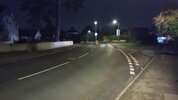
We have a lovely pool of light, which in all fairness is probably far brighter than the sodium bearing in mind the lack of colour spectrum from sodium, directly under each standard but this diminishes to a 'useful level' by about 10m and I'd say non existant by 20m. The front to back beam width is a fraction of side to side, to the point the far kerb of our 1960's estate road is in darkness.

Our 5 took most of day as they modified the existing standard and replaced the electrical parts too before moving on to the next. Our pavements have looked very dark and dingy ever since.
 
We have the same situation with some from sodium to LED and as you say

We have a lovely pool of light, which in all fairness is probably far brighter than the sodium bearing in mind the lack of colour spectrum from sodium, directly under each standard but this diminishes to a 'useful level' by about 10m and I'd say non existant by 20m. The front to back beam width is a fraction of side to side, to the point the far kerb of our 1960's estate road is in darkness.

Our 5 took most of day as they modified the existing standard and replaced the electrical parts too before moving on to the next. Our pavements have looked very dark and dingy ever since.
A picture tells a thousand words
 

Attachments

  • 20250120_023416.jpg
    20250120_023416.jpg
    96.5 KB · Views: 53
A picture tells a thousand words
oops, my mistake. However that may be a better indication than I intended, the previous post is the road ours is a turning off of; the white wall on the left in the is the corner house, our street is bottom left.

This is looking down our street and the white wall finished a few meters behind this photo.
1737815051666.png

The 2 white arrows show the dropped kerb to my and neighbours drives.


2 similar views looking towards the light directly across from our drive showing how far sideways the LED lamp standard illuminates and how little light extends onto the road or the opposite pavement, and how little light comes from the standard some 25m to the right.
1737816415302.png
1737816349573.png
 
Last edited:

If you need to find a tradesperson to get your job done, please try our local search below, or if you are doing it yourself you can find suppliers local to you.

Select the supplier or trade you require, enter your location to begin your search.


Are you a trade or supplier? You can create your listing free at DIYnot Local

 
Back
Top