• Looking for a smarter way to manage your heating this winter? We’ve been testing the new Aqara Radiator Thermostat W600 to see how quiet, accurate and easy it is to use around the home. Click here read our review.

Damp under bay windows

Joined
21 Sep 2024
Messages
30
Reaction score
2
Country
United Kingdom
There is damp on the interior wall where the bottom of the bay meets the top of the wall. The damp only appears to be at the corners. The window photographed is on the first floor, but I also have the same problem with window on the ground floor. How can I fix this? Can I fix it from the inside? As I am a beginner, a quite detailed explanation would be amazing.
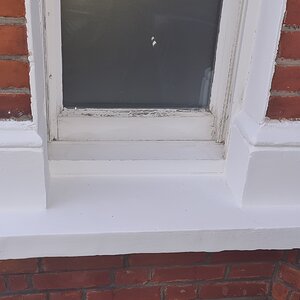
20240927_092327.jpg
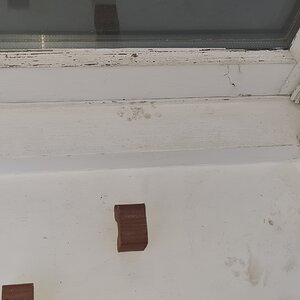
20240927_092100.jpg
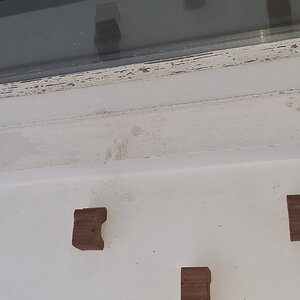
20240927_092049.jpg
 
It could be ingress of moisture from outside, the rain has got into the render/brickwork and not dried out. Its also possible that the room itself isn't kept war and damp has developed, although this would usually manifest itself as black mould. Inspect externally under the windows to see if there are signs of damp or gaps that would let moisture in. The remedy may be to chop out the plaster and let the wall dry out, replacing with breathable plaster.
 
Rainwater penetration, the defect will be on the outside. Photograph the ground floor window all round. It will be easier to reach, Most likely the fault will be same on the other. Look at all joints for gaps. Water may be entering at the top and running down.

Sometimes bay windows have bad or missing gutters and water spills over.
 
Good windows, set into the wall in the post-1666 London style. I think not likely the source. But I see a glimpse of a downpipe beside the bay. Is this near the damp?

And a manhole cover in front of the bay.

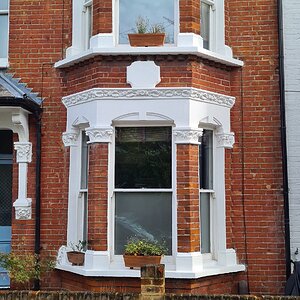
Please post a pic that includes the roof and gutters above the bay, and any external signs of damp near the downpipe or any other plumbing or overflows. How often do you water the plant trough? Does it have a saucer or tray to catch any overflow?

Just to check, the damp is both in the ground floor and on the first floor?
 
The damp is definitely on the ground floor and damp floor. As it is occurring at the corners of the bay and only where the top of the wall meets the bottom of the bay, it strikes me as likely that there is some gap at that point. In the photos I provided, the most obvious damp is at the point I removed the lining paper. However, the damp is at every bay window corner and at the left and ride side of the bay. I was hoping to just remove the top bit of plaster and fill the gap with expanding foam or some other material. Do you think that would be a good idea? I also had a builder come round who suggested removing the plaster putting polythene and battens and replastering. He also wanted to check the guttering for leaks.
 
More like just condensation , single glazed windows? are particularly susceptible..
 
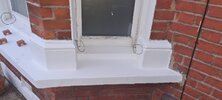
Thanks foxhole. I don't think it is condensation as they are double glazed windows, and I never see condensation o them. I note that damp is only on the bottom of the bay where it meets the wall in the interior. When I say it is on the corners of the bay, I mean that it is on the places circleed in the below image. It is exactly the same on the bay on the ground floor. The wall has lining paper. I removed the lining paper on the second from left circle, so I could see behind it. The plasterwork all seems okay apart from right at the top. I was considering hacking away some more plaster at the top and filling any visible holes with expandable foam. Any thoughts? The wall is a cavity wall.
20240927_092327.jpg
 
Hi, please note I'm not an expert, just a diy'er.

I'm not sure I'd be hacking off plaster and pumping in expanding foam if you've not first identified what the likely issue is. You might exacerbate the issue rather than resolve it?
 
OP,
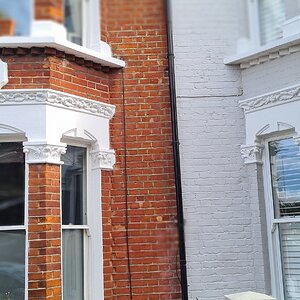
There are no drip channels showing under the stone window sills - this lack of drip channels will allow water to run back under the sill and enter & penetrate the poorly pointed solid wall.
Fresh Drip channels can be cut with an angle grinder.
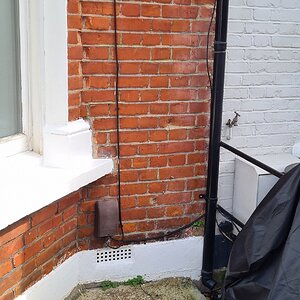
The re-pointing is well wrong - its a mere skim over the original pointing with a very stiff mix of sand & cement. The beds & perps need grinding out to 25mm depth & re-pointed with 4:1 sand & NH lime mortar.

FWI: If you still have suspended floors then the air bricks are set too high to vent under the floor.
The porch RWP is discharging onto the hard surface.
 
I agree with you. I thought the pointing has been done with too stiff a mix. I believe we still have a suspended floor on the ground floor. It's engineered wood. I assume set on joists.
 
It might be down to the lack of drip channels. When it next rains, check to see if the water tracks back toward the bricks.

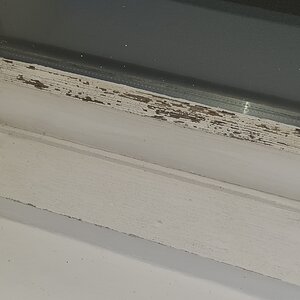
The only other thing I can think of is where the sashbox frames meet the window sills. That would certainly explain the cone shaped stains in the corners.


window.jpg

You could apply a thin bead of something like CT1 with a caulking gun and see how you get on. You also have some hairline cracks where the timber sills meet the stone sills but they are raised up, so I don't think there would be much water ingress from there (but it would benefit from being sealed).
 
Thanks, opps. I think that sounds plausible. It also seems the easiest place to start. If that doesn't solve the problem, I can move onto other steps. At some point, I will repoint it all in any case as I agree the pointing is not done properly.
 

If you need to find a tradesperson to get your job done, please try our local search below, or if you are doing it yourself you can find suppliers local to you.

Select the supplier or trade you require, enter your location to begin your search.


Are you a trade or supplier? You can create your listing free at DIYnot Local

 
Back
Top