
• Looking for a smarter way to manage your heating this winter? We’ve been testing the new Aqara Radiator Thermostat W600 to see how quiet, accurate and easy it is to use around the home. Click here read our review.

Broken brickwork below dpc and doorway

Joined
27 Sep 2011
Messages
457
Reaction score
5
Location
Somerset
Country
United Kingdom
Potential purchase of a house, but the apparently poor workmanship is worrying.

There used to be a garage attached to the house, which has recently been torn down, leaving broken bricks ( where the garage was keyed into the house) with holes going into the cavity. This is unsightly but fixable.
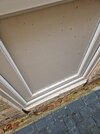
My issue is with the state of the brickwork below dpc, particularly where the external side door is. The bricks, which do not seem to be engineering bricks, have lots of mortar missing and the concrete block in the doorway has been carlessly smashed off leaving holes that seem to go quite far back.
The immediate vicinity has now been blocked paved, witha channel along the wall, so any water tends to pour off into this channel and up against the broken brickwork/block.
To me this is going to cause an issue with damp, but the vendor ( an investor who didn't live in the house and employed a 'builder' to rip the garage down) claims its just cosmetic and will cause no problems.
Is he right?
 

Attachments

  • IMG-20241109-WA0023.jpg
    IMG-20241109-WA0023.jpg
    333.2 KB · Views: 99
  • IMG-20241109-WA0011.jpg
    IMG-20241109-WA0011.jpg
    495.5 KB · Views: 95
Potential purchase of a house, but the apparently poor workmanship is worrying.

There used to be a garage attached to the house, which has recently been torn down, leaving broken bricks ( where the garage was keyed into the house) with holes going into the cavity. This is unsightly but fixable.
My issue is with the state of the brickwork below dpc, particularly where the external side door is. The bricks, which do not seem to be engineering bricks, have lots of mortar missing and the concrete block in the doorway has been carlessly smashed off leaving holes that seem to go quite far back.
The immediate vicinity has now been blocked paved, witha channel along the wall, so any water tends to pour off into this channel and up against the broken brickwork/block.
To me this is going to cause an issue with damp, but the vendor ( an investor who didn't live in the house and employed a 'builder' to rip the garage down) claims its just cosmetic and will cause no problems.
Is he right?
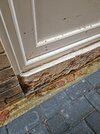
The detailing for that door sill is all wrong now that the external structure is absent. The small shelf of concrete will catch rainwater (cause damp) and the stub of concrete will (thermally) wick in the cold. It's very poor.
 
My thoughts too. That block of concrete needs to be removed and replaced with what though.?
It's a new door ( despite the crud all over it) and the vendor insists the whole area is correct and not an issue. I'm no builder, but it looks wrong to me, for the reasons you said.
 
Probably the correct way would be to break out the concrete, remove the door then brick up to floor level, toothing into the surrounding bricks. Then buy a new door that's the same dimensions but including a doorstep/sill that will overhang the brickwork.

A lot of effort for probably no improvement other than making it look more normal. Your new bricks would still stand out as they'd be cleaner than the rest and/or possibly not match. So probably pointless.

You could cut into the top and retro-fit a plastic step, under the existing door. Then add a bit of trim panel under it. Or a combination of brickwork and retro-fitting a step.

There are epoxy repair cements for use on stone window sills, perhaps you could use this to fill and tidy it up then paint it.

The reality is that it's probably not doing any harm as it is, other than looking strange It's below DPC so doesn't really matter.
 
It's not really about how it looks, which is ****e, but the issue of rain and damp.

Im not sure what you mean by "its below dpc" as the dpc is visible 1 course up from the bottom of the concrete block, so it actually starts below dpc. It was originally an internal door and the 'builder' says he has put in a new upvc door and frame, so would have been better if he did it as you suggested.

He disagrees that a rain step or any kind of rain drip is needed which doesn't sound right to me.
 
You could grind it into a sloping shape, if it doesn't already slope.

It's hard to say, it would be much better if it wasn't like that, but it is.

The answer is probably that you buy any house as-is and just accept that all problems will become yours. If you don't like it then reduce your offer. If they don't like that then they'll tell you to go away.

You definitely don't start telling sellers that they need to fix things, they'll just sell to someone else.

Every house I've bought has had problems that I knew would cost £1000s to fix. I still bought, but at a price I was happy with.
 
I haven't told them to fix anything, but a reduced offer was refused, so he was told why the offer was made.
I'm just looking for advice from.the collective that'll support my reasoning.
 
I suspect that they think you've already decided to buy so don't need to reduce it. If you're making a reduced offer then be prepared to walk away if they won't take it.

They may change their mind if you do, or may not.

You decide what it's worth to you, don't obsess about how much you're getting knocked off, but look at whether it's worth the price. If not don't buy it.
 
I think you're right. The estate agent is driving the sale as much as the vendor, but it won't sell at the price they think, especially with stamp duty changing in April.
Every house I've owned needed work, I know that, but usually noticed once you've moved in and paid.!
 
It's not really about how it looks, which is ****e, but the issue of rain and damp.

Im not sure what you mean by "its below dpc" as the dpc is visible 1 course up from the bottom of the concrete block, so it actually starts below dpc. It was originally an internal door and the 'builder' says he has put in a new upvc door and frame, so would have been better if he did it as you suggested.

He disagrees that a rain step or any kind of rain drip is needed which doesn't sound right to me.
It needs separation from the external weather and temp's, i.e. a few courses of brick up to DPC along with some insulation and DPM internally, before the floor is made good.
 

If you need to find a tradesperson to get your job done, please try our local search below, or if you are doing it yourself you can find suppliers local to you.

Select the supplier or trade you require, enter your location to begin your search.


Are you a trade or supplier? You can create your listing free at DIYnot Local

 
Back
Top