Heat Greek vs Skill Builder mainly heat pump, but some reference to condensing gas boilers.

I've never seen a heat pump
Look like every aircon unit in every film you've ever watched
I can't see how they are cost effective
My system cost me 5 grand, and the RHI paid me 7
I can't see how that's not cost effective!

Can you get someone to fix short notice?
I called Vaillant out once, circulator pump issue fixed under warranty

How reliable?
I've never touched it. "Servicing" it amounts to washing any crap out of the vanes. Never done that either. Been churning out warm water for 8 years now

Saving worth the cost of installing?
I don't have gas. Monobloc systems can be mostly DIY installed and maintained. Overall I'd estimate mine's been cheaper to run than a gas boiler

I was thinking "passivhaus" standards.
Then you don't need a formal heating system at all, and certainly not one as expensive as an HP. Keep a couple fan heaters in a cupboard

Insulation does not have to be particularly good
Insulation should be particularly good in all properties and (in tandem with straight proofing) should be the primary focus of any upgrade, not the heating system

If you get the insulation right you don't need heating, and both wallet and planet thank you ongoing
 
Last edited:
There are some tables out there, but at 40% humidity we humans need a stable air temp of 17.6 c to feel comfortable and at 65% we need 19.7c.
The colder the air temp the lower the humidity i.e. cold air holds less moisture. This means body sweat can evaporate more easily. Increased humidity means less evaporation and thus it is harder to cool down. Since the focus is to stay warm during the winter then surely you want to increase humidity and lower evaporation, not increase it ?
 
The colder the air temp the lower the humidity i.e. cold air holds less moisture.
I'm afraid that's not quite right.
Yes, cold air can hold less water (vapour) than warm air; but that means for a volume of air that contains a certain amount of water vapour, the cooler that air volume gets, the higher the relative humidity will become.
I.e. as cooler air can hold less water vapour, the quicker that air will become saturated.

So as Martygturner says...
There are some tables out there, but at 40% humidity we humans need a stable air temp of 17.6 c to feel comfortable and at 65% we need 19.7c.
If you can lower the relative humidity sufficiently; the temperature we need to remain comfortable doesn't need to be so high.
There are RH limits though, some feel more comfortable breathing in an atmosphere with a slightly higher RH.
 
That's as may be, but assuming you gain an extra 25% efficiency on a £800 yearly gas bill, how long before your new plumbing and radiators pays for itself?
Never.

No heating system can 'pay for itself'.
Heating a building is a cost, both for the initial installation of the equipment, and ongoing fuel & maintenance.

If there is a working heating system, then keep it until it needs replacement.
Then when replacement is required look at alternatives such as heat pumps, rather than just shoving yet another gas boiler in.
 
as cooler air can hold less water vapour, the quicker that air will become saturated.
This is the bit that stumps me. 17.5c is uncomfortable for a lot of people regardless of humidity. 17.5c will never feel like 21c regardless of moisture levels.

But the other problem is that @ 17.5c, as the air becomes more saturated it's no longer @ 40% humidity. I had a PIV with 45% humidity @ 18c, I was still very cold.

I would be interested in seeing any materials that will go into more depth. Its an interesting take and I am interested in learning more.
 
Humidity is an odd thing, once below 0ºC then air can't be humid, it drops out hence frost and snow, so an air source heat pump in air below 0ºC does not have the problems of a system just above 0ºC. So the UK is unlike many other countries, as for so much of the Winter we are just above 0ºC.

Woodlands can have a very high humidity, yet I have not noticed them feeling colder than the walk en-route to them, in fact it often seems warmer in the woodland.

What stumps me, at 17.5ºC outside I consider it as a nice day, and in summer 17.5ºC indoors seems fine, but in winter it's too cold, the big change for me was moving to lights which did not give off inferred heat, in the days of tungsten at 18ºC I felt warm sitting watching TV, today with LED lighting, I want it at least 20ºC to sit and watch TV, so were tungsten lights energy saving?

I would not return to tungsten lights, would change a bulb every other week, but as to feeling cold, hearing the wind at the moment makes me feel cold, yet the temperature is not really that low, 19.6ºC and 47% humidly, but sound of the wind makes me feel cold.
 
What stumps me, at 17.5ºC outside I consider it as a nice day, and in summer 17.5ºC indoors seems fine, but in winter it's too cold, the big change for me was moving to lights which did not give off inferred heat, in the days of tungsten at 18ºC I felt warm sitting watching TV, today with LED lighting, I want it at least 20ºC to sit and watch TV, so were tungsten lights energy saving?

I agree - Temperature and comfort, can be subjective, and even varies wildly from one person to another. Outdoors, it depends on wind speed, humidity, sunlight, and what you are doing. Indoors, humidity, what you are doing, and other factors. Even watching a film on TV, which has lots of snow and ice, can make you feel chilly, I find. Even the colour temperature of lamps, can seem to make a difference.

I cannot agree with your point about lamp type, the waste heat from a 100w lamp, would have been about 90w. The waste heat from a 10w LED perhaps 1w. 90w, or 1w would make little difference to a room's temperature. We used to have a 300w plasma, that wasted perhaps 250w as heat, but made no noticeable difference.
 
What stumps me, at 17.5ºC outside I consider it as a nice day, and in summer 17.5ºC indoors seems fine, but in winter it's too cold, the big change for me was moving to lights which did not give off inferred heat, in the days of tungsten at 18ºC I felt warm sitting watching TV, today with LED lighting, I want it at least 20ºC to sit and watch TV, so were tungsten lights energy saving?

I would not return to tungsten lights, would change a bulb every other week, but as to feeling cold, hearing the wind at the moment makes me feel cold, yet the temperature is not really that low, 19.6ºC and 47% humidly, but sound of the wind makes me feel cold.
Also the sun puts out a lot of visible light, but it also puts out a lot of infrared and thermal radiation. This means that even if the air around you is quite cold, if you are standing in direct sunlight it might not feel very cold since the sun is acting like a heater warming you up. The wind is also a big factor, when you are indoors unless you are right near the radiator etc, there isn't very strong flow of air, which means that your body can heat the air around you without that air being moved away, which slows heat loss. Outside, if there is even a slight breeze, almost all of the air around you is getting moved around and away, which means that it can feel a lot colder.
 
I cannot agree with your point about lamp type, the waste heat from a 100w lamp, would have been about 90w.
The last house living room had 6 x 60 watt tungsten, and when we went to CFL it changed to 10 x 8 watt golf ball CFL which was to be frank a failure, the Philips lamps were no where near bright enough, and that was the last time I used Philips.

However we at that point found in the evening we needed to turn the heating up, until then we would set central heating to 18ºC at 9 am, and total off at 10 pm, the room thermostat was not programmable, it was rather a simple one, no TRV's down stairs, but the Myson fan assisted radiator did have a thermostat built in, so if cool we could hear the fan running. Gas boiler non modulating.

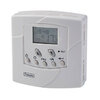
So the thermostat was changed, something like this ae235.jpgand the room temperature would raise at 6 pm. And now did not go off over night, but set low, so the time clock and frost stat became redundant.

As time went on bulbs changed to 3 watt LED, which was not enough, so then 5 watt LED, so around 1/7th of the original tungsten, some times 60 watt some times 40 watt, got mixed pack of bulbs, so depended on what was left in the pack. Since gas is cheaper than electric it was cheaper to use LED, but as to room losses at 18ºC vs 20ºC hard to work out. That house in Bryn-y-baal as name suggests was on the top of a hill, this house in the side of a valley, less sun light, don't see sun until 10 am, but sheltered from wind. By 3 pm solar down to 50 watt, but best today was only 450 watt. Name suggests we get a lot of snow, Maes Gwyn, but not really been that bad to date.

I love the ways names tell you about the area "Coalville" for example, but what happened to get a name "Ashbe-de-la-Zouch"?
 
I agree - Temperature and comfort, can be subjective, and even varies wildly from one person to another. Outdoors, it depends on wind speed, humidity, sunlight, and what you are doing. Indoors, humidity, what you are doing, and other factors. Even watching a film on TV, which has lots of snow and ice, can make you feel chilly, I find. Even the colour temperature of lamps, can seem to make a difference.

I cannot agree with your point about lamp type, the waste heat from a 100w lamp, would have been about 90w. The waste heat from a 10w LED perhaps 1w. 90w, or 1w would make little difference to a room's temperature. We used to have a 300w plasma, that wasted perhaps 250w as heat, but made no noticeable difference.
Minor but important concept to grasp: a 100 Watt lightbulb gives out 100W of heat....... as does a 100W motor doing the mixing, a 100W old fashioned TV, etc.
Anything doing its job within a closed box (house) emits heat and that heat goes into the box. The exception is something like a tumble drier with an exhaust pumping your nice warm air outside.
Dry your clothes with a dehumidifier in a closed room and every one of the 250W that it uses stays in the room...which also becomes warmer and drier as a result.
Dry cold air is far more bearable. 16 degrees and damp is very uncomfortable in a house. 16 degrees and dry is far more acceptable.
Ask anyone who has been to a really cold place like Canada with -15 degrees and dry outside. It's astonishingly acceptable.
 
Minor but important concept to grasp: a 100 Watt lightbulb gives out 100W of heat....... as does a 100W motor doing the mixing, a 100W old fashioned TV, etc.
Anything doing its job within a closed box (house) emits heat and that heat goes into the box. The exception is something like a tumble drier with an exhaust pumping your nice warm air outside.

You are correct, of course. The light energy, will strike surfaces, and impart heat into those surfaces..
 
The colder the air temp the lower the humidity i.e. cold air holds less moisture. This means body sweat can evaporate more easily. Increased humidity means less evaporation and thus it is harder to cool down. Since the focus is to stay warm during the winter then surely you want to increase humidity and lower evaporation, not increase it ?
That was my first thought. The figures seem to be the wrong way round, unless I'm missing something.
 
This is the bit that stumps me. 17.5c is uncomfortable for a lot of people regardless of humidity. 17.5c will never feel like 21c regardless of moisture levels.

But the other problem is that @ 17.5c, as the air becomes more saturated it's no longer @ 40% humidity. I had a PIV with 45% humidity @ 18c, I was still very cold.

I would be interested in seeing any materials that will go into more depth. Its an interesting take and I am interested in learning more.
have a look at the tables... https://learnmetrics.com/how-does-humidity-affect-temperature-chart/
 
Last edited:

If you need to find a tradesperson to get your job done, please try our local search below, or if you are doing it yourself you can find suppliers local to you.

Select the supplier or trade you require, enter your location to begin your search.


Are you a trade or supplier? You can create your listing free at DIYnot Local

 
Back
Top