• Looking for a smarter way to manage your heating this winter? We’ve been testing the new Aqara Radiator Thermostat W600 to see how quiet, accurate and easy it is to use around the home. Click here read our review.

Socket testers, false sense of safety, or actually useful?

Joined
27 Jan 2008
Messages
27,401
Reaction score
3,307
Location
Llanfair Caereinion, Nr Welshpool
Country
United Kingdom
Noted a new Martindale EZ664 and EZ668, they also do CP501, BZ101, CP520, BZ701, EZ165, and EZ365. Some with and some without loop impedance test, and some with and some without RCD test. There are also of course different makes, and some will show line - neutral reversal, and claim "Detect presence of earth" and under and over voltage.

However, earth loop impedance pass level is typically 1.7Ω and under over voltage <195V or >270V and if the neutral to earth voltage is >30V. And the RCD test is for 300 mS, where we would normally look for 40 mS.

I used to have one in a caravan to test line - neutral reversal, was easy on continental caravan sites in the 80s, but when we got the last batch of caravans, we had proper testers, and did not take it abroad, and line - neutral reversal is unlikely in the UK. And one caravan, it was built into the consumer unit, and could be swapped at the consumer unit by pressing one button.

My loop impedance tester will take a lead with 13 amp plug, so does the same as the plug in testers, but actually shows mS, tripping currents, tripping time, and voltage, and leaves it to me to decide if within range.

I have seen the plug in tester in tool kits, but have no idea why carried, but the question is, do the users think if correct lights have lit, all is OK, as I have said many times, a ring final was 1.44Ω, now 1.38Ω, with a B32 MCB, so why pass at 1.7Ω?
 
... all is OK, as I have said many times, a ring final was 1.44Ω, now 1.38Ω, with a B32 MCB, so why pass at 1.7Ω?
Indeed - as I recently wrote it seems unclear (and odd) that these things seem to usually have decided on a 'pass threshold' of 1.7Ω or 1.8Ω for an EFLI test. I suppose one of us should "ask them"!
 
I have watched other trades use the tester, and had a plumber tell me there was a fault with the supply, when my observations and tests showed there was no problem with the TT supply. But at least that way around, there was no danger.

But with a loop impedance of 1.7Ω the current needed to trip the magnetic part of the trip is 135 amps, so 27 amps B type, 13.5 amps C type and 6.7 amps type D. In the main if the line - earth is 1.38Ω or less, then the line - neutral is also within limits. We need 167 amps to trip the magnetic part of a B32 MCB. But most of the plug in testers do not test line - neutral.

So they plug in the tester, and the right LEDs light, and they declare it as OK, even when not OK. If the tester was not made, would the user then get someone with the proper tester to test it? Maybe not, but if the tester said for sockets supplied from a B25, C10, or D6 or smaller MCB only, then there would be no problem.

Same with RCD testing, if it states this test does not mean the RCD complies with regulations, but is unlikely to fail, then OK, but they are sold as if they fully test the socket.
 
But with a loop impedance of 1.7Ω the current needed to trip the magnetic part of the trip is 135 amps, so 27 amps B type, 13.5 amps C type and 6.7 amps type D.
I think you need to explain that statement (at least, for me!).
 
I find them useful to confirm a socket circuit is isolated - not much else
As above, I use one only to test if a circuit is on or off.

Earth and neutral reversal on the socket and you'll still get three green acceptable LED's.

Zs reading is very rough too.
 
The 1.7Ω loop impedance is low enough to trip a B27, C13.5, or D.6.7 MCB in real terms a B25, C10, or D6. I note a lot of RCBO's were C type.
Oh, fair enough - I didn't realise you were thinking of hypothetical MCBs !

However, you've done your calculations assuming 230 V, whereas you should have used 218.5 V (to take 'Cmin' into account), so your hypothetical MCBs would actually be roughly B25, C12.5 and D6.25 - but still, as you say, 'in real terms' B25, C10 and D6 ( but all of those only by the skin of their teeth :-) ).
 
As an electrician, we know the limitations, my worry is non electricians trusting them, and as a result leave a socket which has a real fault, thinking it is OK as the tester says so.

We all take shortcuts, but we are aware of the dangers, only one job have I used a proving unit, which was a bit useless, as it used to seem to remember 400 volts, so no idea if the 50 volt light would light with only 55 volts. On that job, more worried about hydrofluoric acid. And was glad when the job finished.

I rarely rely on one device to prove dead, start with NCV on the clamp-on, before even removing the socket, then use test leads, or plug in RCD tester etc. So the chance of multi-testers all failing together is slim.
( but all of those only by the skin of their teeth :) ).
Can't do that, no teeth left.
 
Can't do that, no teeth left.
At this point in my life (and having lost my NHS dentist as a result of their 'handling' of Covid rules and now almost exclusively private) I don't know if you are lucky or me with half of mine left and most are bad as a result of excessive repairs 60+ years ago (unchecked early NHS exhuberance)
 
Indeed - as I recently wrote it seems unclear (and odd) that these things seem to usually have decided on a 'pass threshold' of 1.7Ω or 1.8Ω for an EFLI test. I suppose one of us should "ask them"!
A thought has just occurred to me (although it wouldn't really 'excuse' them, even if true!) ....

As we know, a B-curve MCBs have a magnetic trip threshold of 3x - 5x their In (e.g. 96 A - 160 A for a B32). Since we essentially can't measure the threshold, we don'r really know what they actually are in practice, but I suspect they are probably typically around the middle of that (wide) range, quite possibly with a relatively small spread on either side of that typical value - and with the 3x and 4x figures being the absolute limits to what would be 'allowed'.

When determining whether loop impedance is low enough for magnetic-trip ADS, we understandably consider the 'worst possible case' scenario, which would be 160 A for a B32, which translates to a maximum Zs ('L_E loop impedance') of about 1.37 Ω (at 230 V - 5% = 218.5 V). However, if 'they' assumed that the magnetic threshold for a B32 was typically about 4x 32 A (i.e. 128 A), then the 'maximum Zs' (again, at 218.5 V) would become 1.707 Ω - which is remarkably close to the apparent 'pass' threshold used by these testers.

As above, even if that is how it has come about, it doesn't really 'excuse' them, since one really has to consider the worst possible scenario (threshold of 5xIn), but it might conceivably be an 'explanation'!
 
I don't really know why we suddenly added 5%, the voltage was 230 plus 10% minus 5% well before the 5% added for safety, it was 1.44Ω for years. I wonder if solar panels? I know when the official voltage changed, I did not see any change in real life. But when a load of solar panels went on some local bungalows, the voltage dropped.

I am noting all the new solar panels around here, at the moment
1745717724489.png
which is still on the high side, here not seen the voltage ever reach 230 volts. But did with last house, pain in the neck, as my old 65 watt fluorescent with 58 watt tube stopped working. I had to convert to LED.

The ELI is really today not so important, it is the PSCC (line - neutral) which is more important, but the plug in testers don't test that. My tester has two loop impedance options on the dial, line - earth and line - neutral, and I know the Robin did the same, but the Siemens unit I had, one could not test line - neutral with the kettle type lead. Caught me out, as assumed it would, like the Robin measure loop impedance to earth and PSCC to neutral, tester I have now displays as ohms and volts, never worked out why it shows volts?

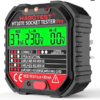
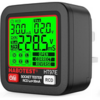
This one 1745718935621.pngis £14, as is this one 1745719077953.pngand one has to ask why are the others so expensive? Could not find instructions but this
1745719265923.png
seems to show what it does, and one wonders what is the catch?
 
I don't really know why we suddenly added 5%, the voltage was 230 plus 10% minus 5% well before the 5% added for safety, it was 1.44Ω for years.
... and "for years" I had been pointing out that BS7671 (and the Wiring Regs before it), and everyone following it, had 'got it wrong' :-) ...

.... calculating "maximum Zs" on the basis the nominal voltage (which is what 'we' did until quite recently) could leave those households with supply voltage less than nominal in the potentially dangerous situation of have seemingly 'compliant' circuits that would not provide the required disconnection times for ADS.

To be sure that things were 'safe' (achieving required disconnection times), the "maximum Zs" should obviously be determined on the basis of the 'minimum possible supply voltage' (currently 230 V - 6% = 216.2 V in UK). However, when, after many decades of 'getting it wrong', BS7671 corrected this by introducing the concept of "Cmin" they used 230V-5%, rather than 230V-6% (apparently for some European or other 'International' reason) - so that any households with supply voltages between 216.2 and 218.5 V may still today be 'theoretically under-protected", even though 'compliant with BS7671'.
 
The ELI is really today not so important, ...
I presume you're saying that because of RCDs/RCBOs? However, as you know, other than in TT installations (where one has no choice) one is not meant to rely on residual current devices to provide fault protection by ADS, RCDs being only regarded as 'additional protection'. In that sense, at least as far as regs are concerned, EFLI is as important (in TN installations) as it has always been.
it is the PSCC (line - neutral) which is more important, but the plug in testers don't test that.
I wonder why you think this is 'more important' - is that merely a reflection of the fact that you think EFLI is 'less important' (because of RCDs), or what?

Of course, in a TN-C-S installation (increasingly common), L-N loop impedance will be the same as L-E loop impedance (EFLI) for circuits with 1mm² T+E cable and lower than EFLI for all other circuits - so the EFLI will always give you an 'upper bound' for L-N impedance (hence lower bound for PSCC).
 
Of course, in a TN-C-S installation (increasingly common), L-N loop impedance will be the same as L-E loop impedance (EFLI) for circuits with 1mm² T+E cable and lower than EFLI for all other circuits - so the EFLI will always give you an 'upper bound' for L-N impedance
That assumes no paralell paths.

Though I question whether there is any need to care about L-N disconnection times, L-N faults are not a shock risk (at least not directly), so as long as the fuse blows/breaker trips before the cable melts we should be ok right? even if it takes some time for that to happen.
 

If you need to find a tradesperson to get your job done, please try our local search below, or if you are doing it yourself you can find suppliers local to you.

Select the supplier or trade you require, enter your location to begin your search.


Are you a trade or supplier? You can create your listing free at DIYnot Local

 
Back
Top