• Looking for a smarter way to manage your heating this winter? We’ve been testing the new Aqara Radiator Thermostat W600 to see how quiet, accurate and easy it is to use around the home. Click here read our review.

Are splayed screw fixings a thing? And fixing grab bars

Joined
15 Jan 2025
Messages
135
Reaction score
4
Country
United Kingdom
Hi all, i'm planning on fitting some grab bars in my bathroom, around the shower and toilet. That is, fixed handles designed to be strong enough to bear the weight of a person, so they can pull themselves up.

This is a Safety thing, people could get hurt if they aren't properly fixed. I have a fair bit of experience with masonry drilling by now though, i'm not too worried about that, though I would appreciate advice for this particular application. I have screw and plug pairs in 6x60, 8x80, and 12x120mm sizes, i'm pondering which and how many to use to fix a bar that can support a human pulling on it

I know that screws fixed into masonry are at their strongest when dealing with shearing forces, that is, parallel to the angle of the wall they're fixed into. And consequently, they are at their weakest in a pull-out force scenario, with force being applied along the direction of the screw to pull it out of the wall. I've got quite a few shelves that could probably bear my weight if i stepped on them, but they might come out of the wall if i grab and pull

Knowing that, and given that grab bars are -designed- to be pulled on, another thought came to mind. Shouldn't it be possible to install multiple screws at an angle splaying out from each other, to fix one object? The thread of each screw tilted outwards from the object along angled drill shafts
So that there is no angle you can pull it at, which exerts force along every screw. Doing it to any one screw would have others be sheared and should anchor better

This would presumably require much longer screws than otherwise, and deeper drilling, and maybe be tricky to drill, but i can't see problems with it aside from that.
Is this a thing that is commonly done? Does it actually provide stronger fixings like I imagine? Are there problems i'm not forseeing?
 
Grab bars come with big screws. I don't recall the size. I think they are mostly supporting the weight of the person, rather than a pull-out force.

The only pull out I can think of would be if you had a rail in front of the toilet for people to pull themselves forward, but toilets usually have the rails at the side.

If you put multiple screws into the same brick you may cause it to crack.
 
Ours have 3 separete fixings at each end. They are fixed to the timbers in a hollow wall. They did not come with screws but the instructions, understanably, advised on using stainless steel screws. Due to the length of the bars and the width between the timbers I had to mount them on an angle which turned out to be a blessing in disguise as the load was spread in differnt directions and the rails could be grabed at different heights. Uless you are mounting them vertically I would suggest you do the same rather than horizontally. I am also pretty sure you could swing on them and they would not pull off the wall
 
I get the point that you are making, but I don't think that drilling screws at jaunty angles will make that much difference.

I would expect grab bars to have a downwards shear load rather than a pull away from the wall load. But I might be wrong...
 
Grab bars come with big screws. I don't recall the size. I think they are mostly supporting the weight of the person, rather than a pull-out force.

The only pull out I can think of would be if you had a rail in front of the toilet for people to pull themselves forward, but toilets usually have the rails at the side.

If you put multiple screws into the same brick you may cause it to crack.
It sounds like you're saying i should just hope they dont get pulled at the exact wrong angle, i guess it is relatively uncommon, but something being pulled on could go all kinds of ways

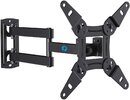
RE: Multiple screws in the same brick, that is a valid concern, which makes me wonder why commercial bars i'm seeing have the screws all close together. Wouldn't it be better, in that case, to have some kind of mounting plate, like is used for TVs, to spread the load over a larger area of wall?
 

Attachments

  • 61EBlj11AbL.jpg
    61EBlj11AbL.jpg
    92.1 KB · Views: 34
Grab handler work as they were designed, no other considerations are required .
 
Grab handler work as they were designed, no other considerations are required .
its all well and good saying that until it comes away in the hand, and someone slips and cracks their head open. People have died from this. Many, many people.

No, i'm not going to trust that this kind of thing will just work, without fully understanding it and knowing its capabilities.
That kind of attitude is fine with a bookcase or a shelf, not with things that could kill people if they go wrong
 
No grab handle is designed to bear the full weight of any person (especially heavier ones). They are an aid to assist the person to raise and lower or to steady themselves in a shower or into / out of a bath. In the same way a human assistant might do the same support function.

Those around toilets are often fixed to a wall but also have a swing down foot that sits on the floor (or is also fixed to the floor). Some aids are fixed between floor and ceiling.

The choice of fixing depends on the structure of the wall(s) being fixed to.
Some walls might need breaking open to insert suitable bracings - noggins and / or sheet materials - for screws to fix into and spread load on the surface material (plasterboard/tiles/backer).

It all depends and you'll need to seek advice from suppliers of the aids you are buying and/or someone on site to check the building materials you are fixing to. (Plus get advice from an Occupational Therapist for type and location of such grab/support rails if possible).

Rather than relying on advice from strangers off the internet. If you want that sort of advice, I suspect You Tube will have some suitable videos.

NB Do remember that the floor surfaces (and footwear) need consideration too... I suspect many falls are due to slips rather than failures of handrail fixings (whether disability grab or those on stairs).
 
No grab handle is designed to bear the full weight of any person (especially heavier ones).

A point to consider is that people using grab bars may not have enormous strength in their hands and arms allowing them to wrench large screws out of walls.

Perhaps we will hear from somebody who has encountered a grab that failed.
 
It sounds like you're saying i should just hope they dont get pulled at the exact wrong angle, i guess it is relatively uncommon, but something being pulled on could go all kinds of ways

RE: Multiple screws in the same brick, that is a valid concern, which makes me wonder why commercial bars i'm seeing have the screws all close together. Wouldn't it be better, in that case, to have some kind of mounting plate, like is used for TVs, to spread the load over a larger area of wall?

The wall bracket in your image probably only has two wall fixings.

The part that connects to the TV seems to be one of the VESA standards- of the 8 holes, it is expected that 4 will be the correct VESA standard.

Whilst I do not doubt that handrails have previously failed, do have anything to backup the suggestion that they result in many, many deaths?
 
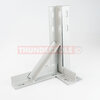
I think i'd ideally like to find, or make, a grab bar that connects to the wall like this, with arms that spread out from the contact point to put screws in that spread load over a wide area

i cant seem to find anything like this, they all concentrate them in little circles
 

Attachments

  • t-and-k.jpg
    t-and-k.jpg
    97.4 KB · Views: 36
I get your point about screws being concentrated in a small area.

Is this a commercial setting? If yes, ask the tradesman/company for a guarantee.

I note that you still haven't provided any evidence to back up your claim about multiple deaths. Perhaps you didn't see my earlier post.
 
It's usually people wanting to attach weight-training machines that have these concerns, usually when it's in a garage built of lightweight blocks.

What is your wall made of, and what's on the other side?
 
its all well and good saying that until it comes away in the hand, and someone slips and cracks their head open. People have died from this. Many, many people.

No, i'm not going to trust that this kind of thing will just work, without fully understanding it and knowing its capabilities.
That kind of attitude is fine with a bookcase or a shelf, not with things that could kill people if they go wrong
You assessment of failure risk is pitiful , most are rated at 200kg.Please provide details off any fatal accident as a result of failure of a correctly fitted grab handle.
 
Last edited:
I get your point about screws being concentrated in a small area.

Is this a commercial setting? If yes, ask the tradesman/company for a guarantee.

I note that you still haven't provided any evidence to back up your claim about multiple deaths. Perhaps you didn't see my earlier post.
i'm not worried about a guarantee, i'm worried about people getting hurt.
Its silly to chase a comment like that so doggedly, one death would be too much, one injury would be too much. I want to make my house safe, and i know screws can pull out of bricks at the right angle
 

If you need to find a tradesperson to get your job done, please try our local search below, or if you are doing it yourself you can find suppliers local to you.

Select the supplier or trade you require, enter your location to begin your search.


Are you a trade or supplier? You can create your listing free at DIYnot Local

 
Back
Top