• Looking for a smarter way to manage your heating this winter? We’ve been testing the new Aqara Radiator Thermostat W600 to see how quiet, accurate and easy it is to use around the home. Click here read our review.

Silly things

All in all considered, the skills used at the time of such conduit used they were often actually more intact for earthing than you might otherwise think, and they blew fuses successfully, lighting often not earthed as a requirement but metered tests showed them sometimes a near success,...... I have been amazed how such systems had some reasonable earthing, even using a 20A test current to confirm that you might have half a chance at least
... but were they not the days when TT installations were pretty common, in which case (pre-RCDs) no amount of earthing was likely to 'blow fuses' when one would have liked them to blow?

Kind Regards, John
 
I was told 1966 the rules changed on lighting and earths, but the 13th said when allowing no earth.
(ix) Lighting fittings using filament lamps installed in a room having a non-conducting floor, mounted at such a height that they cannot readily be touched and are out of reach of earthed metal.
So my parents house with wall lights, needed to have those wall lights earthed. And also fluorescent lights have always required an earth.

As to TT, it seems likely most homes with TT the water pipes although technically bonded to the earth rod, in real terms the water pipe was a rather good earth, good enough so a line - earth fault could rupture a 13 amp fuse.

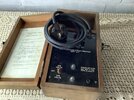
As to when the ELCB-v arrived on the seen, not sure, seems odd, but only found them after the rules had changed, and no longer fitted. But clearly as water pipes got changed to plastic, something needed to be done. I never saw one of these Clare ELCB tester3.jpg in use, in fact even when the RCD hit the scene, it was many years after before I saw my first RCD tester, only after they became a requirement for out door equipment did I see the test set. And I can see why we need the test set, as so many failed. It only needed a bit too much strain on the cables, and it would warp the plastic slightly and if they did work, they were well out of spec.
I would say 2004 and Part P was the game changer, electricians had to raise installation certificates, and wanted to actually test, not simply guess it will be near enough.

Still commercial lagged behind, even if an installation certificate was raised, minor works for alterations were rare, so was actually getting a copy of the regulations until it became BS7671, then it seemed to change, people were sitting exams to show they could read.

 
Forteen years ago I installed these three FCUs

The oven lamp holder short circuited on Friday and while dealing with the blown fuse I discovered something silly about these FCUs
The fuse carriers should have a slot on both sides?
 
but were they not the days when TT installations were pretty common, in which case (pre-RCDs) no amount of earthing was likely to 'blow fuses' when one would have liked them to blow?

There was so many lead pipes and perhaps some copper that we all lived on a giant earth rod back then, in the old towns anyway
 
"Back Then" it was very common to use the water or gas pipe as "The only earth" and chances are it may have just been one or two turns of wire round the pipe and a half hearted bit of twistage.

I came across one like it only couple of years back and the only reason I was looking was the regular blowing of a 30A fuse and that due to an intermittant E&L short in the ancient cooker.
 
Last edited:
ebee said:
There was so many lead pipes and perhaps some copper that we all lived on a giant earth rod back then, in the old towns anyway
I suppose so, but I think that, for an L-E fault to blow, say, a 30A fuse would probably have required an EFLI of something like 3 Ω - were the networks of underground pipes really that 'good'?
 
I suppose so, but I think that, for an L-E fault to blow, say, a 30A fuse would probably have required an EFLI of something like 3 Ω - were the networks of underground pipes really that 'good'?
don't forget there are miles of metal pipe in the ground and they are bonded to all sorts of things
 
I suppose so, but I think that, for an L-E fault to blow, say, a 30A fuse would probably have required an EFLI of something like 3 Ω - were the networks of underground pipes really that 'good'?
In the towns where I Live, then yes, that was conceivable, Old mill towns, terraced houses, plenty of them, metal gas and water pipes (the majority of both was big thick lead collectively buried in loads of miles of earth), `twas quite a collective earthing .
All TNS too.
 
In the towns where I Live, then yes, that was conceivable, Old mill towns, terraced houses, plenty of them, metal gas and water pipes (the majority of both was big thick lead collectively buried in loads of miles of earth), `twas quite a collective earthing .
All TNS too.
Interesting. It's perhaps a bit of a pity that they didn't leave it all there for contnued use as an earth!
 
13A fuse, looking at table 41.2 needs 2.42 ohms to rupture within the required time, and as a boy in my parents house, when I made an error connecting line to earth when trying to repair my spool to spool tape recorder, it ruptured the fuse rather quickly.

But around 2004, I came to fit a wet room, and the only earth I could find was the old GPO one for the party line. So it would seem, in around 1980 when the cast iron water main was replaced with plastic, my parents house lost its earth connection.

But it is a changing world, I was taught how to do an EICR, and one selected different items one hoped each time, and inspected around ¼ of the items, and assumed if no fault found, then likely the rest was OK, only when faults were found, would all be inspected and tested. And the report would state what was inspected, so next time again different items selected. Since no one who was not an electrician should be working on the electrics, we should one hopes never find any incorrect installation, we are looking for things which have degraded over time.

But domestic we have DIY, however should the EICR be done any differently? Specially in rented property where the tenants are told in their agreement they should not touch the electrics, so there should not be any DIY in a rented property. Well we all know from experience tenants do play, and my son at one point had the job of refurbishing the electrics in council houses. I did in some ways feel sorry for the tenants, each room had a ceiling rose, and a pendent lamp, the tenant was allowed to fit a lamp shade, but no more, so he was removing some beautiful chandeliers and placing them in the skip, carefully so the tenant could do a dumpster dunk and get them back. Although it was not always the tenant who had fitted them who salvaged them from the skip.

So we read the new English law on EICR on rented property, if electrical, fixed, that includes any item over 18 kg and not on wheels, it should be included in the inspection. Well sorry I do not feel qualified to work on gas or oil equipment, in fact even the tumble drier, freezer, fridge all with heat pumps, are not my cup of tea, I want to stop at the socket or FCU. We do really need a book to say exactly what the government want us to do, as it stands it is a free for all, and I have no intension of reading up on case law.
 
"The only earth" and chances are it may have just been one or two turns of wire round the pipe and a half hearted bit of twistage.

In the case of a gas pipe, the 'half hearted twistage', could mean a poor connection, and a small emf between them. The result was erosion of the gas pipe, a leak, and a tiny spark, enough to ignite the leaking gas, followed by a fire. Exactly that, happened at my parent's home - I let myself in from school, to the sight of smoke and some flame billowing up by the front door. A gas pipe, in the cellar below, had a bare copper wire just twisted around it. I isolated the gas, and managed to extinguish the flames with a hose. I just caught it in time.
 
13A fuse, looking at table 41.2 needs 2.42 ohms to rupture within the required time, and as a boy in my parents house, when I made an error connecting line to earth when trying to repair my spool to spool tape recorder, it ruptured the fuse rather quickly.
0.4 seconds is rather quickly.
 
13A fuse, looking at table 41.2 needs 2.42 ohms to rupture within the required time,
Indeed - and if the EFLI is greater than about 10 Ω, then it will never rupture - and I don't think that (m)any domestic TT electrodes have an impedance that low
 
Interesting. It's perhaps a bit of a pity that they didn't leave it all there for contnued use as an earth!
Yes indeed, miles of lead or copper, all connected and cross connected in every combination possible and circa 20,000 inhabitants so quite a few houses and all that soil surrounding a lot of the pipework and hopefully most premises connecting to an electrical earth terminal.
What better earthing system would you want?
Someone`s incoming earth connection was lost and it likely would not have made much difference in reality in many cases.
Then our services spent years being replaced with insulating plastic and gradually the situation started changing.
I`ve seen more than a few homes where you get a apparent good Ze until you disconnect that there "new fangled 6 or 10 mil bonding" and then the earth connection disappears/reduces.
supplier digs up front garden to find the old PILC rotted away and apparently no one knew for years - I`ve never seen them dig up for adjacent properties to see if that is a representative sample soI imagine that there could be a lot more. Relying on fortuitous connection until somebody bothers to do a Ze test correctly after disconnecting the incomer (and I know by experience that a lot do not - so any potential problem goes on unnoticed).

In fact I have met some gas workers who actually think that incoming gas supplies are bonded to provide a home with an electrical earth connection.
 

If you need to find a tradesperson to get your job done, please try our local search below, or if you are doing it yourself you can find suppliers local to you.

Select the supplier or trade you require, enter your location to begin your search.


Are you a trade or supplier? You can create your listing free at DIYnot Local

 
Back
Top