• Looking for a smarter way to manage your heating this winter? We’ve been testing the new Aqara Radiator Thermostat W600 to see how quiet, accurate and easy it is to use around the home. Click here read our review.

Replacing ceiling lights

Joined
16 Oct 2008
Messages
182
Reaction score
6
Location
Berkshire
Country
United Kingdom
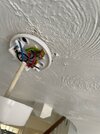
I am replacing 2 ceiling lights which are controlled by the same light switch. I had standard bulb holders but replacing them with a ceiling fitted lights. These lights are in the hallway and there are 2 switches, one on either side of the hallway. I've replaced first light as it was straight forward. However, the second one is a bit more complicated as it has 3 set of wires and I don't know what's the best way of arranging the cables.
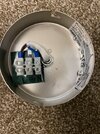
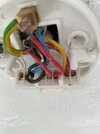
I have attached a picture of how they were fitted in the bulb holder and the connector that I've in the new ceiling light.
Should I get some sorts of other fitting to arrange wires and then connect them to the new ceiling light connector? Any guidance would be really appreciated.
 

Attachments
  • IMG_6954.jpeg
    IMG_6954.jpeg
    191.7 KB · Views: 53
  • IMG_6953.jpeg
    IMG_6953.jpeg
    281.9 KB · Views: 44
  • IMG_6955.jpeg
    IMG_6955.jpeg
    389.3 KB · Views: 49
Last edited:
I assume that you cannot simply fit the new fitting over the existing rose.

Yes, you need an additional connector of some kind. As in the existing rose, you need a total of 4 connectors:

- One for the earth wires, which you have in the new fitting, in the middle.

- One each for live and neutral going into the lamp. You have these in the new fitting.

- One additional connector, to replace the “loop” connector in the middle of the rose that didn’t connect to a wire to the pendant lamp. Use a screw terminal block, wago connector, or similar.
 
@blueagle78
Aah, it’s the weekend. We get exactly the same question every weekend.

important: you have a lot of wires there. They all do different things. If you mix them up you are in a World of pain.
It’s great you’ve taken a photo, but - before you disconnect anything - indelibly mark the red wire that is connected to the yellow on the right hand side. That is the “switched live”.. if you lose sight of that wire you will need a test meter, or an electrician, and other lights in the house will not work!

Secondly - pedantic point on terminology.

These lights are in the hallway and there are 2 sockets
Sockets are things that you put a plug into. Eg on a kettle, vacuum cleaner, etc.
in some houses there are special light sockets. But I think that you mean light switches?
 
Thank you @endecotp and @Taylortwocities for your detailed replies.
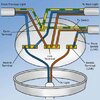
I've found a picture online and if I've understood it correctly, this is exactly what you've advised with the usage of 4 connectors?
I've already disconnected the wires and didn't mark them so I guess I'll have to get the test meter out and figure out the right wires. As of now I've got 2 reds in one connector, black/blue in one another connector and all the lights downstairs are working apart from the 2 in the hallway. I'm assuming out of those 2 red wires, 1 is live?
You're right, I meant light switches and not sockets. :oops:
 

Attachments

  • ceilingroseb2-4137432236.jpg
    ceilingroseb2-4137432236.jpg
    30.1 KB · Views: 18
Last edited:
If every other light on the circuit is working ( including any external light) with the wires connected as you outline above , you would be left with one red,one black and one yellow wire not currently connected to anything ( and of course all the earth wires), is that so ?
 
Looking at your original picture of the wiring as it was ,it would appear that the red and yellow wires connect together in the new light fittings live terminal and the black wire connects together with the other black and blue wires,and they connect to the neutral terminal of the new fitting.
All earth conductors go together in the earth terminal.
The two reds currently connected together in an insulated terminal block stay that way and do not connect to the light fitting in any way.
 

If you need to find a tradesperson to get your job done, please try our local search below, or if you are doing it yourself you can find suppliers local to you.

Select the supplier or trade you require, enter your location to begin your search.


Are you a trade or supplier? You can create your listing free at DIYnot Local

 
Back
Top