• Looking for a smarter way to manage your heating this winter? We’ve been testing the new Aqara Radiator Thermostat W600 to see how quiet, accurate and easy it is to use around the home. Click here read our review.

Reciprocating saws with dust extraction

Joined
16 Jun 2006
Messages
12,735
Reaction score
3,065
Location
London
Country
United Kingdom
At some point I "need" to buy a reciprocating saw.

The other day, whilst engaging in tool porn, I noticed that the new Festool reciprocating saw has a dust extraction attachment.


I like the idea of dust extraction but can't justify the cost of the Festool one given that I don't have any of their batteries and chargers. All of my Festool tools are corded.

I see that Hilti also sell one, presumably more expensive than the Festool.

Does anyone else sell dust extraction kits for their saws?

Personally, I would be happy with a corded unit given that it will be connected to a corded dust extractor.
 
Not aware of any other makes, but would the extraction be efficient enough to justify all the extra costs of elite tools like Festool and Hilti? Its an open blade with a significant stroke, so not convinced it would work that well in typical site conditions inside or out. Nothing than a separate vac couldnt achiev3. I imagin3 they hav3 been developed to meet exacting extraction and air quality standards in Germany. I can see that there will be dust sensitive environments where they will be necessary, but a P3 mask and a shop vac with appropriate filtering should be fine in the great majority of situations
 
Seems a pointless thing to have in a tool designed to rough cut timber , like trying to get a hedge trimmer with a vacuum .

I was thinking more about cutting through things like plasterboard.

I currently use my oscillating saw and try to hold a hose next to it, but the oscillating saw is quite slow.

That said, my jigsaw has dust extraction and whilst it is better than no dust extraction, given the a jigsaw blade cuts on the upstroke, it is not terribly effective.

Oh, and I often used to use a dust extractor to vacuum clean my fake grass...
 
I was thinking more about cutting through things like plasterboard.

I currently use my oscillating saw and try to hold a hose next to it, but the oscillating saw is quite slow.

That said, my jigsaw has dust extraction and whilst it is better than no dust extraction, given the a jigsaw blade cuts on the upstroke, it is not terribly effective.

Oh, and I often used to use a dust extractor to vacuum clean my fake grass...
Jigsaw has blades for both up and down stroke , but a handsaw is quicker thru plasterboard .
 
Jigsaw has blades for both up and down stroke , but a handsaw is quicker thru plasterboard .

Down stroke blades are not very common.

I don't understand the hacksaw comment.

If the plasterboard is in situ, how will you use a hacksaw?

Edit- sorry, you said handsaw, not hacksaw. My bad.
 
Last edited:
Use a padsaw for plasterboard. Go slow and the dust falls vertical, you can even hold a vac hose in the other hand.

Get better blades for your oscillating saw. That saw should have a dust extractor attachment if it's one of the big brands.

Likewise, a spiral saw for plasterboard.

A reciprocating saw is not designed nor intended to be used for jobs or situations where dust extraction is required.
 
I was thinking more about cutting through things like plasterboard.
There are better power tools, like the Makita DSD180 plasterboard cutter or their rotozip type tool (DCO180), or even a jigsaw, or for that matter a multitool. All of those will take dust extraction. But as woody says, a drywall jab saw is designed for the job a lot quieter and makes less dust - if you want something a bit more accurate have a look at the Z-Saw S-90 Japanese keyhole saw (specifically designed for plaster - very handy on some types of renovation). Jab/stab saws have a point, a bit like recip saw demo blades, to allow them to start a cut by plunging through the material

TBH of the above the DSD180 is specifically designed to cut square holes in modern PB (for drywall back boxes etc). The DCO180 is tool which I do use for doing PB cut outs - it is basically a Makita version of the Bosch Rotazip, and even uses the same collets and tooling. Damned noisy, and you really do need ear defenders and a good dust extractor with it (I have one it is brilliant for cut-outs in multi skin drywall, but little else).

Recip saws are really a heavy remodelling tool, which you use at the rough end of the job, when there tends to be dust and debris everywhere (so a vacuum is somewhat redundant). I've tried a few cordless recips and been singularly unimpressed by their speed and power (or rather lack of it, and I do have a 2 x 18 volt one - a Mak DJR360) - the best recip I've had to date is a Milwaukee corded model - 1300 watts, variable orbit (which speeds up cutting no end in timber) and a revolving handle which can be very handy on awkward ccuts. Getting it into some of the places I am cutting out can be a PIA - dragging a vacuum hose in there with me would be downright impossible. And I've found that cordless tools struggle when using big demolition blades (e.g. Milwaukee Ax TCT blades) in tough timbers with embedded bolts, etc. For many other lighter cuts, though, a decent jigsaw with the right blade often does the trick - and the blades are short enough that you are less likely to biff anything behind the PB (and if it's a problem the blades are cheap enough to warrant a bit of surgical shortening with an angle grinder). I am struggling to see where a vacuum connected recip would be of use (although no doubt some or other conservation officer will insist on it now that it exists)

Oh, and I often used to use a dust extractor to vacuum clean my fake grasgrass.
I'll bet you have some of those plastic doggy doo-doos to make it look more authentic, too
 
Last edited:
Use a padsaw for plasterboard. Go slow and the dust falls vertical, you can even hold a vac hose in the other hand.

Get better blades for your oscillating saw. That saw should have a dust extractor attachment if it's one of the big brands.

Likewise, a spiral saw for plasterboard.

A reciprocating saw is not designed nor intended to be used for jobs or situations where dust extraction is required.

Cheers mate.

In the past, when I have used my pad saws to cut holes in skimmed plasterboard, I found that it pulled off tiny chips of the skim coat.

I have two oscillating saws- a Fein FMM250 and a Festool Vecturo. I think the dust extraction for the former is only for the delta sanding pad. The latter is the first generation, but it looks like I might be able to retro fix the dust extraction to the additional collar that I have.

With regards to the blades, perhaps I am at fault. Previously, I have used the "general" Saxton ones. I find that, they, become blunt pretty quickly.

Spiral saws- I did purchase one many years ago- It was the RotoZip branded one- I only used it once and the spiral blade snapped. I can't even remember if I tried in on plasterboard. I think I may have incorrectly assumed that it would create a cloud of dust.
 
There are better power tools, like the Makita DSD180 plasterboard cutter or their rotozip type tool (DCO180), or even a jigsaw, or for that matter a multitool. All of those will take dust extraction. But as woody says, a drywall jab saw is designed for the job a lot quieter and makes less dust - if you want something a bit more accurate have a look at the Z-Saw S-90 Japanese keyhole saw (specifically designed for plaster - very handy on some types of renovation). Jab/stab saws have a point, a bit like recip saw demo blades, to allow them to start a cut by plunging through the material

TBH of the above the DSD180 is specifically designed to cut square holes in modern PB (for drywall back boxes etc). The DCO180 is tool which I do use for doing PB cut outs - it is basically a Makita version of the Bosch Rotazip, and even uses the same collets and tooling. Damned noisy, and you really do need ear defenders and a good dust extractor with it (I have one it is brilliant for cut-outs in multi skin drywall, but little else).

Recip saws are really a heavy remodelling tool, which you use at the rough end of the job, when there tends to be dust and debris everywhere (so a vacuum is somewhat redundant). I've tried a few cordless recips and been singularly unimpressed by their speed and power (or rather lack of it, and I do have a 2 x 18 volt one - a Mak DJR360) - the best recip I've had to date is a Milwaukee corded model - 1300 watts, variable orbit (which speeds up cutting no end in timber) and a revolving handle which can be very handy on awkward ccuts. Getting it into some of the places I am cutting out can be a PIA - dragging a vacuum hose in there with me would be downright impossible. And I've found that cordless tools struggle when using big demolition blades (e.g. Milwaukee Ax TCT blades) in tough timbers with embedded bolts, etc. For many other lighter cuts, though, a decent jigsaw with the right blade often does the trick - and the blades are short enough that you are less likely to biff anything behind the PB (and if it's a problem the blades are cheap enough to warrant a bit of surgical shortening with an angle grinder). I am struggling to see where a vacuum connected recip would be of use (although no doubt some or other conservation officer will insist on it now that it exists)


I'll bet you have some of those plastic doggy doo-doos to make it look more authentic, too

The DSD180 looks impressive. Not sure that I can justify the cost as a stand alone tool. Impressive nevertheless.

Rotozip, as per my previous post, I have the original and am glad to see that I can purchase bits to fit the collet.

I had never thought of using a jigsaw with a short blade for plasterboard. I still have some carbide (tile) blades. I guess they will be fine for plasterboard.

Which corded Milwaukee do you have? Or are you simply suggesting that, in general, a corded on will be better?

The angle grinder to shorten the length of the blade- genius. Hence I am glad that people like you are to help us.

Based on the answers here, I am happy to accept that I, personally, do not need to pay a premium for a reciprocating saw with dust extraction. I do like tools with dust extraction though- in part, because I do domestic work.

Thanks to @blup , @foxhole , @^woody^ and @GhostIntMachine
 
Cheers mate.

In the past, when I have used my pad saws to cut holes in skimmed plasterboard, I found that it pulled off tiny chips of the skim coat.
Will your pad saw take hacksaw blades, if it does fit them so it cuts on the forward stroke not the return. You should get a cleaner cut that way.
 
With regards to the blades, perhaps I am at fault. Previously, I have used the "general" Saxton ones. I find that, they, become blunt pretty quickly.
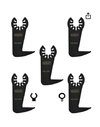
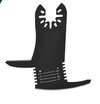
Are you also aware that there are blades specifically designed for cutting PB with a multitool? Here are two types you can find on Amazon and else where:
Multitool PB blade 001.jpgMultitool PB blade 002.jpg

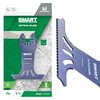
Smart does this type (also from Toolstation?):
Multitool Smart PB blade.jpg

I've tried some of the top ones, but not (yet) the Smart blades - great until you hit anything hard, like a stud...

Spiral saws- I did purchase one many years ago- It was the RotoZip branded one- I only used it once and the spiral blade snapped. I can't even remember if I tried in on plasterboard. I think I may have incorrectly assumed that it would create a cloud of dust.
Rotozips can be pretty dusty to use, but you should be able to get an extractor for one (my Mak came with a clear DX base). I've been told that most people snap their first blade or two, after all the standard blade is 1/8in diameter (3.2mm), but you get better with practice. There are also thicker and special purpose blades available, e.g. 3/16in and 1/4in spiral cutters (guided) which are better for double skin cuts and the diamond-pattern carbide type which can be used on aggressive materials like fibre glass, cement fibre board, Tufnol/Resopal (HPL), etc. Take a look on Amazon for Rotozip and DW tooling

I had never thought of using a jigsaw with a short blade for plasterboard. I still have some carbide (tile) blades. I guess they will be fine for plasterboard.
TCT blades can clog up on PB, and you can't cut them down in length because of the teeth. I sometimes use TCT jigsaw blades on cement fibre board, For cut downs just use bimetallic jigger blades

Which corded Milwaukee do you have? Or are you simply suggesting that, in general, a corded on will be better?
SSPE-1300SX. It's a big, heavy lump - but it has bags of power, blades can be inserted upside down for upwards cutting and the revolving handle can be very handy in tight spaces. Corded tools have a LOT more power than any cordless (and for comparison I have a Mak DJR360 2 x 18volt cordless recip). The SSPE also has variable orbital action, like a jigsaw, which speeds up cutting considerably. Had mine 5 or 6 years. Chalk and cheeese IMHO

Will your pad saw take hacksaw blades, if it does fit them so it cuts on the forward stroke not the return. You should get a cleaner cut that way.
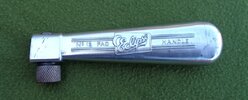
FYI Eclipse used to make a "pad handle" to hold broken hacksaw blades. Holds blades in either direction. They look like a big Stanley utility knife handle, the old #99 model, and are cast metal - called a no.12 pad saw handle and there are several on eBay right now for under a tenner (no longer made AFAIK)

Eclipse pad saw handle.jpg
 
Last edited:
Are you also aware that there are blades specifically designed for cutting PB with a multitool? Here are two types you can find on Amazon and else where:
View attachment 382550View attachment 382551

Smart does this type (also from Toolstation?):
View attachment 382549

I've tried some of the top ones, but not (yet) the Smart blades - great until you hit anything hard, like a stud...


Rotozips can be pretty dusty to use, but you should be able to get an extractor for one (my Mak came with a clear DX base). I've been told that most people snap their first blade or two, after all the standard blade is 1/8in diameter (3.2mm), but you get better with practice. There are also thicker and special purpose blades available, e.g. 3/16in and 1/4in spiral cutters (guided) which are better for double skin cuts and the diamond-pattern carbide type which can be used on aggressive materials like fibre glass, cement fibre board, Tufnol/Resopal (HPL), etc. Take a look on Amazon for Rotozip and DW tooling


TCT blades can clog up on PB, and you can't cut them down in length because of the teeth. I sometimes use TCT jigsaw blades on cement fibre board, For cut downs just use bimetallic jigger blades


SSPE-1300SX. It's a big, heavy lump - but it has bags of power, blades can be inserted upside down for upwards cutting and the revolving handle can be very handy in tight spaces. Corded tools have a LOT more power than any cordless (and for comparison I have a Mak DJR360 2 x 18volt cordless recip). The SSPE also has variable orbital action, like a jigsaw, which speeds up cutting considerably. Had mine 5 or 6 years. Chalk and cheeese IMHO


FYI Eclipse used to make a "pad handle" to hold broken hacksaw blades. Holds blades in either direction. They look like a big Stanley utility knife handle, the old #99 model, and are cast metal - called a no.12 pad saw handle and there are several on eBay right now for under a tenner (no longer made AFAIK)

View attachment 382556

Every day is a school day.

I had no idea that there are specific blades for plasterboard. Thanks for the heads up.

My Rotozip is well old. It still sitting in my old garage. I very much doubt that there is a dust extraction option.

I too have used TCT blades for cutting cement boards. That was 20+ years ago. They were extremely rigid boards from Selco. Angle grinder aside, I couldn't think of anyway of cutting them. It was a very slow process. Unlike hardiebacker boards, you could not score and snap them. Oh, and I had to use masonry drill bits to drill through the stuff and a larger one to countersink the head. They were so hard that the head would not pull in without a counter sink.

I had not realised that variable orbital was not standard on recip saws. Again thanks. I guess I need to do more research.

Thanks to all whom have given me advice.
 
FYI Eclipse used to make a "pad handle" to hold broken hacksaw blades. Holds blades in either direction. They look like a big Stanley utility knife handle, the old #99 model, and are cast metal - called a no.12 pad saw handle and there are several on eBay right now for under a tenner (no longer made AFAIK)

View attachment 382556
They are the same as mine and the type I was refering to in my post
 

If you need to find a tradesperson to get your job done, please try our local search below, or if you are doing it yourself you can find suppliers local to you.

Select the supplier or trade you require, enter your location to begin your search.


Are you a trade or supplier? You can create your listing free at DIYnot Local

 
Back
Top