• Looking for a smarter way to manage your heating this winter? We’ve been testing the new Aqara Radiator Thermostat W600 to see how quiet, accurate and easy it is to use around the home. Click here read our review.

Underfloor Waste Pipe -Joists

Joined
30 Oct 2003
Messages
465
Reaction score
61
Location
Worcestershire
Country
United Kingdom
I am looking at getting the en-suite refitted and the main question relates to the waste from the shower and basin. The shower waste joins with the basin and connect to the soil stack with the piping boxed in above the floorboards. I would like to get the pipes out of sight under the floor if possible - one fitter says yes, another says maybe, I am concerned that cutting notches for 32 / 40mm waste would excessively weaken the joists.

The house is circa 2000 with the chipboard floor sheets so access is not quite so easy. I think that there may also be a lot of piping for the heating system under the boards as well with a manifold perhaps as the floor is always warm in the winter

What is the opinion on going under the floor? I would like to know what to plan for in buyng the suite
 
I too would be concerned where excessive joist notching was involved. What are your joist sizes? Also, I do not like the shower waste teeing into the basin waste pipe because that could cause the loss of a trap's water seal.
 
I too would be concerned where excessive joist notching was involved. What are your joist sizes? Also, I do not like the shower waste teeing into the basin waste pipe because that could cause the loss of a trap's water seal.
I would guess at 8" x 3" joist size

I think a swept tee to the basin and shower is probably the only solution as the soil stack is internal an possibly not too easy to get a second pipe to
 
Unless its really old fat/thick 16" pitch pine joists then nope - do not notch for a 40mm pipe. Anything above a 200mm joist though can be drilled though and get the waste through the centre of the joist.

The joist needs to be at least 400mm to take a 50mm notch which would be the min to take a 40mm waste pipe. If you have a basin and a shower on the same run then the waste would ideally increase to 50mm at the tee or be on their own run depending on distance. Having anything else on a shower waste run only temps, when restricted, for the waste to end up in the shower tray so at least a 50mm pipe will help with that.
 
8x3 joist is massive, are we talking mid span or against the wall, are they underspanned, how many need notching? No-where near enough information.
 
8x3 joist is massive,
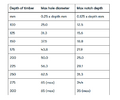
200mm is not massive enough to put a 50mm notch in it. Notch should only be 1/8th the depth of the joist.

1748642713052.png
 
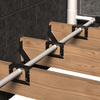
Just wondered if any of you plumbing types had seen these:

snrk-image-3.png
Simpson Strong Tie - solid notch reinforcement kit (SNRK). Can be used for up to 5 joists in a row according to the manufacturer. I came across these recently, but I don't know when they were introduced. Had we had these in the past it would probably have saved me from having to sister or replace joists in situ time and again (often a floor or ceiling out job) because some (hopefully) long dead numpty had overnotched the joists to run pipework and weakened them

Simpson Strongtie are a highly reputable firm whose joist hangers, wall ties, etc are used by a lot of joinery installers in the UK - one of the best. Looks to me those might solve the OP's issue
 
Certainly looks like a potential solution and I have seen joiners use Simpsons stuff and they rate it highly, I think I remember someone mention these before but can't say I've ever seen any documentation or sign off from BC that allows these to be used to avoid the notching standards though. Not sure how much support they would actually add @ 1.2mm mild steel plate?

Possible solution to help repair ones that have already been butchered but again I'd rather use thick steel pate with through and through bolts rather than a 1.2mm mild steel plate TBH. I've seen some real disasters where ceilings and the joist above have had to be jacked back up and reinforced properly, where cowboys have cut lumps out of joists and they have started to bow.

Even then though, given there is already a solution whereby a 200mm joist can be safely drilled up to 50mm then TBH the point is moot.
 
I think the significant point is that the manufacturer specifies a maximum of 5 no in a row - most rooms are much bigger than that. So just how much tension is the steel top strap ever going to be subjected to? On top of the joists there should be properly installed floor boards, or better yet sheet material, which will likely give the necessary "tension strength", especially if the sub floor is sheet material and has been glued and screwed onto the joists.
 
I think the significant point is that the manufacturer specifies a maximum of 5 no in a row - most rooms are much bigger than that. So just how much tension is the steel top strap ever going to be subjected to?

None - they are in compression, at the top of a joist. To be in tension, they would need to be used at the bottom of a joist.
 
Same applies, though, especially for sheet material floors - the sub-floor adds a lot of strength if properly installed.
 
He said house 2000 - no one has mentioned the possibility of the joists being engineered I joists - would be an even bigger problem
 
As I suggest though - the point is Moot. There is already an approved approach whereby a 40mm waste pipe can be routed through joists.

I cannot see where these plates have removed the requirement to follow Joist notching specs when it comes to placing waste runs under the floor. I suggested that for a 40mm waste (43mm OD), a notch of around 50mm would be needed but if that waste pipe was run over more than say one joist then the depth of the notch would need to increase as the run progressed to ensure at least a min 18mm/m fall. I wouldn't trust those plates In any situation to support weakened joists, that's not a criticism of the company its just a matter of fact. I can't see a 1.2 mild steel split plate offering much in the way of support to a floor joist.

I have also mentioned that I have come across clients houses where the ceiling has sagged due to butchered joists above in the bathroom to take waste pipes and they required jacking and metal plates/sisters to rectify and that was with a 22mm T&G floor with a 12mm ply top.
 

If you need to find a tradesperson to get your job done, please try our local search below, or if you are doing it yourself you can find suppliers local to you.

Select the supplier or trade you require, enter your location to begin your search.


Are you a trade or supplier? You can create your listing free at DIYnot Local

 
Back
Top