HW Cylinder - lose heat through convection

Joined
30 Dec 2018
Messages
27,634
Reaction score
5,861
Location
Up North
Country
United Kingdom
I've mentioned this curiosity before, but I have zero intention of bothering to resolve it....

We an open vented system, gas boiler, cylinder, and a MOMO type 3-port valve. Attached to the flow and return of the boiler, I have some very accurate temperature displays, indicating the temperature to 0.1C.

A peculiarity, or feature of the MOMO type valve, is that it only changes its position, when a different demand is placed on it, HW, CH, or both - so at rest, it is left in it's last mode of operation. In summer, with no use being made of the CH, that will always be with the 3-port set for HW. Our HW is set to come on, at 3pm, through to 8pm, so at 3pm the boiler always fires up, to bring the cylinder back up to 60C.

Checking the flow and return temperatures in the summer, at any time after that 8pm HW switch off, I notice the return temperature, is higher than the flow, at the boiler, and between 1 and 2C higher. Yesterday morning, for instance, return was showing 33.6C, and the flow 32.4C. That suggests, with the MOMO set in the last used HW mode, there was a reverse convection flow, conducting heat from the cylinder, through the pipework, to the boiler, where the boiler's heat exchanger is loosing that 1 to 3C, to the atmosphere.

Last thing, last night, by way of experiment, I turned the CH stat briefly up to 30C, to trigger the heating to come on, the MOMO to move to CH, and remain parked overnight, in CH mode - thus, preventing any reverse convection flow of warmth, from the cylinder. This morning, I checked the flow and return temperature displays, and both showed precisely 23.3C. 23.3C is just 1.3C higher, than our present indoor temperature.

In winter, most likely, the CH will be the last thing used that day, so the MOMO will be parked overnight and until 3pm, in the CH mode. So the solution would seem to be, if you have a MOMO, to briefly fire the CH system, last thing at night, but it's only effective, with a MOMO type valve.
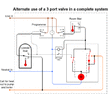
 
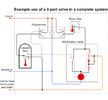
The addition of a simple relay will automatically cure this "last port of call" problem with a mid position valve.
 

Attachments

  • Modified Y plan Schematic.gif
    Modified Y plan Schematic.gif
    38.9 KB · Views: 33
  • Unmodified Y Plan Schematic.gif
    Unmodified Y Plan Schematic.gif
    38.4 KB · Views: 33
@Johntheo5 seems to show the standard three port valve, where you are using the Sunvic MoMo valve which I did not even realise existed.

I have realised it does not save me money using the oil boiler in the summer for DHW only, in the winter can't stop it heating DHW with the C Plan, but we don't set any time to run for DHW only, it just heats it while doing the central heating.

I have no tank thermostat, so to use the oil boiler, I had to guess how long it would need to run for, by experiment I found 4 times a week was not really enough, really needed 5 days being heated for the minium time the Nest Gen 3 thermostat/programmer would run for, which was ½ hour, but the boiler would only run for about 20 minutes, the return water would be too hot, and turn boiler off. The boiler does not modulate, and is 20 kW, so around the 30 to 35 kWh per week.

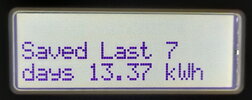
On fitting solar panels, I got an iboost+ in hindsight a mistake, however it does show how much used per 7 days, and that is around the 10 to 12 kWh mark, so use over double the energy to heat DHW with oil to heating it with electric, and with oil not sure if it has got hot enough to stop legionnaires, but I am sure using the immersion heater. Costs between 8.5 and 15p/kWh for the electric, either off-peak or lost revenue as not exporting it. Sunday last 7 days-1.jpg

Without the iboost+ telling me my use, I had just belived what I had read about it costing more to use an immersion heater, which is likely correct in winter, but in summer, the cost to heat the boiler and pipework, means cheaper to use electric.

I had never really considered my mothers house, with a combi-boiler, the built in reservoir would run out when using the shower, but if we turned Eco on, so reservoir not used, we got a significant delay to getting hot water at the taps. Not that we had much option, as DHW tanks had been removed, but when I consider the extra burn time with Eco switched on, the losses at the boiler were clearly quite high.
 
@Johntheo5 seems to show the standard three port valve, where you are using the Sunvic MoMo valve which I did not even realise existed.

I have realised it does not save me money using the oil boiler in the summer for DHW only, in the winter can't stop it heating DHW with the C Plan, but we don't set any time to run for DHW only, it just heats it while doing the central heating.

I have no tank thermostat, so to use the oil boiler, I had to guess how long it would need to run for, by experiment I found 4 times a week was not really enough, really needed 5 days being heated for the minium time the Nest Gen 3 thermostat/programmer would run for, which was ½ hour, but the boiler would only run for about 20 minutes, the return water would be too hot, and turn boiler off. The boiler does not modulate, and is 20 kW, so around the 30 to 35 kWh per week.

On fitting solar panels, I got an iboost+ in hindsight a mistake, however it does show how much used per 7 days, and that is around the 10 to 12 kWh mark, so use over double the energy to heat DHW with oil to heating it with electric, and with oil not sure if it has got hot enough to stop legionnaires, but I am sure using the immersion heater. Costs between 8.5 and 15p/kWh for the electric, either off-peak or lost revenue as not exporting it. View attachment 390119

Without the iboost+ telling me my use, I had just belived what I had read about it costing more to use an immersion heater, which is likely correct in winter, but in summer, the cost to heat the boiler and pipework, means cheaper to use electric.

I had never really considered my mothers house, with a combi-boiler, the built in reservoir would run out when using the shower, but if we turned Eco on, so reservoir not used, we got a significant delay to getting hot water at the taps. Not that we had much option, as DHW tanks had been removed, but when I consider the extra burn time with Eco switched on, the losses at the boiler were clearly quite high.
Summer heating of HW, oil vs elec, cheapest??
It depends on the cost of oil (or nat gas) vs elec.
It would only take a HW demand of ~ 32L at 60C to break even at my energy costs of €0.10/kWh for kerosene & €0.2382/kWh elect.
Assuming a UK gas price cap of £0.065/kWh and because gas boilers only contain a few litres of water vs ~ 20L of a oil fired boiler then gas wins hands down except one is only using 5 or10 litres of HW/day.
 

Attachments

@Johntheo5 seems to show the standard three port valve, where you are using the Sunvic MoMo valve which I did not even realise existed.

John's idea, would work equally with either a normal, or MOMO actuator, electrically they perform identically - they are a straight swap. The difference is, the motor is only powered, when it needs to change position, no springs involved, and it only rotates in one direction. The result is that they are under much less stress, and so last significantly longer.

I could devise something, electronic, to get it to switch to CH mode, but like you, I'm wary of making this house any more complex, worrying about who would be able to make sense of it, when I'm gone.

It explains why generally, the HW stored in my cylinder, is much hotter on a winter morning, than on a summer morning - because the CH will have been used later in the evening, than there has been demand for HW, thus the MOMO parks, blocking the convection losses in reverse, through the boiler.
 
Summer heating of HW, oil vs elec, cheapest??
Yes, it does depend on the losses of the boiler and pipework. Not interested in pipework cylinder to taps, as same with both. So I actually set the boiler to run 4 times a week, and the water was not really hot, but neither was it cold, legionnaires was a worry, and I had considered setting the electric to come on after the oil, as the electric did have a thermostat.

This time of year, our oil tank was typically ½ full, this year ¾ full, which points to using more than I had thought for DHW. I was working on it being a 20 kW boiler, and it runs for around 20 minutes each time it fires up. The original set up, minium time was 1 hour, the Nest Gen 3 changed that to ½ hour, sometimes it would fire a second time in the ½ hour, but normally around 20 minutes run time.

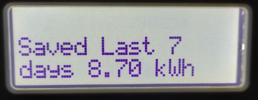
The short 9" immersion heater did use very little power, but it was too short, and we did run out of DHW, the new 27" when first fitted seems to use far more, so added a jacket on the cylinder, so not quite the same conditions, on first fitting the jacket, there was very little change, but now we seem to be using a lot less 1755519297166.png as to why, not sure, maybe warmer water from mains? However, at the highest rate of 30.17p/kWh that's £2.63 per week, at 15p/kWh that's £1.30½ per week, and at off-peak £0.74 (8.5p/kWh) so doing anything to reduce the bill will likely cost more than it saves.

And the bill for oil is annual so we tend to worry more about oil cost to electric cost, where the figure seems to get larger and larger, as to how much we are in credit standing at the moment just under £500, this will clearly drop in the winter, so waiting to see what winter costs before changing the standing order.

Since this time of the year, one of the high electric using items is the heat pump, the idea of heat from the boiler heating the living room needs to be avoided, as it costs to get rid of that heat, and the hot coil pipes go through the living room. Panelled in but heat must enter the living room.

We all look to save energy, be it a lighter foot on the accelerator or less use of the AC, and we read things like the increased air resistance opening a car window costs more in fuel to running the car AC. I know we were taught to look after the pennies and the pounds will look after themselves, but so often energy saving is taken in isolation, the tumble drier used x kWh, but it also either dragged heated air outside, or it heats the room it is in, and cost of using washing line does not include re-washing due to bird lime, and the list goes on.

So I load up the garden waste bin with hedge cuttings, and pay for its removal. And it could fuel an open fire. And I run an AC rather than open a window, as there is a Tom cat in the garden who seems to like our Queen, why? Simple wife tells me, and she must be obeyed.
 
We an open vented system, gas boiler, cylinder, and a MOMO type 3-port valve. Attached to the flow and return of the boiler, I have some very accurate temperature displays, indicating the temperature to 0.1C
Is your boiler at a higher level than the HW cylinder? That would be fairly unusual, but I can't see how your symptoms would occur otherwise.
 
Last edited:
Fixitflav beat me to it. I don't see how convection as described would occur in the usual layout.
 
Is your boiler at a higher level than the HW cylinder? That would be fairly unusual, but I can't how your symptoms would occur otherwise.

No. The boiler is high on the kitchen wall, the cylinder is floor mounted, in the airing cupboard, on the floor above. Base of cylinder is around 24" higher, than the top of the boiler, separated by around 2.5m of horizontal 22mm pipe.
 
Does the flow pipe from the boiler enter the top or the bottom of the heat-exchanger coil in the tank?
 
Is your boiler at a higher level than the HW cylinder? That would be fairly unusual, but I can't see how your symptoms would occur otherwise.
Curiouser and curiouser. There was a discussion on here about something similar a while back, maybe a couple of years. It might even have been yours. I'll see if I can find it, it might throw some light.
 
Curiouser and curiouser. There was a discussion on here about something similar a while back, maybe a couple of years. It might even have been yours. I'll see if I can find it, it might throw some light.

It was most likely my thread!..

It just seems a bit daft, assuming this is/was a common thing, to blame cylinder heat loss on losses through the cylinder insulation.
 
Does the flow pipe from the boiler enter the top or the bottom of the heat-exchanger coil in the tank?

I've just double-checked this....

Before I started, I checked the temperatures of the pipework, pump and 3-port in the airing cupboard, it was all quite warm.

Flow exits boiler, 22mm up to airing cupboard, into bottom of pump, 3-port MOMO directly above it, then into upper connection of cylinder coil. I confirmed all this, by feeling the pipework, after setting the control for 'CYLINDER BOOST', triggering the boiler to fire up.

With the above layout, I just cannot fathom how reverse convection can work, though my temperature measurements, seem to confirm that it is happening. What mechanism of convection, causes the water to fall through the coil, in through the flow, heated up, then out via the return?
 
Last edited:

If you need to find a tradesperson to get your job done, please try our local search below, or if you are doing it yourself you can find suppliers local to you.

Select the supplier or trade you require, enter your location to begin your search.


Are you a trade or supplier? You can create your listing free at DIYnot Local

 
Back
Top