I've mentioned this curiosity before, but I have zero intention of bothering to resolve it....
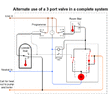
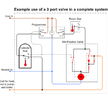
We an open vented system, gas boiler, cylinder, and a MOMO type 3-port valve. Attached to the flow and return of the boiler, I have some very accurate temperature displays, indicating the temperature to 0.1C.
A peculiarity, or feature of the MOMO type valve, is that it only changes its position, when a different demand is placed on it, HW, CH, or both - so at rest, it is left in it's last mode of operation. In summer, with no use being made of the CH, that will always be with the 3-port set for HW. Our HW is set to come on, at 3pm, through to 8pm, so at 3pm the boiler always fires up, to bring the cylinder back up to 60C.
Checking the flow and return temperatures in the summer, at any time after that 8pm HW switch off, I notice the return temperature, is higher than the flow, at the boiler, and between 1 and 2C higher. Yesterday morning, for instance, return was showing 33.6C, and the flow 32.4C. That suggests, with the MOMO set in the last used HW mode, there was a reverse convection flow, conducting heat from the cylinder, through the pipework, to the boiler, where the boiler's heat exchanger is loosing that 1 to 3C, to the atmosphere.
Last thing, last night, by way of experiment, I turned the CH stat briefly up to 30C, to trigger the heating to come on, the MOMO to move to CH, and remain parked overnight, in CH mode - thus, preventing any reverse convection flow of warmth, from the cylinder. This morning, I checked the flow and return temperature displays, and both showed precisely 23.3C. 23.3C is just 1.3C higher, than our present indoor temperature.
In winter, most likely, the CH will be the last thing used that day, so the MOMO will be parked overnight and until 3pm, in the CH mode. So the solution would seem to be, if you have a MOMO, to briefly fire the CH system, last thing at night, but it's only effective, with a MOMO type valve.
We an open vented system, gas boiler, cylinder, and a MOMO type 3-port valve. Attached to the flow and return of the boiler, I have some very accurate temperature displays, indicating the temperature to 0.1C.
A peculiarity, or feature of the MOMO type valve, is that it only changes its position, when a different demand is placed on it, HW, CH, or both - so at rest, it is left in it's last mode of operation. In summer, with no use being made of the CH, that will always be with the 3-port set for HW. Our HW is set to come on, at 3pm, through to 8pm, so at 3pm the boiler always fires up, to bring the cylinder back up to 60C.
Checking the flow and return temperatures in the summer, at any time after that 8pm HW switch off, I notice the return temperature, is higher than the flow, at the boiler, and between 1 and 2C higher. Yesterday morning, for instance, return was showing 33.6C, and the flow 32.4C. That suggests, with the MOMO set in the last used HW mode, there was a reverse convection flow, conducting heat from the cylinder, through the pipework, to the boiler, where the boiler's heat exchanger is loosing that 1 to 3C, to the atmosphere.
Last thing, last night, by way of experiment, I turned the CH stat briefly up to 30C, to trigger the heating to come on, the MOMO to move to CH, and remain parked overnight, in CH mode - thus, preventing any reverse convection flow of warmth, from the cylinder. This morning, I checked the flow and return temperature displays, and both showed precisely 23.3C. 23.3C is just 1.3C higher, than our present indoor temperature.
In winter, most likely, the CH will be the last thing used that day, so the MOMO will be parked overnight and until 3pm, in the CH mode. So the solution would seem to be, if you have a MOMO, to briefly fire the CH system, last thing at night, but it's only effective, with a MOMO type valve.