
OMG never ever say that again OMGNoseall is that you?
Reported


OMG never ever say that again OMGNoseall is that you?
Reported
A lot less radioactive waste and Helium as the main byproduct


So, it seems that in both reactions, an alpha particle is produced. That is essentially a helium nucleus. And that alpha particle then reacts with electrons in the plasma to form a helium atom.
The main difference seems to be that the normal fusion reaction produces a neutron as a by-product. That is a neutral particle. But 3He fusion produces a proton which is a charged particle. A neutron is very difficult to stop and will damage the inside of the reactor. But because a proton has a charge, it can be easily contained by a magnetic field.
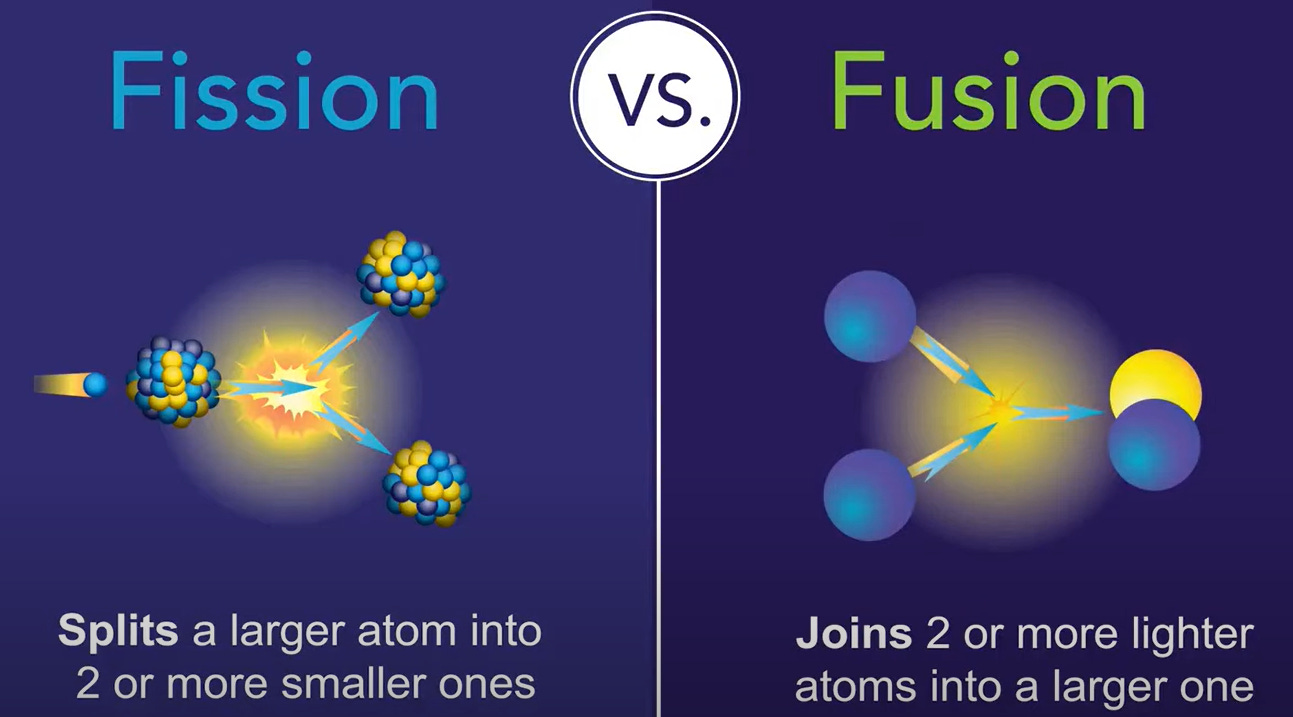
 ifp.org
I assumed it had something to do with squashing things together rather than blowing things apart.

?The classic example is HE3 for clean fusion reactions.
It matters not to MBK, only how he interprets it inside his own 'ed. Like when he makes things up or straight out lies......I knew that much! I was actually comparing two different types of fusion. "Normal" fusion and 3He fusion. I wasn't comparing fusion with fission.
Senile old duffer.it seems Nosenout wasn't aware that water exists on the moon and Mars.

Yes, there is water on Mars, primarily in the form of ice in the polar caps and beneath the surface, as well as some water vapor in the atmosphere. While liquid water is no longer stable on the surface due to Mars' thin atmosphere, a significant amount of liquid water is believed to exist in vast underground reservoirs deep within the planet's interiorIt matters not to MBK, only how he interprets it inside his own 'ed. Like when he makes things up or straight out lies......
Senile old duffer.
I'm not interested in the process, rather why Mars? Inhospitable lumps of rock are of no use to us humans, otherwise you'd see huge populations in deserts, polar ice regions, high mountain ranges etc. At least there is breathable air there.I have had to look into this a little bit as I haven't studied science in decades.
Apparently, there are different types of fusion.
But it looks like the aim with all types of fusion is to end up with normal helium, which has 2 protons and 2 neutrons. This is called Helium 4.
Normal fusion takes two different isotopes of hydrogen (called deuterium and tritium) and squashes them together to form Helium 4. But this way you end up with a spare neutron left over, which is very hard to contain and damages the inside of the reactor.
If you start instead with a rare type of helium, called Helium 3, and fuse that with deuterium, you end up with a spare proton left over, rather than a neutron. A proton is much easier to contain, so it doesn't damage the reactor.
Women with three boobs aswell...OMGYes, there is water on Mars, primarily in the form of ice in the polar caps and beneath the surface, as well as some water vapor in the atmosphere. While liquid water is no longer stable on the surface due to Mars' thin atmosphere, a significant amount of liquid water is believed to exist in vast underground reservoirs deep within the planet's interior
I'm not interested in the process, rather why Mars? Inhospitable lumps of rock are of no use to us humans, otherwise you'd see huge populations in deserts, polar ice regions, high mountain ranges etc. At least there is breathable air there.
That'd be your wife, HWM's wife andWomen with three boobs aswell

Ad hom noted......denso get the bookThat'd be your wife, HWM's wife andMBK'sfillyboy's wife. Three tits together.

Go to Mars to bring back helium?I think he was saying that it has lots of Helium 3 which we could bring back to earth to power the cleanest type of fusion.
Go to Mars to bring back helium?

