• Looking for a smarter way to manage your heating this winter? We’ve been testing the new Aqara Radiator Thermostat W600 to see how quiet, accurate and easy it is to use around the home. Click here read our review.

Pen non contact tester V multimeter

Joined
28 Jun 2021
Messages
519
Reaction score
15
Country
United Kingdom
Hi
I am not electrician, I am electrical engineer used to voltmeters, multimeters and oscilloscopes. I do DIY work in my home only, have always used multimeter. I have seen pen testers; much easier to use and planning to purchase the Lap from SF. I have hired electricians to do work in my rented properties but never present when they are doing the works so don't know what tester they use. Do domestic electricians use multimeters? Or just rely on non contact pen testers?
I understand it's best to check the operation of any tester on a known source first but are pen testers reliable? Do they replace multimeters?
When not to use pen testers
Thanks
 
"Pen" magic wand testers are a vague indication of a line voltage being present. They will light up with quite a low voltage that isn't enough to operate a device. Rub one on your jumper and it will light up.
If not used properly they often don't light up when voltage is present. The only time I use one is when there's a bunch of conductors and i want to know which one is energised. Or to basically show me if a switch is on or off. Once that is done then it is time to use a proper two-probe voltage test device.

In m opinion theior use is therefore limited, and they can lie to you. Yes they have their uses but, first of all, for something to work it needs a live, and your wand might show that is there, but that is only half of the circuit. the something will also need a NEUTRAL and (being zero volts) your wand will not indicate the presence (or lack of ) half of the circuit!.
You need a way to confirm that the neutral is there. Now your wand isn't at all magic, in fact you'll be wondering why you bothered buying one.

So that means you have to turn to a confirmed working two probe test device. A multimeter can do basic testing, but those too can lie to you. Today's multimeters are very high impedance. this means that it can provide voltages on conductors that are not terminated because cables run together will pick up voltages from adjacent circuits through mutual inductance.

For this reason, serious electricians use voltage, and other test devices that have a reasonable low impedance (=ac resistance) so they don't get confused by spurious induced voltages.

Hope this helps.
 
"Pen" magic wand testers are a vague indication of a line voltage being present. They will light up with quite a low voltage that isn't enough to operate a device. Rub one on your jumper and it will light up.
If not used properly they often don't light up when voltage is present. The only time I use one is when there's a bunch of conductors and i want to know which one is energised. Or to basically show me if a switch is on or off. Once that is done then it is time to use a proper two-probe voltage test device.

In m opinion theior use is therefore limited, and they can lie to you. Yes they have their uses but, first of all, for something to work it needs a live, and your wand might show that is there, but that is only half of the circuit. the something will also need a NEUTRAL and (being zero volts) your wand will not indicate the presence (or lack of ) half of the circuit!.
You need a way to confirm that the neutral is there. Now your wand isn't at all magic, in fact you'll be wondering why you bothered buying one.

So that means you have to turn to a confirmed working two probe test device. A multimeter can do basic testing, but those too can lie to you. Today's multimeters are very high impedance. this means that it can provide voltages on conductors that are not terminated because cables run together will pick up voltages from adjacent circuits through mutual inductance.

For this reason, serious electricians use voltage, and other test devices that have a reasonable low impedance (=ac resistance) so they don't get confused by spurious induced voltages.

Hope this helps.
That's very helpful thanks, so really need a voltage tester, saw few online, much less functions than a multimeter but designed for electricians to test voltage and continuity.
 
Are Martindale and Di-Log good brands for voltage testers?
 
In m opinion theior use is therefore limited, and they can lie to you. Yes they have their uses but, first of all, for something to work it needs a live, and your wand might show that is there, but that is only half of the circuit. the something will also need a NEUTRAL and (being zero volts) your wand will not indicate the presence (or lack of ) half of the circuit!.

My opinion is at odds with yours - As a quick, none invasive means of testing, they are an absolutely great time saver, always assuming you are well practiced in its response, and it's limitations, plus when backed up by actual contact tests.

I also disagree with your suggesting the cannot be used to confirm a neutral is available. If the volt-stick is placed near what should be a neutral, and the neutral is absent, then the volt-stick with indicate the item is live. The live indication, confirms the neutral is absent.
 
Ive got a Di-log tester, bit cheapo but it does the job, I use it for dirty jobs...

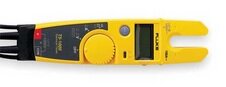
I have a fluke for best.
 
I thought they were the same thing. My multi-meter Diffrence line neutral 8 Feb 24 reduced.jpg has a non-contact voltage tester, as well as contact volts and ohms, and non-contact current both AC and DC, I do find the DC current in the mA range is a bit hit-and-miss due to having to zero the meter, and any small movement it needs to be zeroed again. So to detect 6 mA DC current it not really good enough. But the 9 mA AC the limit for background leakage with a 30 mA RCD no problem.

The non-contact voltage is in 4 stages, so reasonably good at working out which wire is live. But need to confirm it with the leads, as I know it will show my laptop as being live. One can get a range of functions with any multi-meter, my old one will measure frequency, some with read capacitance. Non-contact volts is one of the functions not all multimeters have.

As to the units which only measure non-contact volts, can't see the point, as often no stages it is either on or off, no indication of how strong the signal is, and why carry both?

In theory to prove dead, the tester needs to be two prong type, not require batteries, and be accompanied by a proving unit able to test 50–400 volts. I know the proving unit I had would only produce 400 volts, so like a chocolate fireguard, as it did not show if the 50 volt indicator would actually work at 50 volts. It is a sacking offence on one job, not to have one at one's side, but in most jobs I would just test on another outlet. And testing for dead done not stop it becoming live again while you are working on it.

I look at the pen tester as a toy. Having said that, the neon screwdriver has saved me when there were borrowed neutrals. This is before I had a clamp-on multi-meter.
 
Ive got a Di-log tester, bit cheapo but it does the job, I use it for dirty jobs...

I have a fluke for best.
I am of the opinion in the main fluke is a badge of office, rather than a good tester, I look at these Badge of office.jpgand see they can't measure 9 mA AC or 6 mA DC and wonder why anyone buys them? The only thing they have which cheaper ones don't is a calibration certificate, for earth loop, and RCD testing etc. Yes, needs to be in calibration, but for the multimeter, not really required.

People just like wearing them around their neck to say hey, I'm an electrician.
 
I am of the opinion in the main fluke is a badge of office, rather than a good tester, I look at these View attachment 393549and see they can't measure 9 mA AC or 6 mA DC and wonder why anyone buys them? The only thing they have which cheaper ones don't is a calibration certificate, for earth loop, and RCD testing etc. Yes, needs to be in calibration, but for the multimeter, not really required.

People just like wearing them around their neck to say hey, I'm an electrician.
Ive got that one I've had it years, I wear mine to the pub when im not even working
 
I am of the opinion in the main fluke is a badge of office, rather than a good tester, I look at these View attachment 393549and see they can't measure 9 mA AC or 6 mA DC and wonder why anyone buys them? The only thing they have which cheaper ones don't is a calibration certificate, for earth loop, and RCD testing etc. Yes, needs to be in calibration, but for the multimeter, not really required.

People just like wearing them around their neck to say hey, I'm an electrician.
That red tester you link is it any good? Expensive? Got a link to it? Wouldn't mind one of those...
 

I have one.

I bought it mainly for working on the car with its DC 1mA feature.

It works fine is all I can say.
 
Ive got that one I've had it years, I wear mine to the pub when im not even working
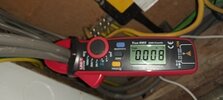
I also used to wear one, like the doctors' stethoscope, but the UT210 series has brought down the price of clamp-on meters, I have the UT210E the UT210D also does DC current, plus frequency and temperature. It says mine does capacitance, it is one of the options on the ohms range, but never tried it The range is here The UT210D does seem the best, but I already have frequency and temperature so went for the UT210E. As said the DC amps, one needs to zero it, so not really good enough to measure the 6 mA permitted with a type A RCD, but not sure if any can measure that low really?
 

If you need to find a tradesperson to get your job done, please try our local search below, or if you are doing it yourself you can find suppliers local to you.

Select the supplier or trade you require, enter your location to begin your search.


Are you a trade or supplier? You can create your listing free at DIYnot Local

 
Back
Top