
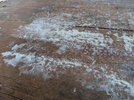
Mould on wooden floorboards under box

Joined
24 Jan 2009
Messages
10
Reaction score
0
Country
United Kingdom
The floor in my living room is currently plain wooden floorboards, sitting over a void, and painted on top with a wood-stain. I left a couple of plastic storage boxes in the corner of the room for a few months (the kind that sit a couple of millimetres off the ground due to stubs at the corners), and discovered last week that what looked like mould had grown under one of the boxes (picture). It was very specific - loads of mould under one box but absolutely nothing under the other box next to it. Not only that, but most of the floor outside that area has been covered with a rug for nearly a year without that causing any problem This seems isolated since it was only one box but I'm a bit concerned because I was planning to have a full fitted carpet laid on the floor in a couple of weeks.

How worried should I be about this mould. Is it a sign that I should avoid fitting a carpet until I've done something else?

Note that the house has had a rising damp problem elsewhere on the ground floor, but not in that area. I've fixed it with a damp course injection to the walls (above floor level).
 

Attachments

  • PXL_20251005_100611085 small.jpg
    PXL_20251005_100611085 small.jpg
    116.9 KB · Views: 172
Need insulation under the floorboards. I think skillbuilder on YouTube covered this subject.

I think that maybe one box was stopping the air so clear. The other let the moist warm air under and it was a cold spot. Condensation caused mould.
I wonder if you have a wall vent at that spot under floor as well?
 
Has the board that was under the box been taken up and refitted at some stage. Ii looks like there may be a gap at the joint. That would allow cold air from the void to rise up under the box. May just need sealiing once you have removed the mould
 
The floor in my living room is currently plain wooden floorboards, sitting over a void, and painted on top with a wood-stain. I left a couple of plastic storage boxes in the corner of the room for a few months (the kind that sit a couple of millimetres off the ground due to stubs at the corners), and discovered last week that what looked like mould had grown under one of the boxes (picture). It was very specific - loads of mould under one box but absolutely nothing under the other box next to it. Not only that, but most of the floor outside that area has been covered with a rug for nearly a year without that causing any problem This seems isolated since it was only one box but I'm a bit concerned because I was planning to have a full fitted carpet laid on the floor in a couple of weeks.

How worried should I be about this mould. Is it a sign that I should avoid fitting a carpet until I've done something else?

Note that the house has had a rising damp problem elsewhere on the ground floor, but not in that area. I've fixed it with a damp course injection to the walls (above floor level).
Was one of the boxes metal?
 
Thanks for the replies/suggestions. Good point about sealing the gaps in the floorboards. If that's a possible cause, and there are no possible bad consequences from sealing the gap, then I can easily get that done. Those particular floorboards have never been lifted as long as I've lived in the house (about 15 years) but I can't vouch for before that, and the house is ~90-100 years old. Having said that, there was a carpet (but no underlay) on the entire floor until about 2 years ago which didn't appear to cause any issues - the floor was fine when that carpet was lifted.

Good point @Wayners about the possibility that one box was letting a thin layer of warm air under it causing condensation. The boxes were both plastic but slightly different shapes. If that's the case, then I'm wondering if I can reason that a carpet + underlay won't allow any airflow under it, and therefore should be fine to put down? (With the proviso of, should seal the gaps first)

I'm not sure that fitting underfloor insulation is possible? Below the floor there's a void (I would guess 6-12 inches, not sure the precise depth, and then just soil. So I'd imagine putting any underfloor insulation in that would completely by=pass the damp course and so cause huge damp problems?
 
You have damp under the floor. This is very common. Bare, uncovered floorboards will lose a modest amount of moisture, evaporating off the top into the room, which then either gets damp, or ventilates away the water vapour.

When you cover the floor to prevent evaporation, the water cannot escape, so it accumulates.

Insulation does not cure damp.

Sealing the floor does not cure damp.

There are two things you can do:

1) look under the floor to find the source of damp. It might be a leaking pipe or drain, including one beside the house that is soaking into the ground and wall. It might be rainwater puddling against the wall due to incorrect levels or slope.

2) ventilate the subfloor void so the water vapour is carried away faster than it is delivered from the source. Start by clearing out the original airbricks.

Preferably do both.

While you are working under the floor, remove any rubble and rubbish, especially organic matter such as wood or dead rats, which will decay.
 
OP,
Lower left in your pic the wood grains are looking very open - what about the rest of the floorboards; are they rough looking open grained or planed smooth?
Why not pierce the floor boards with, say, a compass point - look for softness?
Moisture is presumably coming up from the void below - why not lift a couple of boards & have a look at the conditions below? Examine all timber.
Air bricks vent best at 1500mm centres and 300mm from corners - venting should flow from say the front elevation to the rear elevation.

FWIW:
Mechanical or chemical DPC's go below joists not above FFL's.
 
OP,
Lower left in your pic the wood grains are looking very open - what about the rest of the floorboards; are they rough looking open grained or planed smooth?
Why not pierce the floor boards with, say, a compass point - look for softness?

Checked that thanks, and the wood is rock hard. So I would say, no damage from damp.

The more I think about it, the more I'm thinking, plastic box sitting on the floor with only a millimeter or so of air between the box and the floor in a corner of a room that isn't used that much is perhaps a recipe for mould even in a room that wouldn't normally have issues.

FWIW:
Mechanical or chemical DPC's go below joists not above FFL's.

I would agree. But at different times I've had 4 different damp specialists round to quote for rising damp in other parts of the house (not near where this problem is). And none wanted to treat below the floorboards, which is what I'd have been most comfortable with: All wanted to inject above the floorboards. Which I don't understand because if you do that, you then have to replaster it all, which seems a lot more work than just lifting the floorboards up so you can access the wall below them.
 
I would agree. But at different times I've had 4 different damp specialists round to quote for rising damp in other parts of the house (not near where this problem is). And none wanted to treat below the floorboards, which is what I'd have been most comfortable with: All wanted to inject above the floorboards. Which I don't understand because if you do that, you then have to replaster it all, which seems a lot more work than just lifting the floorboards up so you can access the wall below them.

Never allow anybody who sells silicone injections into your home.

Even if they pretend to be "damp specialists."
 
Never allow anybody who sells silicone injections into your home.

Hmm, isn't silicone injections the standard treatment for rising damp, particularly if a physical damp course had failed?

I am thinking about your suggestion of lifting the floorboards - as I guess it wouldn't be that much effort to get them up - enough of them to have a look round under the floor. But I'm not sure there's a high chance of finding anything in that spot: As far as I'm aware there are no pipes under the floor near where this mould happened, and both walls forming the corner are internal structural walls - so it's unlikely to be from anything specific outside the house.
 
rising damp


Hmm, isn't silicone injections the standard treatment
It is the standard method for extracting money from credulous homeowners and inserting it into the accounts of "damp proofing" companies.


if a physical damp course had failed

DPCs are usually made of slate, which lasts about 200 million years and does not wear out.

However it is often bridged by ignorant or careless building errors.

Errors should be corrected or repaired.
 
OP,
Given you have other damp issues in your house:
1. Why not post a sketched ground plan of the house showing damp spots and mould, & positions of air bricks?
2. Are the outer walls solid or cavity?
3. Pics of outside ground level at the base of the walls?
4. What was the outcome of the "four damp specialists" visits?

Historically, DPC's have variously been made from bitumen & hessian - pure bitumen - lead or copper & other materials including slate.
All you have to remove from below ground floors is cellulose debris - nothing else.

Stephen Boniface of the RICS later acknowledged he went too far to make his point about the corrupt damp industry - he later admitted rising damp did indeed exist. As of course it does.
 
OK sure. Here's a plan of the ground floor living rooms. Both rooms are about 4m x 3m

Living-room damp-plan.jpg


Quick background:
Historical rising damp (yellow in diagram) - I (hopefully) dealt with that by fitting additional airbricks and lowering the ground outside the house (previous owner had actually paved it up to the level of the air bridks!)
About 18 months ago, house was rewired and so plaster in living rooms replaced. About that time I engaged damp specialists to ensure no damp plus deal with some historical areas where damp had reappeared. They did DPC on all walls except the two walls where there was a radiator: Removing the radiator added a complication and there had never been historical damp on either of those walls.
Then about 4 months ago, new damp appeared in the red areas. This was new - never had a problem in that wall before.
About 1 month ago, removed a box that had been stored in a corner (purple area) - to discover mould had been growing extensively on the floorboards below it - which is what prompted this thread.
Although the mould is what prompted this thread, I'm most concerned about the new damp by the radiator (red in the diagram).

I believe outer walls are cavity. House is about 100 years old and built of brick.
 
That's interesting. Damp near the kitchen.

No doubt the kitchen contains water pipes and drains. Does it have a concrete floor?

Have you got a water meter?

If you drew a line between the external stopcock (where the front gate used to be when the house was built) and the internal stopcock (where the sink used to be when the house was built) would it pass under the hall floor?

Does your boiler have a pressure gauge?

Can you obtain a young person with sharp hearing?
 

If you need to find a tradesperson to get your job done, please try our local search below, or if you are doing it yourself you can find suppliers local to you.

Select the supplier or trade you require, enter your location to begin your search.


Are you a trade or supplier? You can create your listing free at DIYnot Local

 
Back
Top