• Looking for a smarter way to manage your heating this winter? We’ve been testing the new Aqara Radiator Thermostat W600 to see how quiet, accurate and easy it is to use around the home. Click here read our review.

Black mould in one part of eaves, directly above bathroom with no extractor fan

Joined
3 Sep 2011
Messages
130
Reaction score
5
Location
London
Country
United Kingdom
What level of problem in this if I address it right now, having only just discovered it?

Screenshot 2025-11-05 111900.png


Found this a minute ago after discovering the eaves in the house was absolutely full of crap from whenever they did the loft conversion:

Screenshot 2025-11-05 112058.png


Have now completely removed this all the way down to the bare lathe of the ceilings in the room below and will be reinsulating in a week or so.

The mould is definitely coming from the fact that we have no extractor fan in the bath, so we bathe with the windows fully open. However, I suspect that the steam has been rising into the soffit and then condensing on the roof. It's directly in line with the window.

Could anyone advise on next steps, the level of problem I've discovered, and how much of this can be remediated using DIY? I'm buying an extractor fan tomorrow and installing and won't be using the bathroom until this is completed.

Any further advice would be appreciated!
 
Wow, you really didn't even bother to read what I wrote, did you? I'm afraid the random video, that had absolutely nothing at all to do with my problem beyond it being about a roof, failed to provide me a solution or any information about how to treat the presence of black mould in my loft, and the likelihood of unseen damage.
 
Last edited:
The mould is definitely coming from the fact that we have no extractor fan in the bath, so we bathe with the windows fully open. However, I suspect that the steam has been rising into the soffit and then condensing on the roof. It's directly in line with the window.

It won't be that, your roof will be leaking. Only a roof leak would put sufficient water into your roof material to make it damp enough for mould growth.

Also, re your post above, remember that people are taking their time to help you here, for free.
 
Give us a clue? Is that loft wall shared or external?
A fan and insulation are definitely required, the mould I can see is fairly minor.
The video provides the reason you have mould , lack of ventilation .
 
Last edited:
It won't be that, your roof will be leaking. Only a roof leak would put sufficient water into your roof material to make it damp enough for mould growth.

Also, re your post above, remember that people are taking their time to help you here, for free.

OK, so take the following metrics:

The bathroom window vents steam 8 inches away from the soffit, and the underside of the soffit has black mould on it, on the outside, visible from the ground, and is only on that singular part of the entire property. The mould tracks into the space shown in the image, and is directly in line with the window. There is no black mould anywhere else in either eaves space.

I'm struggling to conceive how it could be anything else, because the entire eaves space is dry, as per a moisture tester, and the fact that it smells completely fresh and you can literally stand in it and feel the airflow all around you.

The roof has a modern breathable membrane, a vapour barrier, and 50mm air gap running over the top.

It's almost incontrovertibly probable that it's what i say it is. There's nowhere else for the bathroom steam to vent to, and it's venting, twice a day, directly into the eaves space via the soffit and tracking across the membrane and condensing once it hits the cold eaves air. Especially considering the mould gets darker and more abundant the closer it gets to the soffit space.

On the subject of the video, the question wasn't about my roof, it was a question of the state of the damage already done, and how much of it was DIY.

After day researching, it turns out it's entirely doable yourself, which is great. The roof is 100% not leaking.
 
Give us a clue? Is that loft wall shared or external?
A fan and insulation are definitely required, the mould I can see is fairly minor.
The video provides the reason you have mould , lack of ventilation .
You can have all the airflow you want, but if the bathroom window is venting hot steam into it for an hour or more every day, there's not much chance of avoiding
 
OK so you just need to prevent the condensation getting into the roof somehow. Is there a vent in the soffit which it is getting through?

Ideally, fit an extractor fan, as it's a bit chilly to have the windows open now!
 
Perhaps? If you have other vents in the loft space, block up the one near the bathroom window to prevent further steam ingress.
 
Give us a clue? Is that loft wall shared or external?
A fan is definitely required, the mould I can see is fairly minor
You can have all the airflow you want, but if the bathroom window is venting hot steam into it for an hour or more every day, there's not much chance of avoiding
Not correct, mould requires still air to settle and grow.
 
Not correct, mould requires still air to settle and grow.

That's simply not true, I'm afraid. You're just describing the optimal conditions for mould to thrive. HVAC ducts go mouldy, despite literal constant airflow. What causes mould growth is condensation. Condensation occurs, in this instance, because ventilation is low relative to the amount of steam being introduced into the soffit. That's not a "ventilation issue", it's an issue of a concentrated source of moisture overwhelming the existing ventilation measures, hence why the mould is localised to a single area.

You can play this out with simple physics. An airtight container would be optimal for mould growth in your scenario, just as it would be impossible for food to go mouldy if you left it outside.

If you introduce an imbalance into a system, it doesn't matter what measures are in place if that imbalance overwhelms the homeostasis of that system.
 
OK so you just need to prevent the condensation getting into the roof somehow. Is there a vent in the soffit which it is getting through?

Ideally, fit an extractor fan, as it's a bit chilly to have the windows open now!

No vent in the soffit that I can see from ground level, I think that's why the black mould is so present on the outside, it's just hitting it and instantly condensing. Funny you mention the cold, because we've been bathing like this for four years while I renovate the other parts of the house (I was always planning to do this side of the eaves when I eventually did the bathroom), and I once ran a bath in December, and called my wife in and told her to look at the absolute torrent of steam pluming out of the window, and how that would be settling in here if we didn't do it.

This originated in our first flat when we learned you couldn't shower in a closed room with no windows or fan and not have black mould. Our current property was the first property we'd had since that didn't have an extractor fan, so I just insisted nobody bathed without the sash window being open at both ends for the duration of the bath, no matter the time of year, and that it remain open for a minimum 20 minutes after leaving the room.

How foolish I was!
 
That's simply not true, I'm afraid. You're just describing the optimal conditions for mould to thrive. HVAC ducts go mouldy, despite literal constant airflow. What causes mould growth is condensation. Condensation occurs, in this instance, because ventilation is low relative to the amount of steam being introduced into the soffit. That's not a "ventilation issue", it's an issue of a concentrated source of moisture overwhelming the existing ventilation measures, hence why the mould is localised to a single area.

You can play this out with simple physics. An airtight container would be optimal for mould growth in your scenario, just as it would be impossible for food to go mouldy if you left it outside.

If you introduce an imbalance into a system, it doesn't matter what measures are in place if that imbalance overwhelms the homeostasis of that system.
Food goes mouldy in a sealed container, as it does anywhere there is a lack of air movement .
 
Yes, because of the presence of moisture, not "air movement" lol

You're so completely wrong mate, and I could have predicted you'd still argue it. Freezedrying prevents mould for a reason. It's not about airflow, it's about moisture control. It's demonstrable across all of life

There's no airflow in a packet of crisps, yet they NEVER go mouldy, UNLESS OPENED AND INTRODUCED TO MOISTURE PRESENT IN THE AIR.

There's a reason why popping a jar of jam breaks its antimicrobial properties = the introduction of moisture and microbes.

There's a reason why mould grows on park benches, and it's not this new term "still air", but because of MOISTURE RELATIVE TO AIRFLOW. A park bench has literally maximum airflow, yet still goes mouldy...

Seriously, just stop, we could argue this all day, but you aren't arguing with me, you're arguing with basic biology.
 
Last edited:
Screenshot 2025-11-06 091842.png

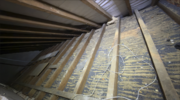
Quick question for anyone who feels like giving their opinion on this - I've completely cleaned out the space ready for the inline fan to be installed, and then the insulation - you can see all the grey poly beads from the cavity insulation that have been leftover from yesterday (there were over 9 bin bags' worth)..

My question is, would you get in this space and hoover, or is that excessive?
 

If you need to find a tradesperson to get your job done, please try our local search below, or if you are doing it yourself you can find suppliers local to you.

Select the supplier or trade you require, enter your location to begin your search.


Are you a trade or supplier? You can create your listing free at DIYnot Local

 
Back
Top