• Looking for a smarter way to manage your heating this winter? We’ve been testing the new Aqara Radiator Thermostat W600 to see how quiet, accurate and easy it is to use around the home. Click here read our review.

BT phone line/service 'upgrade'

An alternative idea, might be that the fibre cabinets, don't need any power/booster amps in them. They could be just places to joint the fibres? They would need power, where the fibre exchange cable went into a cab, and came out as copper analogue.
As I understand it.

Openreach FTTC needs active cabinets to convert from fiber to VDSL. These cabinets are what people usually refer to when they talk about "fiber cabinets".

Openreach FTTP doesn't use cabinets. It runs from the exchange to the "aggregation node" to the "splitter node" to the "fiber DP". These "nodes" are in plastic bullet-shaped housings either underground or on poles.
 
forcing BT to choose between cutting them off completely or implementing a soloution on the BT side.
I personally would have ditched BT completely and relied on my mobile phone. The BT service is hideously expensive and I only need a small excuse to ditch it. The only reason that I keep a landline is that my mother's Dementia does not allow her to reliably remember to call my mobile rather than a landline.
 
As I understand it.

Openreach FTTC needs active cabinets to convert from fiber to VDSL. These cabinets are what people usually refer to when they talk about "fiber cabinets".

Openreach FTTP doesn't use cabinets. It runs from the exchange to the "aggregation node" to the "splitter node" to the "fiber DP". These "nodes" are in plastic bullet-shaped housings either underground or on poles.

Which agrees with what I was suggesting, and so - providing the local exchange has batteries, the fibre would continue to be available through a power outage, but the customers router, likewise, would need battery backup, plus the internal phone.
 
Which agrees with what I was suggesting, and so - providing the local exchange has batteries, the fibre would continue to be available through a power outage ...
I think that we have all always accepted that, but the concern expressed by many has been in relation to ...
.... but the customers router, likewise, would need battery backup, plus the internal phone.
 
From a generic technology perspective, is there any reason why a DSLAM should not have the capability of doing D/A conversion, and only require new software to be flashed onto it to turn it on?
If one is to believe Mr Wikipedia, it already does that ...
Wikepedia said:
  • DSLAM: a device for DSL service. The DSLAM port where the subscriber local loop is connected converts analog electrical signals to data traffic (upstream traffic for data upload) and data traffic to analog electrical signals (downstream for data download).
 
An alternative idea, might be that the fibre cabinets, don't need any power/booster amps in them. They could be just places to joint the fibres? They would need power, where the fibre exchange cable went into a cab, and came out as copper analogue.
FTTC has copper cabling from there to customers' properties. Be the signals down those cables analogue or digital, power there must surely be required?
 
.... my broadband connection comes through 'the ether', not through any copper conductor or optical fibre cable.
To clarify, I thought I would post this photo of 'the ether' through which my internet comes, rather than through either copper or an optical cable...

1764022990613.png
 
1. Ignore any attempts to persuade them to move them over to VOIP services, forcing BT to choose between cutting them off completely or implementing a soloution on the BT side.

There aren't really any "attempts to persuade" which can be ignored. BT turn off the analogue phone service, and that's it, no matter how "unpersuaded" the customer is.

And most people are not "cut off completely", they just have to plug their phone in somewhere else.


2. Make noise in the direction of their elected representitives, who have the power to regulate BT. Point out the special cases (for example emermgency phones) for which no easy alternative to analog phone service is available.

Everyone needs a phone which will work in a power cut. Frankly I think everyone should have had their master socket replaced FOC with a device incorporating a battery backed up ATA which they could use if they chose.

But landline dependent customers will get free VoIP-only broadband, and a BBU.

In the case of medical assistance devices, for example, if they won't work over VoIP then that is unacceptable - the makers have had several years to get that problem fixed, and if any legislative attention is required it should be used to regulate them.


BT are trying to replace a system with substantial resiliency against power cuts with one with far-less such resiliency.

Sorry - I thought you were talking about the change to making an analogue service available from the cabinet instead of the broadband modem, not the whole idea of losing a battery powered, copper cabled, POTS.


I doubt it.

Me too.
 
Yes, and absolutely massive. I worked in the main Leeds exchange - three floors of switch racks, and a large basement, filled with massive submarine batteries, heavy, copper, 50v dc bus bars run everywhere.
In the later exchange equipment (System X/AXE10) the battery back up was 100amp hour batteries configured up 600 amp hour batteries. The principle power was from mains powered AC/DC coverters. The batteries would hold the equipment active for a minimum of 2 hours.
 
Last edited:
I'm sure he did, but FTTC implies that there is copper from cabinet to the consumer.
FTTC = Fibre To The Cabinet from the exchange. From the cabinet to the customer is over good old copper wire.
FTTP = Fibre To The Customer from the exchange (of which there it is planned there will be less than 1000 remaining).
 
So are you suggesting that having an Internet connection should be 'compulsory'
In terms of physical equipment, yes, it will be. Just as it is compulsory for you to have a copper line and an NTE5 or equivalent for your current service. FTTP+NTU or SDSL to the house and then a router+voip adapter into which the phone &/or extension wiring is plugged. Small battery backup units for the router etc are readily available. I would expect new-build estates to be "wired" with fibre.

If you don't want their Internet access then you only pay BT a line & phone services fee as you do now. I'd expect the vast majority of people will take an Internet service over Openreach FTTP from their provider of choice, and then select a VOIP service from either their ISP or an independent one using a small VOIP adapter plugged into their hub,

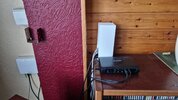
17640589910578627381000664143412.jpg
(Community Fibre -the small black device is the battery backup for the router and the NTU.)
 
Last edited:

If you need to find a tradesperson to get your job done, please try our local search below, or if you are doing it yourself you can find suppliers local to you.

Select the supplier or trade you require, enter your location to begin your search.


Are you a trade or supplier? You can create your listing free at DIYnot Local

 
Back
Top