• Looking for a smarter way to manage your heating this winter? We’ve been testing the new Aqara Radiator Thermostat W600 to see how quiet, accurate and easy it is to use around the home. Click here read our review.

Replacing my old flash immermat timer to a hive thermostat - H & HW V4 with hive nano hub

Joined
29 Nov 2025
Messages
11
Reaction score
5
Country
Ireland
Hi All,

Please see image below, how can I wire up a hive v4 wireless heating and hot water smart thermostat from a old flash immermat timer for oil boiler for house heating and hot water?

Old flash immermat timer

1764402754757.png


1764402957506.png


1764402659423.png


To

Hive V4 Wireless Heating & Hot Water Smart Thermostat White​

1764403127857.png


1764405846108.png


Thank you.
 
The timer only does one function, no idea if domestic hot water (DHW) or central heating (CH), but you can't get both when only wired for one.

I also use an oil boiler, and although mine can heat DHW only by not running the pump, we never use it to only heat DHW, with an off-peak electric supply, and solar panels there is no need to use oil to heat DHW in the summer.

You have line and neutral in, and line and neutral out, and the neutral is not switched, so both neutrals into N on Hive, and the line in to L on hive, and line out will go to either 3 for DHW or 4 for CH, but it can't do CH and DHW independently.
 
Last edited:
Hi ericmark,

Thank you for your response, It's for central heating but we also get hot water from it. In the summer we close of the radiators in the hot press with a valve with red handle and just use it for hot water.

1764409996555.png

1) So the two blue cables (neutral) goes into N on Hive.
2) Brown in (live) goes into L on Hive.
3) Brown out (live) goes into 4 on Hive for central heating. Would that be right?

What about below cables?
1764410408723.png


Thank you.
 
1) So the two blue cables (neutral) goes into N on Hive.
2) Brown in (live) goes into L on Hive.
3) Brown out (live) goes into 4 on Hive for central heating. Would that be right?
Yes.
What about below cables?
I had assumed part of the switch.

I would question using oil to heat DHW in the summer. Likewise, I was using oil to do this, and it had no thermostat on the cistern, so I set it to run ½ hour per day, in fact only ran for 20 minutes, so a 20 kW boiler so 20 x 20/60 x 7 = 46 kWh per week, when the solar was fitted, the iboost+ records how much electric is used. So this was showing around 9 kWh per week, so using 5 times as much energy with oil to electric, assuming the oil burner 100% efficient in the first place.

I realise it is the heating of the pipe work and the boiler its self which is costing the extra, and this will change home to home, but we would normally order oil twice a year, as don't want it to get too low, but last time I looked well over half full, so there is a marked reduction in the oil used.

I had been told so many times it was cheaper to use gas or oil to heat DHW, and I just accepted what I was told, since the immersion heater uses a fused connection unit not plug and socket, it was one of around 4 items in the home I could not monitor with a plug in energy monitor, so it was not until the iboost+ was fitted I had any idea of how much it cost to heat water with electric.

With solar panels, battery, and off-peak supply, no question electric is far cheaper, but even without them, likely still cheaper using electric in the summer.
 
I also have a solar system installed. The "iboost+ would that be the same as the Eddi? The eddi also give us hot water from the solar but the problem is using the eddi doesn't actually give us enough hot water when we need to shower so during the summer we still needed to heat the water for 1h.

We also used to order oil twice a year but I have cut that down buy getting a multi fuel stove installed, which heat up all the radiators and also hot water.

I had also been told it's cheaper to use oil to heat the DHW because immersion heating is more expensive but never thought of it.

So using the oil to heat the DHW, takes both electricity and the oil while using the immersion heater just us electricity. I am also unable to monitor what is used or how much it cost.

As it stand, I don't have a battery yet but I do plan on getting one soon.

You made a good point, I will defiantly consider next summer to only using electric for the hot water.
 
the iboost+ records how much electric is used. So this was showing around 9 kWh per week, so using 5 times as much energy with oil to electric, assuming the oil burner 100% efficient in the first place
Hmmm. My unvented HW cylinder has daily losses of circa 2 kWh... According to the manufacturer. That would be 18 kWh per week without using any water from it.

I can't dispute your actual measured numbers but you must have the smallest HW cylinder and be exceedingly frugal with HW draw-off.

Calculations suggest that 1 litre of water raised 50 degrees C needs 58.2 Wh of energy. 9000/58.2 = only 155 litres of water with no losses accounted for.

Many people still don't have solar and battery storage, nor even cheap rate electric overnight to choose to use to make the economics stack up.

OP needs to look at changing the plumbing to properly control both HW and CH via motorised valves.

I have oil and use for HW is really minimal over the summer months. As I have an EV tariff I could look into a timed immersion heater controller -- but my immersion element is my backup for a faulty oil boiler and if use of it means it needs replacing that is a non trivial plumbing exercise. Plus the cost of a timer smart switch to integrate with my Wiser could mean a long payback period anyway. (Oil being cheaper or on par with off peak electric cost).
 
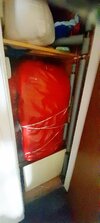
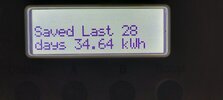
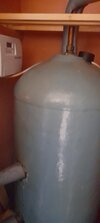
Thank you, @Rodders53 my tank Tank before lagged.jpg I have now put on more lagging Tank after lagging.jpg and summer Last 28 days1.jpg this was typical, can't turn the DHW off when oil boiler running (C Plan) so this time of year I do use oil. We use a direct electric shower, and rarely use the bath, think one in 5 years we have been here, the washing machine and dishwasher are cold fill, and there are three floors, cylinder on the top floor, and boiler on the bottom floor, so a fair bit of pipe work between the two all around 22mm which does not help.
I found, looking at last 7 days, wildly different readings, suppose depends on how many times the heater turns on in a day the tank will stay warm for 3 days, but we did get some days in summer where we had not had enough sun to keep it warm, so we also set it to use off-peak, to start with we were using a 9" immersion heater, now using a 27" immersion heater, which did double the energy used, but stopped us running out of hot water, the 28 day shown was with 27" immersion heater.

Losses from pipe work in winter does not matter, we want the heat in the house, but summer it would clearly mean the AC runs longer, so we don't want the oil boiler heating the house in summer.
OP needs to look at changing the plumbing to properly control both HW and CH via motorised valves.
I was advised against it, as the C Plan allows the boiler to cool by heating the DHW, I was told with my old boiler, not a good idea. But I am no heating engineer, I am electrical.
As I have an EV tariff I could look into a timed immersion heater controller
Same as me, 8.5p/kWh overnight, and I get 12p/kWh in day for export, so would have been better with simple timer to the iboost+ now, but did take 18 months to start getting paid for export, I was with British Gas, and they said I had applied in wrong format, can't see how, used their forms, moved to Octopus, within 2 weeks I was getting export payment, it seems I needed a second MPAN number for export, so all what British Gas said about getting back payment once sorted was never going to happen. Basic they did not want to pay for export, and were using a load of excuses.

The cylinder jacket did not help much, maybe a few kWh per month, going to take years to get my money back. But unless the door is opened to the airing cupboard, the cupboard its self much be good insulation, when we open the door the heat hits one, even with the extra insulation.

 

If you need to find a tradesperson to get your job done, please try our local search below, or if you are doing it yourself you can find suppliers local to you.

Select the supplier or trade you require, enter your location to begin your search.


Are you a trade or supplier? You can create your listing free at DIYnot Local

 
Back
Top