Earth question - Shaver socket

Yes, since it's essentially a 'bureaucratic' decision on their part, that is obviously true.

One might hope that they would understand that it's the DNA in all the somatic cells of an organism (dog or otherwise) that determine it's 'characteristics' and hence, I would have thought, whether it was 'true to the breed'.

Their scientific thinking has been subjected to homeopathy. Dilute the science so much that it becomes undetectable.


If one thinks otherwise, it could get silly. If the presence of traces of 'alien DNA' in the body or blood of an animal (dog, human or otherwise) meant that it couldn't be regarded as 'pure bred' (even though its parentage suggested that it was) that would 'catch' anyone/any animal who had had a blood transfusion or transplant or even who had, or had had, a viral infection :-)

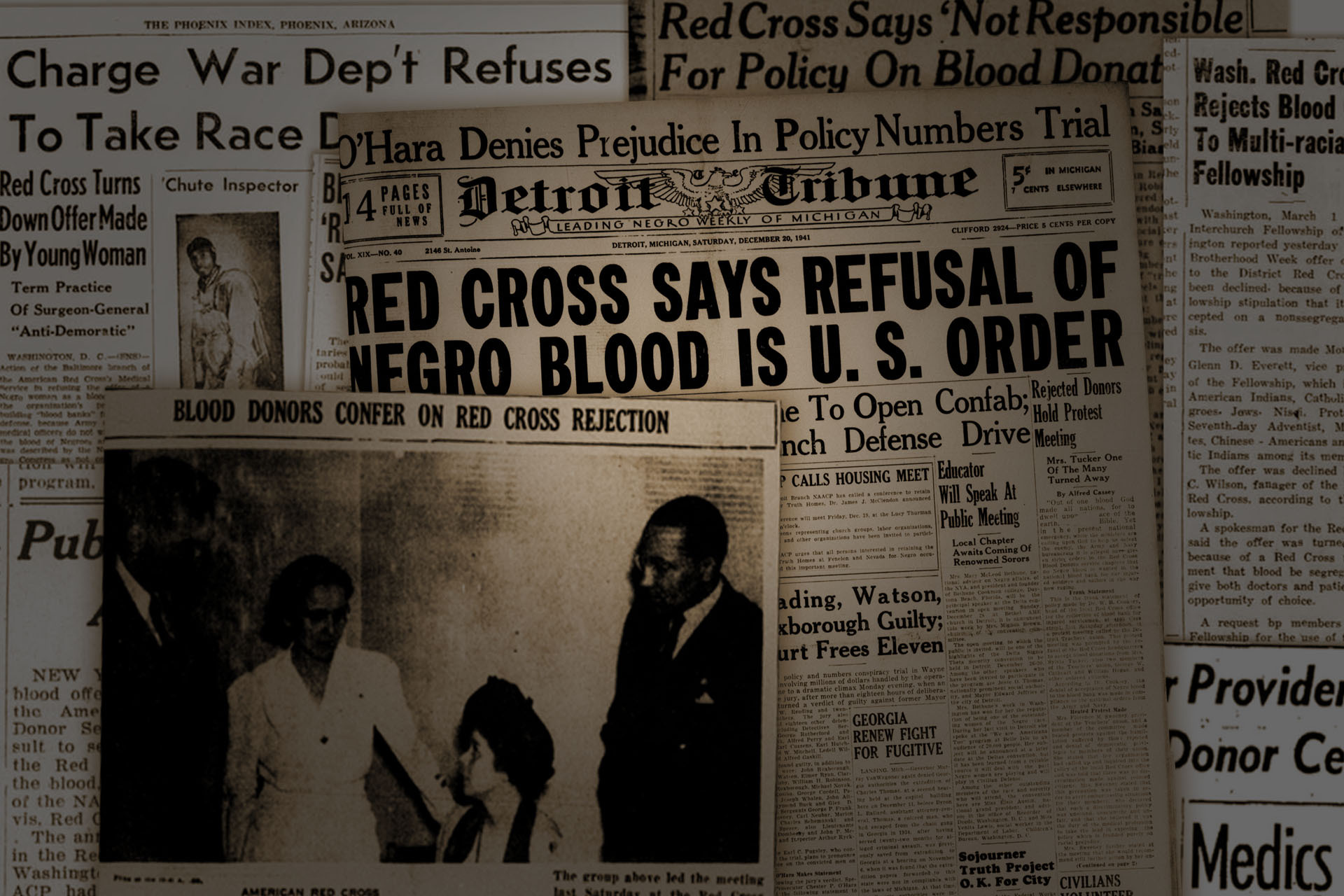
1765477316228.png


<a 1940/1941 newspaper article>
I don't know how much was known about such things in/around 1940, but I suspect not much, since I think that was the very year in which the Rhesus blood group system was first described.

That being the case, I would think it very understandable that some people/organisations might have had (justified) concerns about the possibility that there could be appreciable differences between blood in individuals of different ethnicity (perhaps differences of which they were not then aware) - potentially to the extent that cross-ethnic-group blood transfusion might have been harmful, possibly even dangerous.
 
I don't know how much was known about such things in/around 1940, but I suspect not much, since I think that was the very year in which the Rhesus blood group system was first described.

That's just it. Not much.

And according to what they knew, there was no difference whatsoever between blood in individuals of different ethnicity.


That being the case, I would think it very understandable that some people/organisations might have had (justified) concerns about the possibility that there could be appreciable differences between blood in individuals of different ethnicity (perhaps differences of which they were not then aware) - potentially to the extent that cross-ethnic-group blood transfusion might have been harmful, possibly even dangerous.

Understandable, maybe, but justified absolutely not.
 
That's just it. Not much.
Quite so.
And according to what they knew, there was no difference whatsoever between blood in individuals of different ethnicity.
True, but that means very little, and certainly does not reassure, when what one does know is very little. We certainly do know (and probably did to at least some extent back then) that there are some important biological differences between people of different ethnic groups.
Understandable, maybe, but justified absolutely not.
I haven't got time to get involved in what could well end up as a 'heated exchange'. Suffice it to say that, although I like to think that I have always been about as strongly opposed as I could be to any form of irrational 'racism' or discrimination (on the basis of ethnicity, skin colour or anything else), I do not consider 'exercising caution' in a situation such as we are discussing to necessarily be irrational or 'unjustified' - even you admit that such an approach may be 'understandable'.
 
And according to what they knew, there was no difference whatsoever between blood in individuals of different ethnicity.
Understandable, maybe,
I have no idea of timelines involved but just one of the things we knew at one time was the existence of sicklecell anemia which was thought to be a black blood disorder, so:
justified absolutely not.
at that time
 
Understandable, maybe, but justified absolutely not.
at that time
I don't really think that was 'not justified' even then. "At that time", we probably knew so little about blood in different ethnic groups, that it would (in my opinion) have been very reasonable to 'exercise caution' in relation to a theoretically possible risk which we could not then exclude because of our relative ignorance,

I could quote countless analogous situations in which, in the face of ignorance about possible hazards, we sensibly took a 'cautious' approach. For example ... at the time of the first few Apollo missions to the moon, "according to what we then knew ", there was absolutely no reason to believe that there were any pathogens on the moon that could represent a hazard to human beings (or even terrestrial plant life). However, since that possibility could not be discounted, the returning astronauts were subjected to a period of very strict quarantine (and intensive investigation) upon their return to earth.
 
I don't really think that was 'not justified' even then. "At that time", we probably knew so little about blood in different ethnic groups, that it would (in my opinion) have been very reasonable to 'exercise caution' in relation to a theoretically possible risk which we could not then exclude because of our relative ignorance,

I could quote countless analogous situations in which, in the face of ignorance about possible hazards, we sensibly took a 'cautious' approach. For example ... at the time of the first few Apollo missions to the moon, "according to what we then knew ", there was absolutely no reason to believe that there were any pathogens on the moon that could represent a hazard to human beings (or even terrestrial plant life). However, since that possibility could not be discounted, the returning astronauts were subjected to a period of very strict quarantine (and intensive investigation) upon their return to earth.
Did you realise I struck out 'not'
 
So it is said (and, I believe, documented), and 'worse', but I don't think they were necessarily the first to have done such experiments

It would provide some 'answers' to some questions, but only in relation to 'populations', not individuals - i.e. it could produce estimates of 'averages' in the population, or of the proportion of a population that had a certain outcome etc. - but, as I've said, that is of limited usefulness in relation to an individual, witnessed by the fact that virtually the whole of the science of Statistics revolves around the fact that there is 'variation' (between individuals or whatever).

This is something which I think morqthana probably overlooked. Yes, trials or surveys could establish that, say, when groups of people were subjected to a certain electric shock, more would survive when there was RCD protection than when there was no such protection (and one could even estimate the probabilities of survival with/without RCD protection). However, going back to what I said that morq 'jumped on' (that, if someone had survived a shock which caused an RCD to operate, it would be impossible to know whether or not they would have survived in the absence of an RCD), if an individual survives a shock which causes an RCD to operate it is clearly NOT necessarily the case that they would not have survived without the RCD, even though trials may have established that 'on average' (across groups of people) more survived with RCD protection than without it.

In particular (given the marked variation between individuals) the primary reason why a person survived a shock which caused an RCD to operate may have been that they were particularly 'resilient' to electric shocks (i.e. needed a much worse shock to kill them than would kill many other people) - and it therefore could be that they were equally 'resilient' to the shock when there was no RECD protection.

As above, there is a wide degree of variation between individuals - not to mention, of course, the fact that the nature of the shock (points of contact, skin moisture level, duration etc. etc.) make big differences.

I have seen people who (often without knowing it) had hearts so electrically unstable that they were at constant risk of spontaneously developing a fatal disturbance of heart rhythm (the most common cause of 'sudden death') - so, in them, an electric shock of only 1 mA, or less, might be enough as 'the final straw'. Conversely, although I obviously can't know, I imagine that there are individuals who would/could survive an arm-to-arm shock considerably in excess of 30 mA.

I think the answer to that is essentially a no-brainer - not only morally/ethically but also because we obviously cannot 'unlearn' things.

There are many examples. For example, much/most of what we know about the biological dangers of ionising radiation derives from events and experiments which are more than a little 'ethically questionable'

Kind Regards, John

All agreed John.

I think that if we tested someone again who had survived the first event then the first event in itself might have weakened (or strengthend??) them enough to skew the results of the second test.
We would need to have a cat called Schrodinger to view each test simultaneously whilst also testing photons simultaneously to decide if they are a wave or a particle.
Have we got that clever yet?

I reckon an inspired guess might be the best we can do and the more we study then the better the guess.

Mind you, I might be wrong! I am only guessing :giggle:
 
All agreed John. ... I think that if we tested someone again who had survived the first event then the first event in itself might have weakened (or strengthend??) them enough to skew the results of the second test.
Yes, that's far from impossible - but, as I wrote, simpler than that is the possibility that they survived the first test simply because they were an individual whose 'threshold for harm'(in terms of the outcome of electric shocks) was pretty high - in which case it's quite possible that they would survive a second test for that same reason, even if it were theoretically 'more risky' (i.e. first test with an RCD, second without).
I reckon an inspired guess might be the best we can do and the more we study then the better the guess.
It's always going to be the case that "the more we study, then the better the guess" - but, as I keep saying, the information we get from studies will always relate to populations ('averages' etc.) and hence of limit value in relation to an individual. Large studies might enable us to say (with a fair degree of certainty), for example, that the probability of a person like you dying of disease X in the next 10 years is only, say, 1% - but that does not alter the fact that (if you happened to be one of the few individuals who were 'far from the average') you might die of that disease 'tomorrow'!

Returning to morq's viewpoint, I think that one of the good things that has happened over the decades and centuries is that we have got a lot better at "knowing what we don't know" and, where appropriate taking actions to mitigate risks that we may come to know about in the future ....

.... historically, there are countless examples of the undesirability of taking morq's apparent view that if we don't know something (particularly if it is 'a risk'), then we work on the assumption that the something (e.g. the 'risk') doesn't exist. In terms of the big picture (millennia) it's not that long ago that, because we did not know that there were health hazards associated with X-rays, smoking, mercury, asbestos, coal dust etc. etc. etc. , we took no measures to protect ourselves against possible (but then unknown) hazards. These days, I think we look much more carefully at 'everything' and consider what sort of hazards they might present, even though we are currently unaware of them.

Kind Regards, John
 
historically, there are countless examples of the undesirability of taking morq's apparent view that if we don't know something (particularly if it is 'a risk'), then we work on the assumption that the something (e.g. the 'risk') doesn't exist. In terms of the big picture (millennia) it's not that long ago that, because we did not know that there were health hazards associated with X-rays, smoking, mercury, asbestos, coal dust etc. etc. etc. , we took no measures to protect ourselves against possible (but then unknown) hazards. These days, I think we look much more carefully at 'everything' and consider what sort of hazards they might present, even though we are currently unaware of them.
Yup, as you said.

"Cockcroft`s Folly" might be one example we should strive to achieve.

PS we`ve been around that neck of the woods quite often now.
I wonder why they no longer calls it Windscale???
 
Yup, as you said.
Glad you agree.
"Cockcroft`s Folly" might be one example we should strive to achieve.
That's a little different from what I was talking about, since Cockroft had the foresight and wisdom to recognise a potential hazard and to do things (despite the 'mockery' it attracted) to mitigate the consequences of that hazard, should it ever happen (which it did!).

In contrast, for example, when Marie Curie started experimenting with X-rays, she had no knowledge of any potential health risks and seemingly did not consider the possibility that (then 'unknown') risks might exist.

In some senses, those who morqthana is criticising probably may well have been 'ahead of their time' in ~1940, since, although they did not know of any differences between blood of white and black people, they seemingly considered the possibility of (then 'unknown') differences which might result in cross-ethnic-group blood transfusions being potentially harmful/dangerous.

It may perhaps have somewhat moderated morq's view if they had also expressed concerns about black people being transfused with blood from white people?

Kind Regards, John
 

If you need to find a tradesperson to get your job done, please try our local search below, or if you are doing it yourself you can find suppliers local to you.

Select the supplier or trade you require, enter your location to begin your search.


Are you a trade or supplier? You can create your listing free at DIYnot Local

 
Back
Top