Yes I have got a multi meter and enough knowledge not to kill myself. Have already wired in the brand new valve head earlier today which I had hoped would solve the problemYes ,you would need to do some voltage testing to establish if the orange wire at the wiring centre reads 230/240 volts . Are you competent to work safely on live circuitry ?

You are using an out of date browser. It may not display this or other websites correctly.
You should upgrade or use an alternative browser.
You should upgrade or use an alternative browser.
Downstairs heating only working when upstairs is on
- Thread starter rich19754
- Start date
If your problem is you want heat downstairs, then remove the head from the downstairs valve, manually open it and let the upstairs thermostat control the house for the time being
Thanks but the downstairs does come on providing the upstairs is also onIf your problem is you want heat downstairs, then remove the head from the downstairs valve, manually open it and let the upstairs thermostat control the house for the time being

Both 2 ports...
Permanent 240v on grey
240v on brown when prog demand for heat and stat calling.
Valve motors across and actuates microswitch.
Microswitch connects grey to orange which sends 240v to boiler.
Oranges and greys are commoned in wiring centre (as in same colours are commoned)
This is the standard setup.
Permanent 240v on grey
240v on brown when prog demand for heat and stat calling.
Valve motors across and actuates microswitch.
Microswitch connects grey to orange which sends 240v to boiler.
Oranges and greys are commoned in wiring centre (as in same colours are commoned)
This is the standard setup.
Just something to be aware of
although the grey should be permanent live then giving power to orange when microswitch made
A lot of people wired them up as orange perm live giving power to grey when microswitch made .
.
.
As you have already changed the valve head
Your first port of call should be looking at grey and orange wires as this is where boiler get fired from
although the grey should be permanent live then giving power to orange when microswitch made
A lot of people wired them up as orange perm live giving power to grey when microswitch made .
.
.
As you have already changed the valve head
Your first port of call should be looking at grey and orange wires as this is where boiler get fired from
Just something to be aware of
although the grey should be permanent live then giving power to orange when microswitch made
A lot of people wired them up as orange perm live giving power to grey when microswitch made .
.
.
As you have already changed the valve head
Your first port of call should be looking at grey and orange wires as this is where boiler get fired from
Attachments
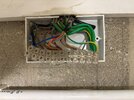
- Joined
- 8 May 2017
- Messages
- 10,676
- Reaction score
- 2,877
- Country

230/240 volts between the orange wires terminal and earth terminal when downstairs valve only is on calling for heat.

- Joined
- 27 Jan 2008
- Messages
- 29,412
- Reaction score
- 3,615
- Location
- Llanfair Caereinion, Nr Welshpool
- Country
There are so many variations, this one 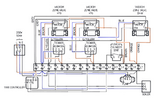 for example only shows a two channel programmer, and the whole idea of motorised valves is a bit last century before we started using electronic TRV heads.
I have looked at instructions, and some simply don't make sense any more, but it seems theory and practice don't always match, in theory having electronic TRV heads removes the need for hard-wired motorised valves, but it seems one can get heat through one pipe, but not worked out how as yet.
Anyway, the point is, combining both valves, as long as you have electronic TRV heads, would not matter. In fact, could be an improvement. Modern boilers should modulate, (turn up/down) not switch on/off to get the best economy out of them, and a hard-wired valve turns on/off, which is not the best way, where a TRV turns up/down, and with this house even if on/off, 14 TRV heads will not all switch together, so we get a gradual increase or decrease in flow, which better allows the boiler to gain the latent heat from the flue gases.
Old boilers, like my old oil boiler, simply switched on/off, and the return water temperature did not really matter, in new boilers, the return water temperature needs to be low enough to condense water out of flue gases and gain the latent heat. So the key to this is the setting of the lock shield valve and use of TRV heads. Been like this since the 90's, however the TRV has progressed, with the electronic head allowing setting in degrees C not some silly *123456, and being able to set when each room is heated. We start with stand alone with likes of Terrier i30 and eQ-3, then we see bluetooth added, some eQ-3 heads have bluetooth, then they connected to internet so you can use geo-fencing and the like, and then we have connection to a hub, so it will actually fire the boiler, and even smart versions which work out how long it takes to heat a room, so you set time you want room hot rather than time to start heating.
This has also changed the ideas of where to put radiators, traditionally they were under windows, but this puts the TRV also under the window, so cooled by outside, so better on an internal wall, but some systems get around this problem, by if a wall thermostat and TRV are in same room, auto linking them so the wall thermostat controls the TRV.
This has resulted in many of the old ideas today no longer being true, like not fitting a TRV in a room with a wall thermostat, again last century, today where radiators are under windows, we do fit both in the same room, and we can also connect to boilers using the ebus with the likes of OpenTherm where the thermostat tells the boiler to turn up or down not on and off, which clearly can't be relayed through a hard-wired motorised valve.
However, we have to consider cost, my home 14 TRV's so to convert all to linked electronic TRV heads looking at around £600, so I have some linked, but not all, also multi-wall thermostats, not that my system will really help as still using an oil on/off boiler, but one needs to sit back and decide what compromise will work for you at a reasonable cost.
This is the whole point of the essay, it may be easier to fit electronic TRV heads than find the fault. If you know there are other methods of control, you can see alternative ways around your problem. Out of interest, I have 5 stand-alone bluetooth, 4 internet linked, and 1 linked to boiler. I have made mistakes, if starting again it would be all Drayton Wiser, but started with silly Nest, so a bit of a hoch potch.
for example only shows a two channel programmer, and the whole idea of motorised valves is a bit last century before we started using electronic TRV heads.I have looked at instructions, and some simply don't make sense any more, but it seems theory and practice don't always match, in theory having electronic TRV heads removes the need for hard-wired motorised valves, but it seems one can get heat through one pipe, but not worked out how as yet.
Anyway, the point is, combining both valves, as long as you have electronic TRV heads, would not matter. In fact, could be an improvement. Modern boilers should modulate, (turn up/down) not switch on/off to get the best economy out of them, and a hard-wired valve turns on/off, which is not the best way, where a TRV turns up/down, and with this house even if on/off, 14 TRV heads will not all switch together, so we get a gradual increase or decrease in flow, which better allows the boiler to gain the latent heat from the flue gases.
Old boilers, like my old oil boiler, simply switched on/off, and the return water temperature did not really matter, in new boilers, the return water temperature needs to be low enough to condense water out of flue gases and gain the latent heat. So the key to this is the setting of the lock shield valve and use of TRV heads. Been like this since the 90's, however the TRV has progressed, with the electronic head allowing setting in degrees C not some silly *123456, and being able to set when each room is heated. We start with stand alone with likes of Terrier i30 and eQ-3, then we see bluetooth added, some eQ-3 heads have bluetooth, then they connected to internet so you can use geo-fencing and the like, and then we have connection to a hub, so it will actually fire the boiler, and even smart versions which work out how long it takes to heat a room, so you set time you want room hot rather than time to start heating.
This has also changed the ideas of where to put radiators, traditionally they were under windows, but this puts the TRV also under the window, so cooled by outside, so better on an internal wall, but some systems get around this problem, by if a wall thermostat and TRV are in same room, auto linking them so the wall thermostat controls the TRV.
This has resulted in many of the old ideas today no longer being true, like not fitting a TRV in a room with a wall thermostat, again last century, today where radiators are under windows, we do fit both in the same room, and we can also connect to boilers using the ebus with the likes of OpenTherm where the thermostat tells the boiler to turn up or down not on and off, which clearly can't be relayed through a hard-wired motorised valve.
However, we have to consider cost, my home 14 TRV's so to convert all to linked electronic TRV heads looking at around £600, so I have some linked, but not all, also multi-wall thermostats, not that my system will really help as still using an oil on/off boiler, but one needs to sit back and decide what compromise will work for you at a reasonable cost.
This is the whole point of the essay, it may be easier to fit electronic TRV heads than find the fault. If you know there are other methods of control, you can see alternative ways around your problem. Out of interest, I have 5 stand-alone bluetooth, 4 internet linked, and 1 linked to boiler. I have made mistakes, if starting again it would be all Drayton Wiser, but started with silly Nest, so a bit of a hoch potch.

- Joined
- 5 Nov 2024
- Messages
- 5,570
- Reaction score
- 2,616
- Country
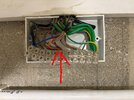
Will have a look but I did remove this and reconnect/check everything this morning and the downstairs still wouldn’t work (unless the upstairs/boiler was on) - am totally baffledThis orange (pointed out here) looks suspect
I take it the (D/stairs) valve is opening but not firing the boiler?, if so then even though a new valve head I would confirm that its micro switch is closing by removing the valve head grey&orange wires and with the M.meter on resistance check for continuity between them, should read maybe 0.1/0.3 ohms or the same as when you touch the two probes together, this is with the valve energised and open.
- Joined
- 27 Jan 2008
- Messages
- 29,412
- Reaction score
- 3,615
- Location
- Llanfair Caereinion, Nr Welshpool
- Country
Sorry missed the picture 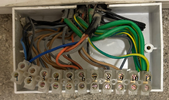 I would start with numbers as shown, so one can record what each wire does.
1 = Neutral
2 =
3 =
4 = unused
5 = Line supply
6 = Supply to boiler
7 = unused
8 =
9 =
10 = unused
11 = Earth
So I have 4 which it is not clear what they do, but using 1 as a base to measure from, I would hope 1 - 5 always line 230 volts, and 1 - 6 line when the boiler is running. What I am looking as is the motorised valve cable, which you can rely on colours being correct.
I would guess 8 and 9 are the two thermostats? As 9 seems to connect to a cable with the orange wire coming out of it, and that cable, we would expect to have a thermostat connected to it. So a process of estimation, seems likely 1 and 3 feed the thermostat from the programmer, what you are building up is a truth table, to show what each wire does.
I would start with numbers as shown, so one can record what each wire does.1 = Neutral
2 =
3 =
4 = unused
5 = Line supply
6 = Supply to boiler
7 = unused
8 =
9 =
10 = unused
11 = Earth
So I have 4 which it is not clear what they do, but using 1 as a base to measure from, I would hope 1 - 5 always line 230 volts, and 1 - 6 line when the boiler is running. What I am looking as is the motorised valve cable, which you can rely on colours being correct.
I would guess 8 and 9 are the two thermostats? As 9 seems to connect to a cable with the orange wire coming out of it, and that cable, we would expect to have a thermostat connected to it. So a process of estimation, seems likely 1 and 3 feed the thermostat from the programmer, what you are building up is a truth table, to show what each wire does.

DIYnot Local
Staff member
If you need to find a tradesperson to get your job done, please try our local search below, or if you are doing it yourself you can find suppliers local to you.
Select the supplier or trade you require, enter your location to begin your search.
Please select a service and enter a location to continue...
Are you a trade or supplier? You can create your listing free at DIYnot Local
Similar threads
- Replies
- 21
- Views
- 9K
- Replies
- 10
- Views
- 15K

