How to do washing using off-peak?

The drier at 600 watt for a few hours, yes worth waiting for the off-peak.
OK you have me wondering, now. I'm off to fit a Meross smart socket with energy monitor to the Miele Heat Pump tumble dryer to know how much it uses from today onwards )for a while, at least).

To be frank I had no idea how little the washer was actually costing in electric. The circa £40-50 of detergent per annum is the biggest cost followed by the roughly £17 for water and sewerage, plus a bit for the water softener salt blocks!

The ensuite towel rail (180W element) has used almost double the electric of the washer!
 
The 2.5 hours is not simply times by 650 watt which my tumble drier uses, as it depends on the load, with a light load, it uses a mark/space system to reduce the output near the end of the drying cycle.
1766427654233.png

Here is one I did earlier. But not all loads will give this patten, my monitor only shows an hour, so this is a number of pictures combined.

Comparing a vented drier with a heat pump drier, I can't turn the vented down to 650 watt, but the one I had would turn down to 1 kW, and would take around 90 minutes, the maximum time I could set, sometimes it needed turning on again, as not quite dry, but it means not so cut and dried as to if the vented or the heat pump used less or more power to the other.

The condensing drier, be it water, room air, or heat pump cooled, has no option to change the time it takes to dry, so one can't compare a drier taking an hour with a drier taking 2.5 hours, but the vented drier often had the option of one or two elements, with a simple switch, and we see 2 kW = 1 hour and 1 kW = 1.5 hours so clearly the longer taken to dry, the less energy used.
 
Or put the liquid soap container in the bottom of the empty drum and the clothes on top.
That was the problem, we do that when manually starting the wash, but when we set a delayed start, for some reason, it tumbles the clothes while waiting for start time, every so often. So the soap ends up on the clothes in concentrated form.

Summer the difference between 8.5p and 15p, per kWh, not worth worrying about, winter the battery is not big enough so using the three machines with built-in timers overnight, dishwasher, washing machine and tumble drier, means we have enough battery power to last well into the evening.

But snow on the solar panels does not help.
 
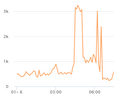
I look at @Why Not Indeed graph, and wonder where my graphs are. I seem to remember only wash water heated, rinse water is not heated. To work out the area under the graph would not be easy, I think this 1767810775599.png is washing machine, then coffee before going to bed, but could have been dishwasher.
 
I occasionally look at electricity usage.

The washing machine runs the heating element for around ten minutes, near the start of the wash cycle. The exact amount varies with time of year and cycle chosen.

10 minutes at 2.5kW is a trivial cost.

The dishwasher uses a little more, because it has a hot wash and a hot rinse.

The churning motor and pump loads are too small to worry about.

In neither case is it worth the effort of tinkering with the powder or detergent and timing the machine.
 

If you need to find a tradesperson to get your job done, please try our local search below, or if you are doing it yourself you can find suppliers local to you.

Select the supplier or trade you require, enter your location to begin your search.


Are you a trade or supplier? You can create your listing free at DIYnot Local

 
Back
Top