The bit between worktop and wall - in a kitchen

Joined
5 Dec 2013
Messages
89
Reaction score
8
Location
Midlothian
Country
United Kingdom
Hi,

I am looking to replace a worktop in a kitchen. There will be a sink in the worktop. Washing machine and dishwasher underneath so a little bit of heat. No cooker or oven involved they are on a different wall.

The existing worktop is 61cm deep. I have found a suitable worktop but it is only 60cm deep. Due to a reason too hard to explain I need to fit the new worktop with the front at the same distance from the wall as the old worktop, which will leave a gap at the back of the worktop of 1cm between the wall and the worktop. I can pack it out a bit to keep the worktop rigid. But I still have the problem of having to seal up the area between the wall and the worktop to prevent spillage.

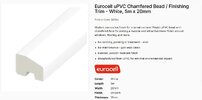
My question is: would it be a big mistake to use the following product fixed in place with silicon or acrylic adhesive?


Thank you all.
 

Attachments

  • finishing bead.jpg
    finishing bead.jpg
    75.3 KB · Views: 6
Not so easy to find a matching worktop at the right price. Plus it is a long cut to do without proper tools. I will be buying a jigsaw and downcut blades to do the sink cut-out.

I have to put something between the wall and the worktop anyway. I can also get quarter round quadrant 17mm deep which would probably do the job. What normally goes there? The quadrant is meant to be for that kind of thing, isn't it?
 
The quadrant is meant to be for that kind of thing, isn't it?

Not actually made for that use, no, it is intended for UPVC door/window fitters, but yes, it works just as well indoors. It's not self-adhesive, and so needs something suitable, to stick it in place - and will solve your problem for not much cost.
 
I will be buying a jigsaw and downcut blades to do the sink cut-out.

I did an in-situ sink cutout with a regular fine wood jigsaw blade. What do others think? There are disadvantages to downcut blades, which is why they are not the default.

Remember that the edge of the sink overlaps the worktop by ... maybe 15mm? So small chips are not visible.

You can experiment with some cuts in the middle of the sink area first.
 
I've done worktops for both offspring as well as a couple of rentals and at least 2 iterations of home,

Son's was worst as he wanted a Belfast sink so no lip to hide roughness. My approach is drill the corners to give a nice radius then bulk of cuts using circular saw. Mine (Evolution) doesn't have a riving knife so easy to plunge especially if you take the time to set decent guiderails in place. I'm sure a tracksaw would be easier but you use what you have. Decent blade, go nice and gently and finish cuts with a fine tooth hand saw. Strip of masking tape along the cut.
 
Thank you. I already have jigsaw with the old type of blade fitting (u-fitting) but would maybe buy a better saw to get a better selection of blades.
 
I did an in-situ sink cutout with a regular fine wood jigsaw blade. What do others think? There are disadvantages to downcut blades, which is why they are not the default.

Remember that the edge of the sink overlaps the worktop by ... maybe 15mm? So small chips are not visible.

You can experiment with some cuts in the middle of the sink area first.
I seem to recall job and knock saying the up cut blades deviate on the underside. I have never used one. I tend to use my track saw and then a jigsaw or japanese saw for the corners.

I think the other problem with upcut blades is that you need to prevent the jigsaw bouncing up. Probably less of an issue when using a better quality saw such as Festool ot Mafele
 

If you need to find a tradesperson to get your job done, please try our local search below, or if you are doing it yourself you can find suppliers local to you.

Select the supplier or trade you require, enter your location to begin your search.


Are you a trade or supplier? You can create your listing free at DIYnot Local

 
Back
Top