Economy 7 Water Tank - Timer Switch

Joined
8 Jun 2017
Messages
444
Reaction score
120
Country
United Kingdom
Hi

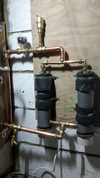
I have an economy 7 water tank that heats up overnight. Currently it's always running on a thermostat to keep at temperature.

I want to fit a timer similar to the one on the storage heaters. What amp timer am I likely to need? I'm not at the flat and would like to buy the time before i go there and get it fitted.

Not sure if there is a norm for this, the property is 20 years old

Thanks in advance
 
If it’s only using the economy 7 supply a timer won’t help you as it would only get power during the economy 7 hours

What are you trying to achieve?
 
Last edited:
What amp timer am I likely to need? I
16 amps is the usual choice, example: https://www.screwfix.com/p/lap-digital-immersion-timer/1804r
A search for 'immersion timer' will reveal plenty of other options.

However before buying anything, you will need to determine how the E7 is configured, as some are switched via the meter or an external device, in which case a timer will be of no use.
There is also the question of whether the entire supply goes to the E7 rate, or whether it's just the supply for the heaters.
Whether the existing supply to this water heater is on 24/7 or is already switched via the metering equipment.
Is this a cylinder with a single element, or a cylinder with 2 elements, or a twin element in a single casing.
 
@flameport is spot on as usual. The old economy 7 timers seem to have gone, and only the more modern ones remain, it was common to have two immersion heaters, one near the top of the cylinder as a boost, and one further down to heat whole tank, the other method was an external thermostat using the Willis system, unlikely to find that in mainland UK, only the Irish seem to be able to get it to work.

The other problem is British Summer Time. The early timers could not correct BST and UTC, so the times stay on UTC, it seems E7 is the only tariff to still do that, all the rest move summer and winter.
Not sure if there is a norm for this, the property is 20 years old
Seems unlikely it will have the old White meter of the 70s/80s not even sure if it will have a teleswitch, even if it has, it will not have it for long, but how the switch is made is important, one consumer unit or two, or special split type, the best option is post pictures of meter, consumer unit/s and immersion heater/s.
 
Hi,
Thanks for the replies
I'm not 100% sure of the configuration but it's one large (5ft cylinder) with only one element from what I remember. Also not sure if just the heaters are on the E7

I have storage heaters running on a timer, but the heater (on it's own mcb) seems to be just 'on' all the time, I'm guessing there is a thermostat so it just keeps heating up as required. Problem is it's heating back up a lot so wanted to just restrict it to heating overnight for a few hours

My night cost is less than half of the day costs

I think I'll buy a 16a timer and see if suitable when I get there?

If the MCB is 16a for the water will 16a timer be ok?


Thanks
 
Thanks

I will upload a photo tomorrow when I get there, I was hoping to get it fitted tomorrow though but need to determine what's what. The heater has an isolator switch on it that I've had to tun off for now as it was costing £3 or £4 per day to keep the water at temp, probably due to minimal heating being on too
 
I will upload a photo tomorrow when I get there, I was hoping to get it fitted tomorrow though but need to determine what's what. The heater has an isolator switch on it that I've had to tun off for now as it was costing £3 or £4 per day to keep the water at temp, probably due to minimal heating being on too
Ashs been said, it's not really clear as to what you're trying to achieve - or, indeed, what could be achieved with your current setup without some modification.

If it's currently costing you £3-£4 per day to "keep the water at temp", if you managed to install and use a time switch in a manner which reduced that cost, I presume that the water would then no longer be "at temp", at least for some of the time - would that be acceptable to you?
 
In this post I have shown pictures of my set-up, and talked about some of the options and costs.

It shows a picture of before
1771514513552.png
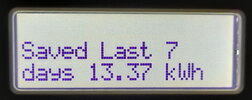
and after, this picture also shows the controller used, and how much I used in 7 days 1771514664379.png the advantage of the controller I am using is it shows how much I have used, I would not think an Iboost+ would help you, but it shows how much used. So standard tariff looking at £3.34 a week, with a split tariff, around £4.27 peak rate, and £1.14 off-peak so maximum saving is around £3.14 per week. It is unlikely your rates match mine of £0.085 and £0.32 per kWh, Eco7 tends not to give such a saving, I only have off-peak for 5 hours.

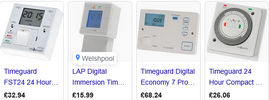
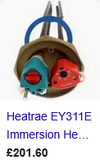
I agree if you have off-peak, you want to use it, but the figures you quote, makes me think something else is wrong. There is a whole range of timers 1771515575051.pngto show just some, but it may not need a timer, my home was never designed for an off-peak supply, So just a single immersion heater, I could get the dual model 1771515868266.pngbut for me it would not help. The
1771516069131.png
dual element was standard in the 1950's with a switch
1771516175017.png
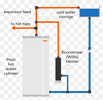
bath and sink, the Irish, I must take my hat off to them, worked out a far better way, 1771516303518.pngthe Willis system heats the cylinder from the top down, so the longer you run the immersion heater the more hot water you get, so you could if you so wanted, have a range of thermostats at diffrent hights and select how much DHW you want. The Willis system has been promoted for solar panel use of late, as it will give hot water with little or much sun, and store the extra when the sun shines, but the English and Welsh plumbers don't seem to be able to get their head around the system, seems the Irish are anything but tick.
 
.... the Irish, I must take my hat off to them, worked out a far better way, View attachment 408147the Willis system heats the cylinder from the top down, so the longer you run the immersion heater the more hot water you get ......
I think I must be dim, because I've always struggled to understand how the Willis system (as depicted in your diagram) can possibly work.

I cannot see why heated water from the Willis heater should travel downwards into the cylinder, which contains colder water. It will rise to the top of the column of water in the expansion/vent pipe, but I don't see why it should move downwards - and, since the connection to the taps comes off the expansion pipe below the connection to Willis heater, I would expect it to draw water (for the taps) from the colder water at the top of the cylinder.

What am I missing?
 
I assume it starts a flow, and the gate valve regulates the flow, but can't find the Willis website. I liked the idea, but I am not sure how it will work with varying output from the immersion heater? My immersion heater controller can run between 200 watts and 3000 watts, with pulsed DC, and I was not willing to take the plunge when I simply don't know how it would work.

I note there is a heat exchanger version for use with wet solar panels. There have been a few Irish inventions, 4 wheel drive cars with motorcycle engines, and the gyro-copter which I sat in the transport museum in Holywood Ulster Transport Museum a few times, it said there was an unrecoverable fault, which could cause them to fall out of the sky, but did not say what.

I was working in H&W for a time, and it was very interesting.
 
I cannot see why heated water from the Willis heater should travel downwards into the cylinder, which contains colder water. It will rise to the top of the column of water in the expansion/vent pipe, but I don't see why it should move downwards - and, since the connection to the taps comes off the expansion pipe below the connection to Willis heater, I would expect it to draw water (for the taps) from the colder water at the top of the cylinder.
The heated water will rise up through the heater via thermosyphon, as it does it draws cooler water from the bottom of the cylinder, heating the cylinder from the top down.

will.png
 
I assume it starts a flow, and the gate valve regulates the flow, but can't find the Willis website.
As I said, with a Willis system simply as shown in the diagram you posted, I cannot understand how heated water would/could ever get into the cylinder. Nor can I see how any valves could alter that. I find it hard to believe that anything other than a pump could force heated water(hence lower density) to travel downwards into/through cooler water, despite gravity and Mr Archimedes.

Maybe the system is significantly more complicated (perhaps including a pump) than your diagram (and most other diagrams one sees) suggests?
 
The heated water will rise up through the heater via thermosyphon, as it does it draws cooler water from the bottom of the cylinder, heating the cylinder from the top down.

View attachment 408200
I'm still pretty lost! ....

When all taps are closed, a small amount of water heated by the Willis heater will rise up into the expansion pipe, with the displaced cooler water moving downwards into the cylinder and/or the feed from the Willis heater. Since no water is being drawn, no water will be drawn from the bottom of the cylinder. So long as the taps remain closed, I cannot see why water at the top of the cylinder should get significantly heated - which would mean that there would be no significant heating of water in the cylinder whilst the taps remain closed.

When tap(s) are opened, water flowing to them will be a mixture of that from the top of the cylinder (which I would expect to be pretty cold, if taps had previously been closed) and from the Willis heater, the proportions via those two routes being determined by the relative resistances to flow in the two routes. What comes out of the taps would therefore seemingly be a mixture of heated water in the Willis heater (until it runs out) and of the (I would think cooler) water in the cylinder.

So, if it works (which I assume it must do), I must still be missing something.
 

If you need to find a tradesperson to get your job done, please try our local search below, or if you are doing it yourself you can find suppliers local to you.

Select the supplier or trade you require, enter your location to begin your search.


Are you a trade or supplier? You can create your listing free at DIYnot Local

 
Back
Top