
Rear discs, uneven wear pattern?

Joined
8 Jul 2008
Messages
1,477
Reaction score
121
Location
Derbyshire
Country
United Kingdom
I might need pads replacing on my C4 picasso, and i was inspecting the rear discs.

I noticed the wear line is different on one side vs the other. There is no issue with braking.

It looks like one side has a smaller brake pad? At first I thought it was positioning perhaps, but the inner wear line seems to be in the same position on both, but the outer diameter wear line is much thicker on one.

Does this likely mean that a new disc might be needed with it being such a thick band? I would assume there is a higher chance a fresh brake pad would make contact with it.
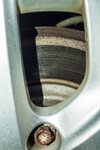
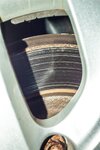
disc-2630.jpgdisc-2631.jpg
 
After taking asbestos out of pads they don't half eat in the metal disc causing groves..
Very often they change pads and discs because of this. Pads and discs are cheap enough to buy at around £80 for 4 wheels but unfortunately the labour rates have gone up crazy amounts.
 
Change the discs as well as the pads. Some cars are like that. Ford Fiestas and Focus's fronts for example, only seem to contact/wear the central third of the inner disc faces.
 
Change the discs as well as the pads. Some cars are like that. Ford Fiestas and Focus's fronts for example, only seem to contact/wear the central third of the inner disc faces.

Why would the wear be different on either side though? Just chance based on positioning angle etc. ?

It seems a large difference to be positioning, but I guess it could be just that.
 
Does this likely mean that a new disc might be needed with it being such a thick band? I would assume there is a higher chance a fresh brake pad would make contact with it.

My rear discs show much worse than that, around 1/3 wide strip, where there is no regular contact, and other owners report similar. My braking is especially light, most of the time, I have to occasionally deliberately brake hard, just to freshen up my braking surfaces. The light braking, means only light pressure is applied on the rear pads, and limited contact between pad and disc, to polish the dish.

For all of the years, I've owned the car, the same pads and discs have passed the MOT, without any issue.
 
My rear discs show much worse than that, around 1/3 wide strip, where there is no regular contact, and other owners report similar. My braking is especially light, most of the time, I have to occasionally deliberately brake hard, just to freshen up my braking surfaces. The light braking, means only light pressure is applied on the rear pads, and limited contact between pad and disc, to polish the dish.

For all of the years, I've owned the car, the same pads and discs have passed the MOT, without any issue.
But, I assume you would be in the same situation that when you finally did need to replace the pads, you would replace the disc too? But not due to disc thickness wear, it would be the ring of corrosion (unless you got the discs skimmed, which the cost of doing seems pointless).

In my case the pads are nearly worn out, but the disc, only has light thickness wear so I could conceivably keep using them, if it was not for that thicker ring of corrosion where the pads are not making contact.

My assumption being that just having new pads would likely mean they will get fouled on that ring of corrosion as I am unlikely to be able to seat them in the exact position the current pads are in.

I was just checking it was normal or common to have different wear patterns of corrosion, and what this meant for just pad replacement.
 
Spin the hub with a drill while you polish the rusty bit out with a flap wheel in the grinder if you don't like the look

Or just fit new pads and go about your life

The rears don't do so much anyway; ever harder braking notionally shifts weight to the front - if the rears participated hard there would be a risk of locking up and rapid loss of control. Some rear brake force is needed for stability, but you're overthinking this rusty section of disc
 
Last edited:
My assumption being that just having new pads would likely mean they will get fouled on that ring of corrosion as I am unlikely to be able to seat them in the exact position the current pads are in.

It's simply cosmetic, ignore it - providing the thickness of the disc meets minimum spec., and the pads likewise. If you replace the pads, they will quickly bed in to even a rusty disk, and the disk to the pads. Disk brakes are designed to accommodate heavy footed drivers. Light footed driver will find their discs rust in places, from lack of use. In an emergency, they will be no less effective.
 
Back
Top