All true, but if you want a place which is in daylight throughout the UK's hours of darkness, you're going to have to think about distances (hence losses and installation costs) , far, far greater than those. Even to find a place that was very windy when the UK was 'calm' could require some pretty large distances.It's much easier for us. ... North Africa to Spain is not far. ... Europe has interconnected grids. So does UK. Even GB is attached to Norway, France and RoI.

You are using an out of date browser. It may not display this or other websites correctly.
You should upgrade or use an alternative browser.
You should upgrade or use an alternative browser.
For a change, good news, price of electric being reduced.
- Thread starter ericmark
- Start date
Many are r*tards or fraudsters.Many consider it entirely feasible and desirable.

All true, but if you want a place which is in daylight throughout the UK's hours of darkness, you're going to have to think about distances (hence losses and installation costs) , far, far greater than those. Even to find a place that was very windy when the UK was 'calm' could require some pretty large distances.
The greens always forget the physics, and the costs involved!

- Joined
- 27 Jan 2008
- Messages
- 28,923
- Reaction score
- 3,540
- Location
- Llanfair Caereinion, Nr Welshpool
- Country

I seem to remember the river Seven and Solway Firth were considered as being far enough apart that tidal generation would work. But it was tried somewhere in France, and it seems the idea stinks literally, and they had to modify their idea and only generate in one direction as it needs the tide to clean the bay.Even to find a place that was very windy when the UK was 'calm' could require some pretty large distances.
The idea of pontoons with wind above and tidal below has also been considered.
I know my dad was in charge of a multi-fuel power station, part of the Shotton steel works, and it could use coal, coke, blast furnace gas, and coke oven gas, but steel making in Shotton has stopped.
Even on the Falklands, the diesel generators used the cooling water to heat the accommodation. There was at one time a British gas boiler with a sterling engine to use waste heat to produce electric, it seemed the problem was government rules, it did not slot into part L or something so was dropped.
The problem is time, be it a solar panel, wind farm or any other power station it takes time to get the investment back, and the government chop and change the rules too fast, so someone in good faith fits solar panels, and then 6 months latter they find they could have had them free with some government incentive, so their children say we are not doing it until we are paid to do it, as we are likely throwing away money. Plus the free panels are using inverters which don't include batteries, so the householder does not really see the benefit, and likely also too small, so they talk about how useless they are, and others are put off fitting panels.
We have seen the same with heat pumps, I have lived where they were the norm. The small window mounted units if they failed, it was just exchanged, and it heated and cooled, room by room, so rooms not used not heated or cooled, but the government grants stopped that type being used, and the type used got a bad name, mainly due to poor fitting, so people have said thanks but no thanks. The government meddling has done the reverse to what was intended.
Like the selling off or privatising of the electric industry, so we still have a government controlled sector of the electric industry but not our government but the French government.
Rant over.
- Joined
- 27 Jan 2008
- Messages
- 28,923
- Reaction score
- 3,540
- Location
- Llanfair Caereinion, Nr Welshpool
- Country
What is going on
 Jonathan Tracey YouTube video and my letter
 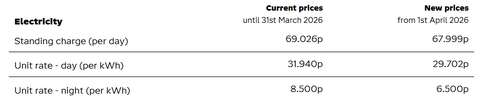 so his standing charge has gone up, mine has gone down. And he pays a lot less than me p/kWh.
OK I would love it if standing charge was got rid of, and the cost per kWh went up instead, but that is hardly fair, it means some one who can't fit solar panels is paying for the supply to my house, and that's not really fair.
so his standing charge has gone up, mine has gone down. And he pays a lot less than me p/kWh.OK I would love it if standing charge was got rid of, and the cost per kWh went up instead, but that is hardly fair, it means some one who can't fit solar panels is paying for the supply to my house, and that's not really fair.
Last edited:

It means some one who can't fit solar panels is paying for the supply to my house, and that's not really fair.
I agree, that was a defect in the overgenerous subsidies of solar panels in early days, which benefitted the owners of large houses with large roofs who also could afford to invest in an instsllation.
Almost as if the plan was intended to benefit the prosperous owners of large houses, with the subsidy coming from the poorer owners or tenants of smaller homes.
It started to become justifiable when the payment tariff dropped to the same as, or lower than, the retail price.
The payments seem to be on a downward trajectory now.
When owners get batteries and use all the power themselves, they will not need subsidies.
Like the selling off or privatising of the electric industry, so we still have a government controlled sector of the electric industry but not our government but the French government.
Yes, that invalidates the Thatcherite claim that selling off publicly owned assets below their value was in some way morally superior.
The same applies to our foreign-owned railways and foreign-owned sewage works.
I know my dad was in charge of a multi-fuel power station, part of the Shotton steel works, and it could use coal, coke, blast furnace gas, and coke oven gas, but steel making in Shotton has stopped.
I put an experimental scheme in, in the Black Mountains, Wales, where pumps ran on off-peak power, pumping water up to a reservoir, to then use the stored water during peak demand for water during the day.
- Joined
- 27 Jan 2008
- Messages
- 28,923
- Reaction score
- 3,540
- Location
- Llanfair Caereinion, Nr Welshpool
- Country
Dinorwig Power Station known locally as Electric Mountain, has done that for years, opened 1984. It was mainly to complement the nuclear power station, which was very show taking up and shedding load, at 1,800 MW it is still one of the world's largest batteries, at 9.1 GWh assuming it is not raining and refilling as being used.
There is another one in Scotland, sorry no details.
The question is who should do the storing? The supplier or the user?
The tariff structure is clearly designed to encourage the user to store energy. But some of the systems have been rather poor. I remember a set of council houses with a central storage room, and ducted hot air to each room, a colleague lived in one, and the central store would keep hot for a week, and with the fans off, very little heat seeped into the house. But the storage radiator never really worked, you could not switch them off. A 2220 watt storage radiator (1000 watt output) compliant with Lot 20, will hold 15.54 kWh reading the advert. So in theory should last 15.5 hours.
But what we want, is a unit that if we get a warm day, still has at least 10 kWh when the next charge period arrives, this simply is not the case.
So the bachelor/spinser pad, with the EV in the drive, if they go to work, not need to heat the house, if they don't, then use the cars battery to heat the house. Where it all goes wrong, is when two people live in the house, so one is using the car so other left to freeze.
So we see the home owner wanting Fiat Panda has a 44 kWh battery, so with 5 hours it needs 8.8 kW to recharge it, anyone see the problem here?
There is another one in Scotland, sorry no details.
The question is who should do the storing? The supplier or the user?
The tariff structure is clearly designed to encourage the user to store energy. But some of the systems have been rather poor. I remember a set of council houses with a central storage room, and ducted hot air to each room, a colleague lived in one, and the central store would keep hot for a week, and with the fans off, very little heat seeped into the house. But the storage radiator never really worked, you could not switch them off. A 2220 watt storage radiator (1000 watt output) compliant with Lot 20, will hold 15.54 kWh reading the advert. So in theory should last 15.5 hours.
But what we want, is a unit that if we get a warm day, still has at least 10 kWh when the next charge period arrives, this simply is not the case.
So the bachelor/spinser pad, with the EV in the drive, if they go to work, not need to heat the house, if they don't, then use the cars battery to heat the house. Where it all goes wrong, is when two people live in the house, so one is using the car so other left to freeze.
So we see the home owner wanting Fiat Panda has a 44 kWh battery, so with 5 hours it needs 8.8 kW to recharge it, anyone see the problem here?

Yes, much less windy today, hence far more reliance on CCGT - at the present time ...Today
Do you mean you always drive your car so it's empty every day?So we see the home owner wanting Fiat Panda has a 44 kWh battery, so with 5 hours it needs 8.8 kW to recharge it, anyone see the problem here?
Do you mean you always drive your car so it's empty every day?
What if you then find you need to make an unplanned use of it?
I would keep enough charge in it to be used for modest amount.
I rarely need to travel more than 50 miles unexpectedly.
If I ran my petrol car to empty, I would be aware that I'd need to call at a filling station.
I rarely need to travel more than 50 miles unexpectedly.
If I ran my petrol car to empty, I would be aware that I'd need to call at a filling station.

DIYnot Local
Staff member
If you need to find a tradesperson to get your job done, please try our local search below, or if you are doing it yourself you can find suppliers local to you.
Select the supplier or trade you require, enter your location to begin your search.
Please select a service and enter a location to continue...
Are you a trade or supplier? You can create your listing free at DIYnot Local
Similar threads

- Replies
- 4
- Views
- 326
- Replies
- 0
- Views
- 190