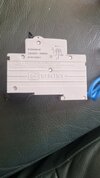
Bidirectional and data sheets.

Ask the manufacturers. However, if the data sheet doesn't state that it is bidirectional, I'd bet there's a 99.99% probability that it isn't!

MK bidirectionals have it printed on the body (and also on the box):

1000007655.jpg
 
Last edited:
As has been says, if the product does not claim to be "bidirectional", it almost certainly isn't intended to be.

However, I wonder if someone can help me understand? Despite a fair bit of trying, I haven't yet managed to work out what this "bidirectional" is all about. On the face of it, current (including L-N current differences) is current, regardless of which direction it is travelling. Furthermore, we know that a standard SP RCD or RCBO with zero current flowing through the L ('SP isolation') can, in the presence of an N-E fault, trip as a result of current flowing 'backwards' through the N from a load on another circuit.
 
Could it be something to do with how the electronics are powered?
Who knows?!

Once the device has tripped, there presumably is no need for the electronics to be powered so, given that the two sides are connected together prior to the trip, I can't see why it would matter 'which side' it was normally powered from?
 
I think it is where something is powered from the devices output so once it trips the supply is auto broken, so when used the other way around it remains powered up even after it has tripped.
Are you talking about a 'something' within the device (i.e. it's electronics)? If so, then see what I've just written to davelx.

We have on a good few times in the past discussed the fact that with 'traditional' RCDs/RCBOs, other than for a small potential issue if the Test button is kept pressed for an appreciable period of time, the device will work totally satisfactorily regardless of 'which way around' it is connected.
 
The original RCDs were pure mechanical, no electronics were used, but early RCDs had problems. Any slight distortion when torquing up the terminals could cause them to fail. The use of electronics has resulted in improvements, the early RCDs did include type S, but types AC, A, F, and B were unknown.

If I had found a data sheet dated 2010 I could expect there be reference to mono or bidirectional, but the data sheet was dated 11-12-2025 by which time there should have been a reference to if bidirectional or not.
 
The original RCDs were pure mechanical, no electronics were used, but early RCDs had problems. Any slight distortion when torquing up the terminals could cause them to fail. The use of electronics has resulted in improvements, the early RCDs did include type S, but types AC, A, F, and B were unknown.
All true, but not really relevant to this discussion.
If I had found a data sheet dated 2010 I could expect there be reference to mono or bidirectional, but the data sheet was dated 11-12-2025 by which time there should have been a reference to if bidirectional or not.
Perhaps, but I'm not convinced. If, at a certain point in time, one possible feature of a type of product is pretty rare, would you really expect the data sheets of all the others to indicate that they didn't have that particular (rare) feature?
 
Most of the data sheets I read are for electronic components rather than circuit production equipment, but my experiance is that data sheets almost never talk about features that a product *doesn't* have.
 
Most of the data sheets I read are for electronic components rather than circuit production equipment, but my experiance is that data sheets almost never talk about features that a product *doesn't* have.
Exactly.

I suppose eric would probably argue that, in this case, it's not just the absence of a "not bidirectional" statement (which I wouldn't expect to see) since there is a 'positive' statement which could be made ("unidirectional"). However, as I've implied, since the issue of directionality has historically not existed, I would think that people simply assume that any such product is 'how they have always been' unless there is some explicit statement to the contrary.

However, this is all just about documentation/'claims', and doesn't help me to understand what (in this context) 'bidirectional' actually means (technologically)! Do you have any ideas about that?
 
Hager , Garo and others state it in datasheet ,if bidirectional.

I can't find any mention in Schneider documentation which seems odd .
 
This whole 'bidirectional' effort is meaningless for the vast majority of circuits.

It's mostly hype shovelled up by the issue of Amd3 to BS7671:2018, which was touted as an 'emergency' amendment to add such things.

The main driver was the usual bandwagon companies slinging in PV and battery systems onto older installations with consumer units that were never designed for them, with such items being stuffed onto circuits with shared RCDs or poking RCBOs in there because the uneducated installation slingers were told that RCDs must be used for everything as they make everything safe and proper.
 
This whole 'bidirectional' effort is meaningless for the vast majority of circuits.
It's mostly hype shovelled up by the issue of Amd3 to BS7671:2018, which was touted as an 'emergency' amendment to add such things.
The main driver was the usual bandwagon companies slinging in PV and battery systems onto older installations with consumer units that were never designed for them, with such items being stuffed onto circuits with shared RCDs or poking RCBOs in there because the uneducated installation slingers were told that RCDs must be used for everything as they make everything safe and proper.
Thanks - that all sounds pretty credible.

So what, if anything, is the difference between a 'unidirectional' device and a 'bidirectional' one? ... and what, if any, problems are there in using a 'traditional' device with supply and load connections reversed (other than the small potential issue {which has always existed, since long before anyone had heard of PV} if the test button is 'held down' for appreciable periods)?
 
Thanks - that all sounds pretty credible.

So what, if anything, is the difference between a 'unidirectional' device and a 'bidirectional' one? ... and what, if any, problems are there in using a 'traditional' device with supply and load connections reversed (other than the small potential issue {which has always existed, since long before anyone had heard of PV} if the test button is 'held down' for appreciable periods)?
Unidirectional breaks the line pole supply side only.
Bidirectional presumably breaks the line pole top and bottom
Eliminates the TB problem and the issue of electronics staying powered via second supply on newer rcds.

Im not clear on how the electronics is affected on newer rcds .Seems to be part of trip mechanism that should be momentarily enerigized during tripping is somehow remaining energised longer via the 2nd supply

2nd question Im not sure what you mean.

The old EM rcds were unidirectional and as you say bring supply in the wrong end you’ve got the potential test button issue

Disclaimer; could be wrong on many points
 
Last edited:

If you need to find a tradesperson to get your job done, please try our local search below, or if you are doing it yourself you can find suppliers local to you.

Select the supplier or trade you require, enter your location to begin your search.


Are you a trade or supplier? You can create your listing free at DIYnot Local

 
Back
Top