
- Joined
- 22 Jan 2007
- Messages
- 24,260
- Reaction score
- 3,609
- Country

Is that technically possible though?, if there is never any export, that issue will never arise.

Is that technically possible though?, if there is never any export, that issue will never arise.

Yes, as the export is from that circuit to rest of house, not just export to the grid where there is a problem.Is that technically possible though?
It would be difficult, if not impossible, to ensure, 'technologically', that there would never be any export (not like DC, where one could simply put a diode in the incoming grid supply!). However, what I was suggesting is that, particularly in UK (climate-wise), these small bits of solar kit are probably unlikley to produce more electricity than is actually 'needed', such that there would be nothing 'left' to export.Is that technically possible though?... if there is never any export, that issue will never arise. ...
I'm wondering the opposite really, I think, the new product standard has yet yo be released. Could they be designed with a guarantee not to export.However, perhaps what you are implying, there could not be a guarantee that export wouldn't happen sometimes (sunny days with low electrical loads)
Have I not already given my answer (right or wrong) to that - which, in my post you're just quoted, said ...I'm wondering the opposite really, I think, the new product standard has yet yo be released. Could they be designed with a guarantee not to export.
I previously wrote "difficult or impossible" but, on reflection, think that it's probably impossible. As I see it, in order to be able to power any of the local loads (within the property), the output voltage of the inverter would have to be slightly higher than the grid voltage - and if that is the case, then at least some electricity (even if only a tiny amount) is, I think, bound to be exported.However, perhaps what you are implying, there could not be a guarantee that export wouldn't happen sometimes (sunny days with low electrical loads) ...
That will be interesting - since, as above, if you are correct it sounds as if they are talking about something which currently seems to me to be technologically impossibleBritish Gas, for one, seems to be implying this. I'll post a link in a bit, I'm on a train!

I said it before but my assumption was that new bidirectionals would be switching the line pole at both endsIndeed. Until very recently, I had always assumed that 'traditional' RCDs (without markings) were all 'unidirectional', and that 'bidirectional' was a relatively new-fangled concept which had arisen as a result of electricity export.
However, having just found a number of bog-standrad RCDs (RCCBs) on my shelves which are 20+ (quite possibly 25+) years old, which appear to be about as 'bidirectional' as they could be, I'm definitely coming to wonder whether there ever have been (at least, 'this century') any that were actually 'unilateral'.
Yes. Even with the additional switched contacts for the test button circuitry (which seems to be what is done to make a device 'bidirectional') there will still be a potential problem with 'lengthy presses of the test button) if (due to being faulty) the device fails to trip when it should - and it would require a fair bit of additional complexity to address that possibility. As I've suggested, it may be felt that since such a device is 'already faulty', and hopefully will be replaced since it did not respond to the test button, that this is not a issue to worry about?
Yes, but as I've said, if the device does trip when it is meant to, that is not a problem - since having the electronics permanently powered (for years/decades) is precisely what the devices are used to experiencing in-service.
A possible problem arises if (due to being faulty) the device fails to trip after the electronics has detected a residual current which should result in a trip (since it is not impossible that the electronics uses more current in that situation) -- but, as I have said (unless, I suppose, the devices became much more complex) I find it hard to see how that possibility could be addressed (just as with the 'test button problem'), even in a device said to be 'bidirectional'. If the device does trip when it should, then any residual current will vanish, so that the electronics should return to their 'normal' state (in which being continuously powered is not a problem).
It would, but I don't think that would be a very good (or necessary) way to achieve what is needed, since it would involve 'unnecessarily' having two sets of contacts in series in the main current path through the device (potentially carrying a high current).I said it before but my assumption was that new bidirectionals would be switching the line pole at both ends .... That disconnects the internals and the test button
Have I not already given my answer (right or wrong) to that - which, in my post you're just quoted, said ...
It was just a question, "could there be a guarantee", as in, could it be ensured that there would be no export (to the grid).However, perhaps what you are implying, there could not be a guarantee that export wouldn't happen sometimes (sunny days with low electrical loads)
Not explicit, but neither a simple yes either.That will be interesting - since, as above, if you are correct it sounds as if they are talking about something which currently seems to me to be technologically impossible

Sure - and as I have pointed out, I had previously written (and you had quoted) ...It was just a question, "could there be a guarantee", as in, could it be ensured that there would be no export (to the grid).
Is that not an answer (at least, my opinion of the answer) to your question?... there could not be a guarantee that export wouldn't happen sometimes ...
Thanks. I'll have a look when I have some moments and will then probably comment again. However, the little bit you've quoted seems to suggest that, at the least, they probably share my suspicion that export is not really a part of the thinking about these things - at least not initially?Not explicit, but neither a simple yes either.
View attachment 415902
Plug In Solar Panels Explained: What UK Households Need to Know
Plug in solar panels could be on sale in the UK within months. Learn how they work, new safety rules, potential savings and what the Government’s changes mean for homes.www.britishgas.co.uk
Fair enough, but the situation is obviously a bit more complicated/'unpleasant' with RCCBs, since (if one just 'plugs in' the PV kit) the RCD through which current from the PV inverter is flowing will also be protecting several other circuits.I'll start with RCBO first, this house has 14 RCBO's in the consumer unit ...
Sure, whether there are RCBOs or RCCBs, current from the PV will only flow through one device, the flow through all others be in the 'usual' direction (from supply towards load)... plug in solar would likely feed in through one RCBO and out through the other 13 RCBO's the feed in RCBO needs to be bidirectional as most of the daylight hours the current will be going in the reverse direction, even if not exporting to the grid.
As I've been writing to denso, is that ("NO export to grid") actually possible? As I understand Mr Kirchoff, current from the PV inverter can only flow ('backwards') through the one RCD connecting it to the CU's busbar if the output voltage is slightly greater than the voltage at he busbar, which in turn will be the grid voltage (as seen in installation). If the output of the inverter is at slightly above grid voltage then it is surely inevitable that at least some (even if very little) current will always be 'exported', isn't it (again, per Messrs Kirchoff & Ohm)?even if not exporting to the grid.
This seems to be introducing a new goalpost (iboost+), which I don't know much about, and I doubt will be any relevance to users of whatever 'plug-in solar' we may end up with in UK. I can but presume that what you describe is achieved by some fairly clever electronics controlling he immersion (or, indeed,battery charging). I don't know much about what goes on, 'control-wise' within the inverter but I would assume that (again, per Messrs Kirchoff and Ohm), for a given inverter output, the only way of controlling how much gets exported is to (usually manually) switch local loads on and off?As to export to the grid, my iboost+ and I am sure there are many other products, can detect export, but I want it to charge battery first, so I can set it to export 100 watt, 150 watt etc, before it starts to use the excess, with 6 kW a 100 watt is nothing but with only 800 watt, to switch in an immersion heater does seem a little pointless.
I've read it a few times.Is that not an answer (at least, my opinion of the answer) to your question?
I thought/think that you meant I was implying "there could not be a guarantee that export wouldn't happen", when I was just asking a question. I do understand your answer to the question though.However, perhaps what you are implying, there could not be a guarantee that export wouldn't happen sometimes (sunny days with low electrical loads) - but, as I said, 'they' might just possibly choose to 'overlook/ignore' that if they felt that the amount of export was likely to be 'negligible'.
Oh, that takes me back, there was another as well, but can't remember his name.Mr Kirchoff
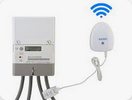 The way iboost+ monitors import/export could be used with solar inverters, so no need to open the CU, but
 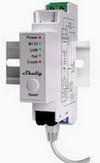 these seem to be the norm which need mounting in a box, the IHD (in home display)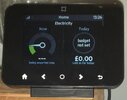
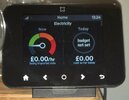 keeps flicking between the two screens, however, solar and battery is very different to just solar.
I think you now understand what I have been writing, which is what matters - but I'm still a bit confused!I've read it a few times. .... I thought/think that you meant I was implying "there could not be a guarantee that export wouldn't happen", when I was just asking a question. I do understand your answer to the question though.
 )
)Sure, it's obviously possible to measure the magnitude and 'direction' (import/export) of electricity moving between the grid and the installation- that's obviously how metering works!... The way iboost+ monitors import/export could be used with solar inverters, so no need to open the CU ....
True, but you can control whether or not any significant amount gets exported by switching on/off the local loads. As I've said before, it looks to me as if one can't avoid exporting some (even if only a very small amount), unless one disconnects either the grid or solar, since if they are both connected, if the voltage from solar is high enough to preferentially feed loads, then it will presumably also be high enough to export at least a little?With just solar, only thing which can happen to excess, is for it to be exported, there is no need to measure, as nothing you can do with it.
That's sort-of true - but, again, one may well be able to 'control' the situation (altering amount being exported) by switching on/off local loads as well, of course, by 'controlling' the battery charging.With solar and battery, measuring is essential, and the import/export line on the graph will be flat until battery either fully changed or discharged to the set limit.
I would need to look a bit to understand exactly what it is doing. Can the mains really (directly) 'feed the socket on the front' - or is it the case (as with a UPS) that the 'mains' (grid supply), when available, can (after conversion to DC) feed the inverter which, in turn, 'feeds the socket on the front'?... but with these <image> there is no back feed, the solar and mains can both feed the socket on the front of the unit, it is grid tied, but no way it can back feed, and legal today. It is basic an UPS unit with added solar.

If you need to find a tradesperson to get your job done, please try our local search below, or if you are doing it yourself you can find suppliers local to you.
Select the supplier or trade you require, enter your location to begin your search.
Are you a trade or supplier? You can create your listing free at DIYnot Local


