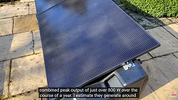
What is electrical equipment and what is an electrical installation?

I've always understood that anything wired in without a plug/socket is part of the installation, such as a cooker.
Indeed - and I imagine that a lot of people would agree with you.

However, what if it were something (oven, water heater, space heater etc.) possibly about 3kW, 'plugged in' to a socket? Would that 'plugging in' mean that the item was NOT part of the electrical installation (and would that remain the case even if the item were mechanically 'fixed' to the fabric of the building?
 
@JohnW2 I see your point, but I would say a built-in cooker and hob are installed, but a freestanding cooker, I would expect on moving house one would take it with you. So not installed even if hard-wired.

And a trouser press I have screwed to wall just to stop it falling over. Same with cupboards I have used brackets so they will not fall over rather than making them built in.

On the other hand, on moving I would not dream of taking my paving slabs to next house, and they are not fixed in any way.

But when it comes down to inspection and testing, or if a G98 needs completing, then we need some concrete instruction as to what is installation and what is equipment, at work we would agree as to who did what, in the main plugged in was PAT tested hard-wired would be done at same time as the EICR, but results entered in the equipment register.

This is all well and good in-house, but where an outside firm does the inspection and testing, not so easy.
 
@JohnW2 I see your point, but I would say a built-in cooker and hob are installed, but a freestanding cooker, I would expect on moving house one would take it with you. So not installed even if hard-wired.
I'm not sure that I necessarily agree with all that, since things like large/heavy cookers very often are not 'taken away' when people move house.

In any event, you are again making the mistake of assuming that the rules/regs/whatever we're discussing will necessarily have a basis in common sense ;)

Is one thing not fairly clear about this 'plug-in solar' business - that, unless they are totally daft, those making these rules/whatever will have to accept that if products are 'freely sold' with attached BS1363 plugs then (whether the inventors of the rules like it or not) they will be 'moved about' and may be plugged into any existing BS1363 socket - so they would hopefully have to satisfy themselves that the products they were 'authorising' would be reasonably 'safe' if used in that fashion?
 
Is one thing not fairly clear about this 'plug-in solar' business - that, unless they are totally daft, those making these rules/whatever will have to accept that if products are 'freely sold' with attached BS1363 plugs then (whether the inventors of the rules like it or not) they will be 'moved about' and may be plugged into any existing BS1363 socket - so they would hopefully have to satisfy themselves that the products they were 'authorising' would be reasonably 'safe' if used in that fashion?
Yep, in a nutshell that is the situation.

How folk tend to use stuff must be factored in to all designs and all rules/laws .
Even the most outrageous use of any item must be considered once it become clear that it is more than just a very few absolute nutters in a massive batch of sensisible folk using things in a certain way.

"Suicide Showers" and "Widow Maker" extensions spring to mind in some situations - the nearest I saw to any was a BT extension with a BT plug each end, thankfully but the principle still remains.

The two BT plugs each end was not as dangerous as something I saw by the same person - A "Builder" renovating bathroom tiles on a property his ex and his children lived.
I am convinced that the intention was not bad even though the situation was extremely dangerous.
Electric shower removed from wall to enable tile replacement - cables out of wall and open to touch. So he made it "safe" by disconnecting the shower at the pull switch - the "disconnection" was both the incomming and the outgoing reds into one switch terminal and the blacks into the other cable, he reckoned this kept the cables tidy and because the electric was now no longer "flowing thru the switch it was now safe", I was asked to investigate it when a child got a shock on touching the bare ends where the shower heater had been.
 
I've always understood that anything wired in without a plug/socket is part of the installation, such as a cooker.
Additionally I've always understood that anything fitted to a building with a plug/socket is part of the installation, such as under cupboard lighting.
 
I wonder what different people classify the term "Fixed Mains Wiring" as then ?
To me?

Sometimes a bit of common sense has to be applied... However generally speaking:
If it's fixed to the fabric of the building - it's fixed AND If it's permanently wired to the fixed wiring of the building - it's fixed.
 
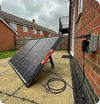
1782375738447.png Weighted down with containers filled with water, Not fixed. But this 1782376143488.png must be considered as installed. So the same kit depending on how used could be a portable appliance and installed. This 1782376314227.png is clearly not installed and likely to be exported to neighbours garden in the next high wind.

A kettle like this 1782376606497.pngI would call installed, even if plugged in. But on the other hand, it was clear the previous owners had a TV screwed to the wall, due to holes where the screws were, and my TV also held on the wall with a bracket, it would require a tool to remove it, but I would not consider it as installed. It was simply a method to ensure it would not fall over when balanced on small feet.

So my washing machines, tumble driers, dishwashers, cooker, fridge/freezers, freezers, all will likely not be moved until they fail, so are in real terms not different to the immersion heater.

But ask AI, and it says
An installation refers to the act of putting equipment, software, or machinery into position and making it ready to use. It also describes a formal ceremony, a specialized physical facility, or a specific genre of modern art.
so it seems even plugging in a kettle is to install it?

I know 1990s working on Sizewell 'B' there were mobile homes, and caravans, the main difference was a caravan could be legally towed behind a car, where the mobile homes were too wide, and had to be moved on the back of a wagon. Also, mobile homes had a 32 amp plug and socket and the caravan a 16 amp plug and socket (although on a 6 amp MCB) in real terms the mobile home would never move, as no mobile home site would allow one to site a second hand unit, so it was scrapped at end of life, and never moved site to site, so not really mobile. But nevertheless, they were plugged in.

After second world war, we had pre-fabs, designed to last 10 years, OK some still in existent today, but design was for temporary accommodation, so we have 1782378217265.png this where he is testing the idea, and is clearly not going to be left in place. video here and this is the problem, he is clearly not going to complete another G99 as after the test it will be dismantled.
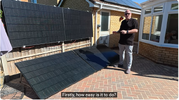
I think on-site guide, showed a whole load of plugs with double adaptors etc, and said there were insufficient sockets, but that could have been a whole load of cordless tools battery chargers plugged in when the house was being built, and may never again get used like that.

The picture shown earlier this
1782379026678.png
1782379132458.png
to me is a big problem. Both from the same site, OK plumbers not electrical, but not being able to close the lid on the socket is a clear problem.

And for someone to write an article on plug in solar showing this, to me is worrying. Plus it means not socket to plug in laptop 1782379425002.png clearly a demo, but also something one would not do, I will plug in a 3.8 amp car battery charger, with extension lead, the plug of the extension lead will allow the socket cover to be clicked closed, and the reel and charger are under the bonnet so if it should rain, they will not get wet. And that is something I will only leave for maybe a couple of days.

Why it shows an RCD plug I don't know.

 
To me?

Sometimes a bit of common sense has to be applied... However generally speaking:
If it's fixed to the fabric of the building - it's fixed AND If it's permanently wired to the fixed wiring of the building - it's fixed.
That might include a plug and socket approach being classified according to use. Does "fixed" need the intention to be permanent or mostly so for much of its useful life?
Like a lot of things in life we are bringing opinions into it, some people have slightly different interpretations so there is no fixed line, it moves sometimes one way or sometimes the other way.
We need to use common sense (or uncommon sense!).
Ask ten Electricians and get 11 different answers. :giggle:
 

If you need to find a tradesperson to get your job done, please try our local search below, or if you are doing it yourself you can find suppliers local to you.

Select the supplier or trade you require, enter your location to begin your search.


Are you a trade or supplier? You can create your listing free at DIYnot Local

 
Back
Top