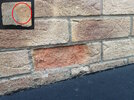
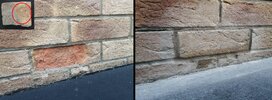
Spalled brick replacement under DPC.

Joined
22 Sep 2022
Messages
39
Reaction score
1
Country
United Kingdom
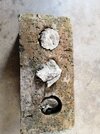
I have a spalled brick just below the DPC on a 20-year-old house. I can’t see any signs of water ingress in that area but have noticed how reddish the rest of the spalled brick is compared to a leftover brick with the face chipped off (inset pic). Possible faulty firing?

Regardless, should I approach replacing this brick with caution due to the DPC sitting on top? Any advice welcome.
 

Attachments

  • Brick.jpg
    Brick.jpg
    586.7 KB · Views: 30
Splashes bouncing up on brick maybe?
Replace brick.
Treat wall with something like storm dry to prevent further damage.

if like me you ain't well practiced cover surrounding bricks and new brick to keep clean with duck tape when you fit new brick
 
Splashes bouncing up on brick maybe?
Replace brick.
Treat wall with something like storm dry to prevent further damage.

if like me you ain't well practiced cover surrounding bricks and new brick to keep clean with duck tape when you fit new brick
It's a detached house and I can't find any other bricks on the same course (a few inches from the paths) with potential issues. Great idea about the duck tape ! I'll use that.
 
It's a detached house and I can't find any other bricks on the same course (a few inches from the paths) with potential issues. Great idea about the duck tape ! I'll use that.
It looks like it may have been struck to me as the two bricks below are damaged.
 
Hate to admit it, but I have to agree with noseall above...
 
It looks like it may have been struck to me as the two bricks below are damaged.
Hmmm, I did think that myself. If it had been struck, it would have been last year when a pallet of flooring was delivered and left in the exact same place ! Could it had caused the damage and then a year later, a slight tap has dislodged it? The brick is right on the pathway to the front door.

A further 4 metres along, the concrete footpath rises to meet the front door where it sits at the same level as the DPC over a 2 metre span. All 18 houses have been built the same, and none have any damp issues in that span. Although the path slope's away from the house, so when rain does bounce the slope causes it to bounce onto the driveway, not towards the house bricks. I keep meaning to cut a gap between the path and wall at that point and fit an ACO drain.
 
Find a replacement. Ideally an original from somewhere less visible. If not then you should be able to identify it and apply for a sample (usually free or very cheap). Look at LBC for starters, it looks like it may be one of theirs but not certain. But LBC don't provide samples now, they just send a photo out - so you'll need to find somewhere you can buy one, which may be tricky but possible.

Drill around the ends and beneath repeatedly with an 8mm masonry drill bit (stitch drilling). Drill diagonally to start to merge the holes. You may find the mortar's soft enough that you can drag the drill sideways to merge the holes together, if not use a bolster. Don't touch or go near the joint above it, make the brick fall downwards, away from the DPC.

Once you've got it out, scrape the edges clean. Then gently rub away from the underside of the DPC with a gloved hand. Wash it all out with water and a hand brush. Leave it damp, if you have a break at this point then dampen it again before carrying on. Not dripping wet, but not dry either.

Put a mortar bed beneath, fill the brick's frog if it's frogged. Press mortar against one end of the hole. Butter the other end of the brick, making the fillet narrower at the back edge than the front. Hold the brick up on a trowel, guide it in unbuttered end first, then turn in the buttered end. Align the brick. Use your trowel to gently push down on its top surface until it's at the right level.

Then feed in mortar to the top edge, using two trowels to slide small sausages in at a time.

 
Find a replacement. Ideally an original from somewhere less visible. If not then you should be able to identify it and apply for a sample (usually free or very cheap). Look at LBC for starters, it looks like it may be one of theirs but not certain. But LBC don't provide samples now, they just send a photo out - so you'll need to find somewhere you can buy one, which may be tricky but possible.

Drill around the ends and beneath repeatedly with an 8mm masonry drill bit (stitch drilling). Drill diagonally to start to merge the holes. You may find the mortar's soft enough that you can drag the drill sideways to merge the holes together, if not use a bolster. Don't touch or go near the joint above it, make the brick fall downwards, away from the DPC.

Once you've got it out, scrape the edges clean. Then gently rub away from the underside of the DPC with a gloved hand. Wash it all out with water and a hand brush. Leave it damp, if you have a break at this point then dampen it again before carrying on. Not dripping wet, but not dry either.

Put a mortar bed beneath, fill the brick's frog if it's frogged. Press mortar against one end of the hole. Butter the other end of the brick, making the fillet narrower at the back edge than the front. Hold the brick up on a trowel, guide it in unbuttered end first, then turn in the buttered end. Align the brick. Use your trowel to gently push down on its top surface until it's at the right level.

Then feed in mortar to the top edge, using two trowels to slide small sausages in at a time.
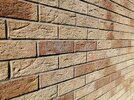
Thank you for that information. I really appreciate it :) I've tried to get these bricks before using brickfinder and other sites without much luck. They're perforated (3 holes), possibly a rustic multi buff / yellow ?. I have found two in decent condition that I can use to replace the damaged brick. But it would be handy to know what they are as I may have an extension built in the future.
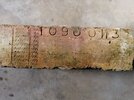
 

Attachments

  • Brickwork (5).jpg
    Brickwork (5).jpg
    449.1 KB · Views: 14
  • 01.jpeg
    01.jpeg
    872.8 KB · Views: 11
  • Brickwork (4).jpg
    Brickwork (4).jpg
    497.6 KB · Views: 14

If you need to find a tradesperson to get your job done, please try our local search below, or if you are doing it yourself you can find suppliers local to you.

Select the supplier or trade you require, enter your location to begin your search.


Are you a trade or supplier? You can create your listing free at DIYnot Local

 
Back
Top