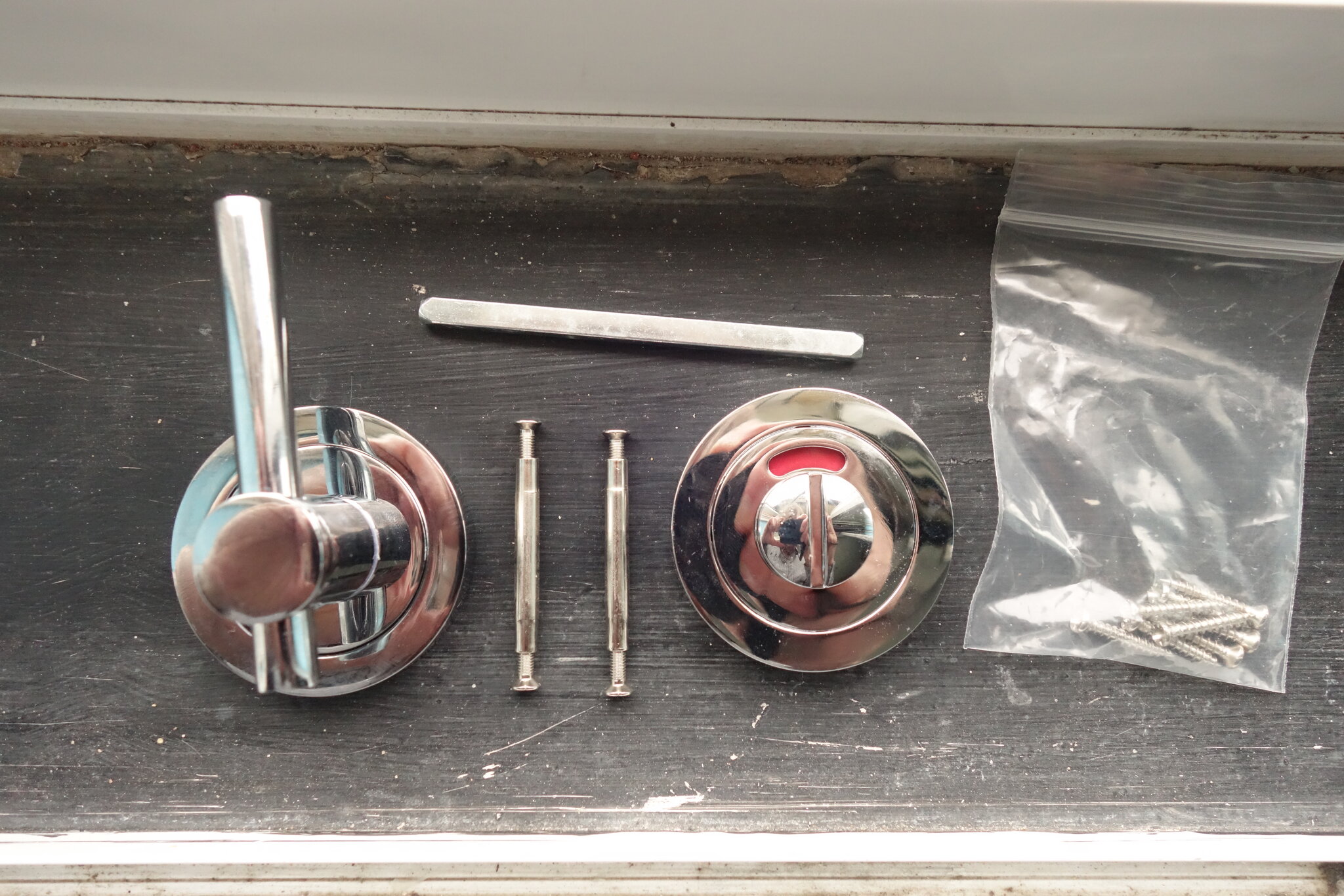
I posted a similar question a few weeks ago but this is a different set and a different unexpected component. The two items in the middle of the (not very good) picture are threaded tubes with a 3mm bolt, length 20mm, in each end. I don't think I need them but I would be happier if I knew why they were included.

You are using an out of date browser. It may not display this or other websites correctly.
You should upgrade or use an alternative browser.
You should upgrade or use an alternative browser.
Odd component in bathroom lock set
- Thread starter Calculus
- Start date
- Joined
- 25 Apr 2016
- Messages
- 2,958
- Reaction score
- 760
- Country

They are used when attaching the the door furniture to hollow doors as wood screws have very little to grip into.

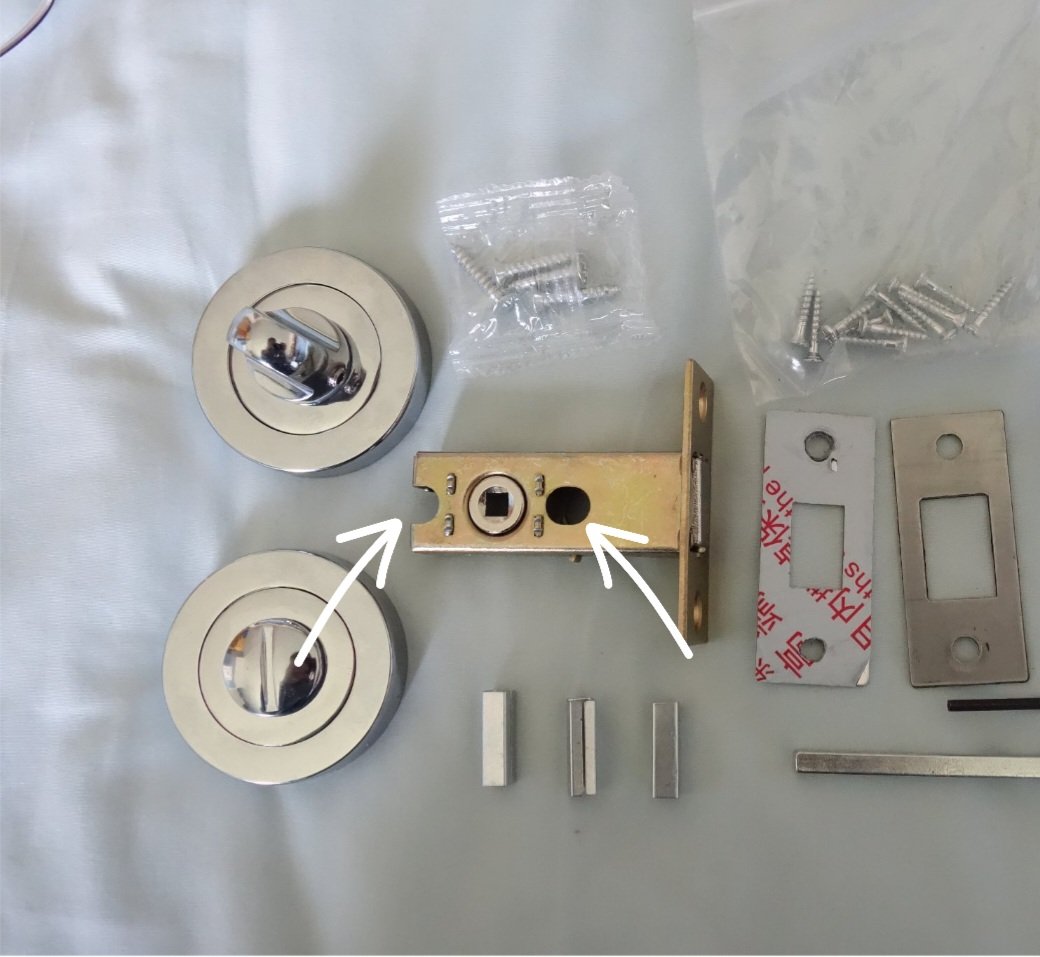
A picture from your other post, those 2 screws would fit through the latch and as Diver mentioned it's to stop the screws pulling out the door through constant use, they effectively clamp the 2 handles together sandwiching the door

That would make the door over 2” thick?Thanks everyone for solving the mystery. The door is a couple of inches of wood then a core of chipboard (not air) so wood screws will probably work.
No, only an inch to an inch and a quarter thick. When I say chipboard, that's what it looks like, peering down the mortice. I have to go back and dig out another 12mm because the people I'm doing the job for want the lock further from the edge of the door. I had used a 45mm offset deadbolt because that is what came with the handles. After some searching I have found a deadbolt with a 57mm offset which should meet the requirements.That would make the door over 2” thick?
Whenever fitting door furniture on doors where the standard screws are sufficient, I take "ownership" of the interconnecting screws.
When working with chipboard cores, I tend to use the interconnecting screws. The supplied standard screws are normally 3mm and pants quality.
When working with chipboard cores, I tend to use the interconnecting screws. The supplied standard screws are normally 3mm and pants quality.
You said it was a couple of inches of timber plus chipboard core.No, only an inch to an inch and a quarter thick. When I say chipboard, that's what it looks like, peering down the mortice. I have to go back and dig out another 12mm because the people I'm doing the job for want the lock further from the edge of the door. I had used a 45mm offset deadbolt because that is what came with the handles. After some searching I have found a deadbolt with a 57mm offset which should meet the requirements.

- Joined
- 22 Jan 2007
- Messages
- 24,241
- Reaction score
- 3,604
- Country
I think he means from the door edge in, not the door thickness.You said it was a couple of inches of timber plus chipboard core.
Correct. I've been using a 9mm width powerfile to cut out the mortice; still a hard job even with that.I think he means from the door edge in, not the door thickness.
Did you not drill the mortise?Correct. I've been using a 9mm width powerfile to cut out the mortice; still a hard job even with that.
I did not. The recommendation I got from Youtube was to drill a single large hole using a spade bit. Too hazardous for a non-carpenter. I did start drilling smaller holes but decided to go with a multitool with narrow blades (hard to get hold of now) plus hammer and chisel and the Makita 9mm powerfile. I'm thinking I should have stuck with drilling.Did you not drill the mortise?
If doing a few doors, I would recommend paying just over £100 for a Souber DBB door lock mortiser. Not only will it create the mortice it will cut the face plate rebate at the correct depth. It auto centres, you just set the depth/height etc- changing the milling heads as required. The only other tools you will need are a drill and chisel (to square the face plate rebate).
It is almost idiot proof. For 10 doors it works out to about a tenner per door but it will massively reduce the time per lock.
Downsides- they provide the 3 most common width of cutters but you may need to buy additional cutters. Drill specs, they recommend at least 2000-3000 RPM. That rules out most cordless drills. When I purchased my DBB, I tried using my old Metabo corded drill but found the drill body too long and heavy to handle. In the end I paid over £300 for a Metabo cordless drill which has a max 4000 RPM. Naturally, I use the cordless elsewhere though.
It is almost idiot proof. For 10 doors it works out to about a tenner per door but it will massively reduce the time per lock.
Downsides- they provide the 3 most common width of cutters but you may need to buy additional cutters. Drill specs, they recommend at least 2000-3000 RPM. That rules out most cordless drills. When I purchased my DBB, I tried using my old Metabo corded drill but found the drill body too long and heavy to handle. In the end I paid over £300 for a Metabo cordless drill which has a max 4000 RPM. Naturally, I use the cordless elsewhere though.
Impressive! But does it work for a tubular deadlock?If doing a few doors, I would recommend paying just over £100 for a Souber DBB door lock mortiser. Not only will it create the mortice it will cut the face plate rebate at the correct depth. It auto centres, you just set the depth/height etc- changing the milling heads as required. The only other tools you will need are a drill and chisel (to square the face plate rebate).
It is almost idiot proof. For 10 doors it works out to about a tenner per door but it will massively reduce the time per lock.
Downsides- they provide the 3 most common width of cutters but you may need to buy additional cutters. Drill specs, they recommend at least 2000-3000 RPM. That rules out most cordless drills. When I purchased my DBB, I tried using my old Metabo corded drill but found the drill body too long and heavy to handle. In the end I paid over £300 for a Metabo cordless drill which has a max 4000 RPM. Naturally, I use the cordless elsewhere though.

DIYnot Local
Staff member
If you need to find a tradesperson to get your job done, please try our local search below, or if you are doing it yourself you can find suppliers local to you.
Select the supplier or trade you require, enter your location to begin your search.
Please select a service and enter a location to continue...
Are you a trade or supplier? You can create your listing free at DIYnot Local
Similar threads

- Replies
- 17
- Views
- 31K
- Replies
- 3
- Views
- 2K

- Replies
- 1
- Views
- 1K