Protector-Plug Flymo

Joined
27 Jan 2008
Messages
29,321
Reaction score
3,606
Location
Llanfair Caereinion, Nr Welshpool
Country
United Kingdom
1787487879793.png

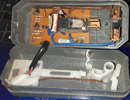
2. SWITCH ON. But can't find a switch, the light does flash, but 4. PLUG IN APPLIANCE. And the appliance is not powered, and the light continues to flash, I was going to test it, but one it is 30 mA so have no socket over 30 mA to test it with, two batteries flat in the tester, and three can't get it to turn on, so seems going in the bin.

Found when clearly out some old tools etc, and at first glance thought it was 10 mA, since 1990s all my sockets have been RCD protected, my dad it seems unlikely he would have used one, so likely father-in-law, the pin protector still on it, but seems it has seen some use.

Think I may have found it. Noted shutters open, sharp rap closed them, but still no power from it. Google takes me to Wellco RCD which is very different, temped to break it open to see if a switch on the shutters.
 
Hiya Eric = no sign of a test button?

What I might have been tempted to have tried is the old tried and tested "Bang Bang 240 Test" as we used to call it .
a 8200 ohm resistor of highest wattage to hand wired across L & E pins of a spare plugtop including a 1A fuse as a Go/No Go test.

Theoretically 240v/ 8200ohm = 29.27mA or 230v/8200 = 28.05mA might give an indication that approching 30mA likely to trip.

Usual Caveats apply of course.
 
Does this help
1787514238132.png
?

I helped a neighbour with one some years ago. I can't remember any detail now but it did go in the bin.

I had another type with a start button on the back which had to be pressed after powered but could only be reached when plugged into a reduced size extension socket which somewhat defeated the objective.
 
I remember one of those from the 1980s. I think it may have been one of the first mass-market affordable RCDs / ELCBs.
 
I have no intension of reassembling it. 1787526400638.png The white bits seem to also push on the top of relay as well as the contacts, and I am not sure how they interconnect with each other.

I can't test it as all sockets are RCD protected so likely the main ones would trip first.
 
I have no intension of reassembling it. View attachment 421029 The white bits seem to also push on the top of relay as well as the contacts, and I am not sure how they interconnect with each other.

I can't test it as all sockets are RCD protected so likely the main ones would trip first.
Oh yes, all coming back to me now, not fully rated for 13A :rolleyes:
It would have been mid to late 1980's and my neighbour had mowed his grass then tried using his welder...wah...wah...wah.
 
Well would a one in one out socket/plug need a fuse - some of those two way splitter type death cubes have no fuse.

The esy way to test it on an RCD socket is to get a plug and wire N on plug to both N & E on a test extenion type socket outlet and the L plug to L socket - sometimes known as and "up/down test socket, it simply means that both the N & E are derived from N only and the L is derived from L.
A sort of fake TNC-S into the tester socket if you think about it that way.

It`s the method I use to test my RCD testgear at home for my own personal calibration check because it will not trip the house RCDs only the RCD under test.

Just keep it under lock and key and clearly labelled "Danger DO NOT USE"
 
Well would a one in one out socket/plug need a fuse - some of those two way splitter type death cubes have no fuse.

The esy way to test it on an RCD socket is to get a plug and wire N on plug to both N & E on a test extenion type socket outlet and the L plug to L socket - sometimes known as and "up/down test socket, it simply means that both the N & E are derived from N only and the L is derived from L.
A sort of fake TNC-S into the tester socket if you think about it that way.

It`s the method I use to test my RCD testgear at home for my own personal calibration check because it will not trip the house RCDs only the RCD under test.

Just keep it under lock and key and clearly labelled "Danger DO NOT USE"
Do I read this correctly as introduce a N-E fault on an extension lead and expect it not to trip?

EDIT: Just read it properly, I see your test method.
 
The N at the socket is derived from N at the plugtop.
The E at the socket is derived from the N at the plugtop.
The L at the socket is derived from the L at the plugtop.

Therefore any fault at the socket is seen as a N L current at the extension plugtop only and will not trip the circuit RCD .
It will only trip any RCD that is wired into the extension socket.

To put it another way - take a bog standard extension lead complete with plug at one end and socket at the other - cut the plug off and wire the lead into a new plug (plugtop) both G/Y and Blue into N on the plugtop and Brown into Line at the plugtop.
The Earth at the plugtop has no connection.

Subsequently any appliance plugged in via this extension lead is not Earthed, it is Neutraled instead.

Not good in the home or office but OK for this restricted lead but OK for a test lead by a competant person if used correctly for testing purposes only.

PS - corrected just now, sorry,

PPS - and again now it`s a different day.

Result - no current on the Earth pin on the special extension lead, only L & N currents at that point, any current drawn between any terminals on the test extension socket will only be seen as current beteen L & N at the extension plugtop.
 
Last edited:
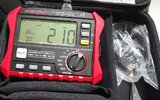
RCD tester ramp.jpg I simply turn the dial to one of the RCD test functions, plug it in and press the test button. But unfortunately found the batteries are flat, and I did not have a spare 8 x AA cells. (Nearly called them batteries)
 

If you need to find a tradesperson to get your job done, please try our local search below, or if you are doing it yourself you can find suppliers local to you.

Select the supplier or trade you require, enter your location to begin your search.


Are you a trade or supplier? You can create your listing free at DIYnot Local

 
Back
Top