
Splicing column rebar

Joined
17 May 2026
Messages
6
Reaction score
0
Country
Indonesia
Hi guys. I'm new here just looking for some help please. Hopefully asking in the right place. I'm english but building in Indonesia.
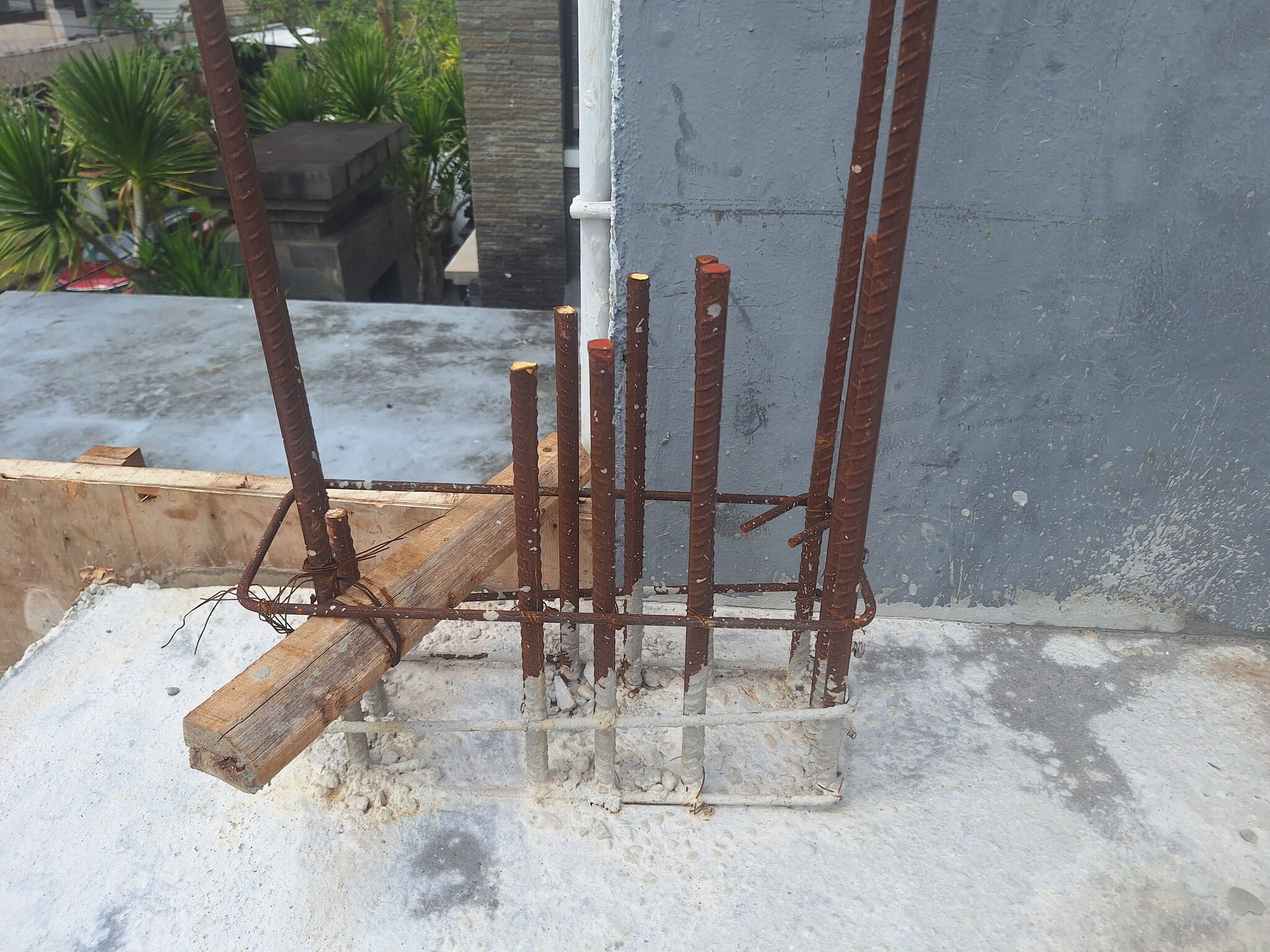
Our builders have messed up a bit on house build and left the rebar short for splicing to new column on one column. We have 12 columns and the rest are OK. 16mm rebar so really needs a minimum spliced overlap of 64cm + from my understanding. We are in Indonesia so there are no building code issues, just want to ensure structural integrity even if not perfect.
The column in question is only 2.5m from another major column and will only have to carry its share of the part flat, part pitched roof. It probably carries the least load hence it was designed slighty smaller with less steel than most of the other columns. The column is 20 x 50 cm with 12 x 16mm rebar. The four corner rebars are all about 1m long which is good but the other vary from 20-45cm. And the spacing has gone very uneven. I know we cant weld new ones as it makes the steel brittle. Was thinking maybe tie the short ones together in a spiral with 6mm wire? Also extra stirrups, stirrups 10cm spec but could do at say 7cm spacing instead where the splice is. Also placing a couple of additional vertical bars in the large spacing?
No haters please. This is a developing country, just looking for a realistic solution. TIA
1000025891.jpg
 
Rebar is extended via wire tying. The overlap depends on the bar diameter and other factors but it's normally around 500mm
 
Thanks but what i am saying is there isn't 500mm, thats the problem. I read overlap should actually be 40 to 50 x diameter depending on which source I was reading. So minimum 64cm. If you look at the photo all the rebar in the middle are short, one is only 20cm and the others range up to 45cm. Not much overlap. I was hoping the long corner bars would be a saving grace and maybe just strengthen the shorter bars with 6mm wire instead of the normal tying wire. Open to suggestions really
 
Thanks but what i am saying is there isn't 500mm, thats the problem. I read overlap should actually be 40 to 50 x diameter depending on which source I was reading. So minimum 64cm. If you look at the photo all the rebar in the middle are short, one is only 20cm and the others range up to 45cm. Not much overlap. I was hoping the long corner bars would be a saving grace and maybe just strengthen the shorter bars with 6mm wire instead of the normal tying wire. Open to suggestions really
Can you not drill and grout a (steel) dowel in?
 
I had thought about that as wouldn't be difficult, but that column is choca with rebar. 2 beams connect to it at 90 degrees. Each beam has 4 x 16mm top rebars with hooks, then 3 extra 16mm bars about 5cm below them for added shear resistance. Not going to be able to drill 18-20mm holes without hitting the steel and compromising integrity.
 
Well if you want to do it to UK standards then you'll need to drill the base. But then you really would need to check the rest of the build as there is no point in having one column to a better standard than all the other work.

Otherwise, check what the local standards are and see if that amount of overlap is acceptable. It may well be.

Strictly you need a local engineer's advice, as overlap is just one of several factors that influences design and failure risk.
 
Its not really about UK standards. All western standards would include a large safety margin. Exactly how much i dont know. Here in Indonesia there are no standards or codes we need to work to for permits. This is purely for my peace of mind. Most builders here never even use 16mm rebar, normally no 10 wire or 13mm rebar for larger builds, so our build is over engineered by local standards. But they've just messed up on this one column.
I guess what I'm asking other than solutions is someone with experience saying that realistically in the real world n 4 x 1m spliced 16mm rebars in corners, supported with 8 x 16mm albeit shorter bars should be more than strong enough.
 
Several points worthy of note;:

1. 40 diameters is the normal minimum for a tension lap but is generally adopted universally
2. Hot rolled high yield steel can be welded with a bit of care
3. Swage on couplings (like mahoosive cable crimps) are available
4. An ordinary masonry drill isn't going to cut existing steel

So: are all the bars designed for tension? Do they all need to be 16dia (they don't all look the same size to these aging mincers)? Is it high yield steel (probable) or deformed mild steel (possible)? What if anything does the builder propose to do?

Safest bet would be builder makes a proposal, your designer oks it and away you go.

Real world I'd go with welding: you can find stuff on line but basically a bit of preheat and IIRC from many years ago, low hydrogen rods.
You have a reasonable lap already so you don't need to build up full strength in the splice merely supplement.
 
Thanks thats helpful to know. To give you some specifics yes all the steel is the same, just bad photo probably sorry. All 16mm 420 grade rebar which is the best available here. There's 2 lower graded than that. Beams designed for tension with additional bars in centre bottom and top 1/4 into colums for added shear strength. Columns just a ring of rebar like normal. Its a case or poor execution rather than poor design.
With regard to welding, sounds like you are implying whilst it makes weaken the steel a bit the benifits of the stronger connection would outweigh that? Not easy to find a welder in Indonesia with specific welding gear and competency of different welding techniques. Normally its a guy in flip flops with a stick welder and no eye protection lol. So low hydrogen rods is probably mission impossible. I'll try to explore options on this though.
I prefer the swage coupling option and have already looked and only found 1 coupling supplier online but cannot find anyone selling the hydraulic machine to compress the couplings. There's just no demand for things like that here and its very hard to import things, even Aliexpress is banned.
Our builders say it'll be fine, but they would say that because they messed it up and dont have any consequences if it fails later. Builders here receive no qualifications or formal training and I trust myself more than them on structural issues but i'm no expert. They find reading and writing difficult to put it into perspective.
 
Might have found a solution thanks to Stevie888. I can buy low hydrogen welding sticks online and my builder says he can weld them. I know the welding process (presumably even lower hydrogen) will weaken the steel at least a little so was thinking just hedge my bets and weld half of the short ones alternately. I'll make sure we preheat the rebar before welding. I'll do some research on this but presumably involves a blow torch. Not sure how much to preheat the steel without researching it.
 

If you need to find a tradesperson to get your job done, please try our local search below, or if you are doing it yourself you can find suppliers local to you.

Select the supplier or trade you require, enter your location to begin your search.


Are you a trade or supplier? You can create your listing free at DIYnot Local

 
Back
Top