Bidirectional and data sheets.

Unidirectional breaks the line pole supply side only. ... Bidirectional presumably breaks the line pole top and bottom
Any RCD obvious must break the connection between the 'line pole' on the supply and load sides, regardless of where the break occurs, so you are presumably just talking about breaking of the supply to the electronics?
Eliminates the TB problem and the issue of electronics staying powered via second supply on newer rcds.
I don't see "the issue of electronics staying powered via second supply on newer rcds" (after device trips) being an issue other than in relation to the 'Test Button problem' - and even that only becomes a problem if (I would imagine rarely) someone keeps the test button depressed for an appreciable period of time.

As I've said, this potential "Test Button issue" has always been there if people wired RCDs 'upside down'. If manufacturers had regarded that as an appreciable problem,they could presumably have addressed it. For example, I imagine that they could have included a diode plus a high voltage zener in series with the 'test resistor' such as to reduce the power dissipated in the resistor to a low enough value for a sensibly sized resistor (that could cope with continuous pressing of the button) to be used. Perhaps better, even if slightly more complicated, I imagine that it would have been pretty trivial to arrange for pressing the test button (even if it were kept pressed) resulted in a test current only flowing for a very brief period of time (e.g. by triggering a 'non-retriggerable' monostable).

Even just a slow-acting fuse (maybe 'fusible link') in series with the resistor might well be considered to be adequate.
2nd question Im not sure what you mean.
It really goes with the first question. The first asked what was the difference between unidirectional and bidirectional devices, and the second asked why these differences were considered necessary (i.e. what they were meant to achieve).
The old EM rcds were unidirectional and as you say bring supply in the wrong end you’ve got the potential test button issue
Yes - but, as far as my current knowledge goes, that's about "it" - i.e. the only problem I can see is the (minor, maybe even 'trivial') potential 'Test Button Issue'. In particular, and most importantly, I do not yet see reason why the RCD functionality of a traditional ('unidirectional') should be affected by current travelling 'in the other direction'. If there is any 'safety issue', the only one I can think of is the theoretical 'fire risk' associated with the test resistor overheating if someone kept the button depressed for a fairly long time whilst there was a net export.
Disclaimer; could be wrong on many points
Hardly needs saying - exactly the same could be true of me - we are, I presume, both human :-)
 
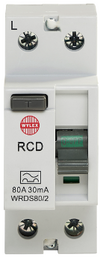
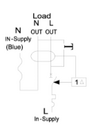
With the first raised problem with uni-directional we were told if it did not state load, input, or other on the RCD we could consider it as being bidirectional, so what is L? Is that load, line, or live? 1779027568645.pngSince in the main bus bars connect to the bottom I would assume it means line? I have seen boards with the RCDs either end, so the line would be on the other side, but since no earth connection, why would it matter which side is neutral, and which is line?

So 17th May 2026 so earlier to data sheet in question this Proteus data sheet says very clearly
1779028368641.png
so do we assume that Wylex is now a make to avoid? I see
1779028722799.png
the
1779028756723.png
to show bidirectional but looking at adverts for the RCBO I have fitted
1779029267160.png
the picture does not seem to show anything to show bidirectional, but adverts clearly say it is. I will assume the BD at the end of the part number shows bidirectional, it does say "After installation and testing of this product it is essential that the INSTRUCTION LEAFLET is available for reference" ups, I did not even notice a instruction leaflet came with it. But we will be called to many installations and need to know if bidirectional, we can't expect it to always be written on the device, or on the data sheet it seems. So is this a ploy to sell more consumer units?
 
Probably best to designate it to a Greek leter or three then we can all know what it is and the differences in definitions, hopefully theres still a Greek letter or two left for us to use in this situation.

Our Tutor on my first C&G Wiring Regs course course did comment that as Electricians we use Greek letters quite often. To enable us to charge more on our invoices - he might have been correct on that!
 
I don't see "the issue of electronics staying powered via second supply on newer rcds" (after device trips) being an issue other than in relation to the 'Test Button problem' - and even that only becomes a problem if (I would imagine rarely) someone keeps the test button depressed for an appreciable period of time.
The bit of google research i did suggested the 2 issues. 1 internal contact will disconnect TB and second supply anyhow if so.

As expected most of the videos etc. don't really explain it fully.
 
The bit of google research i did suggested the 2 issues. 1 internal contact will disconnect TB and second supply anyhow if so.
As I said, given the current (unsatisfactory!) state of my knowledge, I don't see any potential problem other than the Test Button one (which is arguably pretty 'trivial'). Given that the electronics are obviously happy to be powered continuously (for years/decades in some cases), I can't see why it makes a jot of difference whether they remain powered after the device has tripped (breaking main connection between 'in' and 'out').
 

If you need to find a tradesperson to get your job done, please try our local search below, or if you are doing it yourself you can find suppliers local to you.

Select the supplier or trade you require, enter your location to begin your search.


Are you a trade or supplier? You can create your listing free at DIYnot Local

 
Back
Top