Re-opening front reception room and dining room

Joined
20 May 2026
Messages
4
Reaction score
0
Country
United Kingdom
Hi all,

I’m new to the forum and do a bit of DIY around the house, but I’d appreciate a second opinion on this one.

I’m looking at re-opening what seems to be an old opening between the front reception room and the dining room in a Victorian house in London, built around 1890.

The house was originally an end-of-terrace, although other houses have since been built next to it. From what I can see, there was historically an opening between the two rooms which was later filled in. I don’t know when that was done.

I first thought about opening the wall up much more, but decided against it as that would probably mean steels/RSJs, Building Control, a lot more making good, etc. So the plan now is just to reinstate the old opening, not make it any wider.

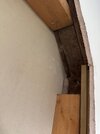
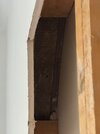
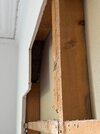
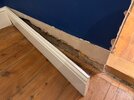
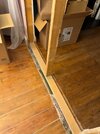
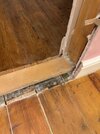
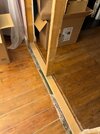
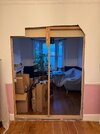
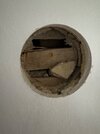
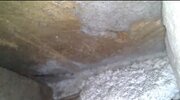
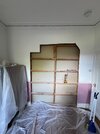
I’ve stripped back one side and removed some plasterboard. The later infill looks to be timber studs with plasterboard over it. Around it there are older timbers which look as if they may have formed the original opening. I haven’t opened up above the head, so I don’t know for sure what is above.

The newer central stud does not seem to be taking any load. At the top I can slide a piece of paper between it and the timber above, except possibly where there is a nail. So my guess is that the later timberwork was just put in to close the opening, rather than to support anything.

A couple of questions:

1. Would you remove all the newer studs/battens, including the ones at the sides, or would you leave the side studs in place and only remove the middle/horizontal bits?

2. The finished opening won’t have a door — just a simple opening between the two rooms. I’d like to avoid damaging too much of the existing plaster/plasterboard if possible. What would be the neatest way to finish the reveals and edges?

I will keep you posted with the progress.

Thanks in advance.
B
 

Attachments

  • IMG_8335.jpeg
    IMG_8335.jpeg
    627.6 KB · Views: 38
  • IMG_8336.jpeg
    IMG_8336.jpeg
    460.2 KB · Views: 37
  • IMG_8337.jpeg
    IMG_8337.jpeg
    610.2 KB · Views: 37
  • IMG_8338.jpeg
    IMG_8338.jpeg
    749.2 KB · Views: 38
I’m looking at re-opening what seems to be an old opening between the front reception room and the dining room in a Victorian house in London, built around 1890.

The house was originally an end-of-terrace, although other houses have since been built next to it. From what I can see, there was historically an opening between the two rooms which was later filled in. I don’t know when that was done.
Our first house was built in 1899 and that had at some time been converted to a through lounge using a couple of timbers bolted together to support the wall above and for the upstairs joists to rest on. I think that your 'opening' was, like ours, probably a 60’s thing when through lounges were the fashion that has since been filled back in using a stud wall rather than original bricks. I don't think they built houses with through lounges in the 1890’s.

I would start with removing all the stud work from yours, see what you have and work from there. There may be some brick piers left and they could just be plastered.

Our current 60’s built house was built with a through lounge from new. We closed that up and put French doors in between!
 
Last edited:
If in doubt, get a structural engineer in to check
 
Thanks for the replies.

That makes sense, and I agree it may well have been a later through-lounge alteration rather than something original to the 1890s house.

I don’t think I’ll remove all the studwork blindly, as I don’t want to risk disturbing anything that may be part of the existing structure and load bearing of the old opening.

My plan is only to remove the newer central studs, and possibly the newer side studs as well, as they do not bear the load.

For the side studs, I need to decide whether to keep or remove the newer ones depending on what gives the neatest finish for the reveals/edges, while leaving the older intacts. Do you think that removing the side studs might weaken the “historic” stud work? This would make the opening 10 cm larger but it might be better to leave them in place.

Thanks
 
How well do you know your neighbours?
Houses of that era tended to all have doors through the wall, and many owners blocked them up at some point or “modernised” it to form an arch.
Someone in your road likely still has the original set up and might let you see? Once you understand the original structure it will e easy,

My late brother’s house was originally built with three doors across the divide, you could pass through one, or fold all three back to make a through lounge. A previous occupant modernised it by adding an arch - likely a preformed metal gauze that is plastered.

When the house next door was being worked on, he tried to buy the doors only to be let down and searched for yonks.

I managed to buy some antique doors but he died before I managed to give them to him.

I would investigate exactly what you have before making any decisions.
 
I don’t know the neighbours that might have the original opening I will leave a note to ask them.

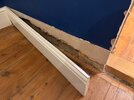
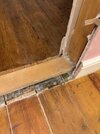
I opened up the wall between two rooms and could see that the wooden floor runs continuously from one room to the other. This suggests that either there has always been an opening there, or the floor is not original (which seems unlikely).

On one side, I can clearly see what appears to be the original wall, untouched.

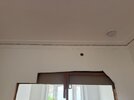
Would you recommend opening up the plasterboard above the current opening and installing a steel beam, just to be safe / sake of it or is it reasonable to assume that the original structure is still adequate? (The central stud does not seem to hold any load at the moment as I can pass some paper above it). I am not too keen on changing everything and potentially damaging the cornices.

From a design perspective, I am also undecided. I am considering either a rectangular opening, which is more traditional, or something more unusual, such as a hexagonal-style opening with the corners cut (it would make the opening larger). I am not particularly keen on arches. Has anyone come across this kind of hexagonal opening before?
 

Attachments

  • IMG_8368.jpeg
    IMG_8368.jpeg
    702.6 KB · Views: 12
  • IMG_8367.jpeg
    IMG_8367.jpeg
    800.6 KB · Views: 12
  • IMG_8366.jpeg
    IMG_8366.jpeg
    933.6 KB · Views: 12
  • IMG_8368.jpeg
    IMG_8368.jpeg
    702.6 KB · Views: 12
  • IMG_8366.jpeg
    IMG_8366.jpeg
    933.6 KB · Views: 12
  • IMG_8367.jpeg
    IMG_8367.jpeg
    800.6 KB · Views: 12
Can we see the top.?
Search houses for sale (and sold) for interior photos of houses in the area that may show the original or solutions.
Personally, I wouldn’t go with an angled corner?

Unless I am getting the wrong idea, adding a 45° corner makes the doorway narrower, not wider?
 
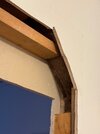
I’m considering this option because the original opening already has this shape, and I’d rather not alter the original header if I can avoid it.

One option would be to form a simple rectangular opening, but that would mean either making it narrower and higher, or wider but lower, compared with the original shape.

The other option would be to follow the existing shape more closely, with a sort of angled corner / chamfered opening rather than a pure rectangle. That would allow me to keep closer to the original opening and possibly achieve a wider opening between the two rooms.

The issue is that I’ve been looking online and I can’t really find examples of this being done. That makes me think it may not be a very common or recommended solution. Most examples I can find seem to be either a standard rectangular opening or an arch.

Has anyone seen this type of chamfered opening done before, and is there any reason it would be a bad idea structurally or visually?
 

Attachments

  • IMG_8408.jpeg
    IMG_8408.jpeg
    593.1 KB · Views: 9
  • IMG_8409.jpeg
    IMG_8409.jpeg
    668.9 KB · Views: 9
Your basic hole will be a rectangle 99% of the time. Anything you do to the corners is purely decorative.

We had one in one of our rentals that was like a keyhole: round at the top with dwarf walls each side. When I stripped that out the catnic that had been installed was a bit light on bearing so rather than a plaster job I fitted a lining made of 2x6 which beefed everything up nicely.
 
If the money is there, I would invest to do it properly. I.e. opening it as much as possible, but with brick support on either side. Then you are sure. My house has a very similar setup and the previous owners have done this. Makes a huge difference to make it as wide (but safe) as possible. If you have other structural plans for the house might be worthwhile to get a structural engineer in.

And also what other have suggested, go to rightmove sold houseprices for your postcode. Often it gives you an idea what the rest of the terrace looks like and how it may have been done for all the houses on your street. FWIW, I've never seen such chamfered openings in such a property, however I have seen 45degrees "noggins" between studs in my house close to doorways...

Also note, that if you do something that requires BC to check, you might need to consider firedoors if there currently is a kitchen connected to the rear reception room.
 
I would certainly open it up a bit more, you have nothing to lose, so long as you don’t remove the older timbers?
Leave anything greyish, remove the more yellow stuff and cut the PB back a bit.

I would be surprised if the whole wall was studwork.
It could have been lathe and plaster originally, or brick.
Are you sure that the angled timbers (even if grey) were originally there? They haven’t been added just to help with the newer studwork?
I suppose the original doorway could have had plaster corbels ?
 
I'd firstly remove the plasterboard to the ceiling above where you have already. That should visually tell you what or how the floor above is supported.
 

If you need to find a tradesperson to get your job done, please try our local search below, or if you are doing it yourself you can find suppliers local to you.

Select the supplier or trade you require, enter your location to begin your search.


Are you a trade or supplier? You can create your listing free at DIYnot Local

 
Back
Top