My apologies.apart from cost... t&e in conduit is half the price.
no GOOD reason not to use SWA.

My apologies.apart from cost... t&e in conduit is half the price.
Fair enough - but that's not what I asked. As you correctly quoted, I asked whether the UV resistance of what you use was greater than that of "standard white or grey sheathed T+E", not 'meter tails'.Nope it is exactly the same with the same product code on the drums as standard "meter tail" PVCYou say that DNOs do not use 'special PVC', but is it not more UV resistant than standard white or grey sheathed T+E? 'Ordinary' PVC


Westie is correct, I have seen some of the mural wiring. And it worries me. Like where the cables are run 6 inches below a thatched roof and supply three properties. These cables could be 40 years old.I suggest that some of you go and look at DNO mural wiring that is clipped to properties all over the country.
In the main it is PVC/PVC 16mm or 25mm meter tails.
Indeed. Actually, per current TLC prices (excl VAT) 16mm² 2-core SWA is £4.15 per metres, as compared with £3.91 for 16mm² T&E - a difference of 24p (28.8p incl VAT) per metre. Hence, by the time one has bought conduit (or whatever), using T&E would almost certainly be more expensive. Admittedly, one would also have to buy glands for the SWA (a few pounds) - and some would favour 3-core SWA (£5.64/m excl VAT, £6.77 incl VAT).16mm 2 core SWA is about £3.60 a metre, you aren't going to save much money messing around with T&e or tails in conduit, plastic pipe or clipped exposed.
I suspect that, in contrast with VIR, UV-exposed PVC/PVC cables (with UV protectors) do not usually present an appreciable immediate risk, even when disturbed. Whist the sheath may become brittle, and hence crack when disturbed, I would doubt that UV would penetrate through the sheath to the insulation, which therefore ought to remain in good condition (and hence not crack).Westie is correct, I have seen some of the mural wiring. And it worries me. Like where the cables are run 6 inches below a thatched roof and supply three properties. These cables could be 40 years old. ... I guess like old vulcanised rubber these cables are fine until disturbed. In about a years time they will have to be disturbed when the roof is re-thatched.
Fair enough. Probably for no good reason, I had always assumed that the black-sheathed (and maybe also brown-sheathed) cables had UV-protection, whereas grey/white-sheathed T+E didn't.Apologies John ... No not to my knowledge
Nor an installation difference - it will not be he making off the ends.Whatever, I really do not see how the OP can perceive a significant enough cost difference to persuade him not to use SWA.
Possibly - it would depend why.So, was I right to be a little concerned about this
Is that wise? If the sheath and insulation had become brittle, they might not crack and expose live conductors until they were handled - which could be a bit late to decide to put the gloves on!In that case as long as it has been visually inspected and shown to be OK there is no need to wear gloves. They only need wearing if live conductors (i.e. the actual metal) are exposed.
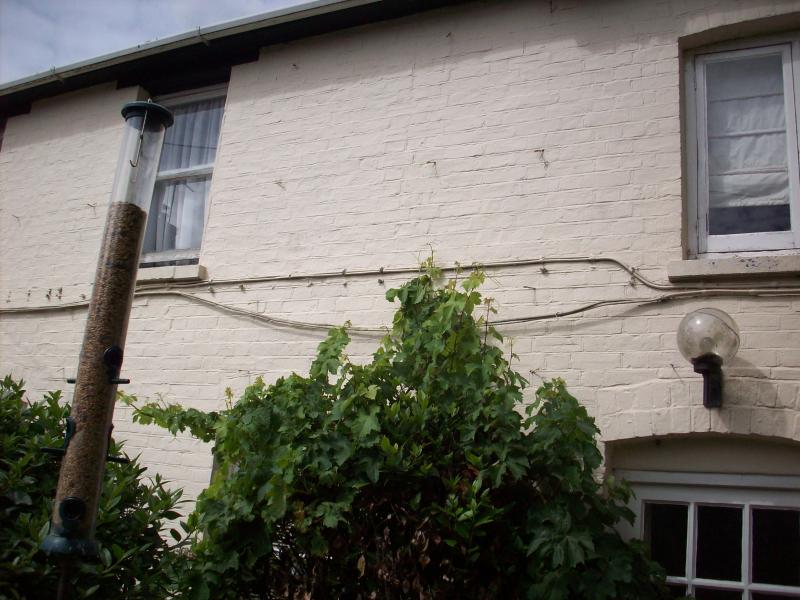
As I described in the original thread, my main concern was that the clips were progressively breaking and hence the length of the sagging portion gradually increasing (to the left in photo), and there were also many clips broken in the vertical portion of the cables which are not visible in the photo. It would only have taken a small number of further clips to break for the entire weight of a large sagging portion of the cables to be hanging off the connections to the (I think 'ABC') cable to the pole.Looking at the murals in the photo, at that distance it looks fine and is of no concern.
I've certainly seen evidence that the PVC sheath of ordinary (grey/white) T&E can become brittle if continuously exposed to sunlight for 20 or 30 years, but even that is not really a problem so long as the cable remains disturbed. As I wrote to bernard, I would doubt that the inner insulation would get affected by UV.So I do wonder what the huge fear of PVC used outdoors is, I've seen little evidence it deteriorates as some stress
See my recent response to westie.Possibly - it would depend why.So, was I right to be a little concerned about this
I agree - but, as I've said before it's my neighbour's wall, so I don't really have any say about it. I presume that the situation arose for historical reasons. Until about 1950, that house was part of what is now mine. I imagine that the supply then entered 'the property as a whole' close to where it arrived from the pole, hence no mural wiring. However, when the properties were split, there was a need to provide a separate supply to 'my' bit, which is, I imagine, when those mural cables (probably predecessors of the current ones) first appeared. A direct overhead run from the pole to my property would have gone partially over the neighbour's roof, and maybe that would not have been allowed?I would be concerned about the ghastly idea of cables clipped to the wall in the first place, irrespective of their type.
Is that wise? If the sheath and insulation had become brittle, they might not crack and expose live conductors until they were handled - which could be a bit late to decide to put the gloves on!
Interesting. The absence of incidents certainly suggests that these cables are not really a problem (as I said, I would not expect the inner insulation to be affected by UV - unless, of course, the sheathing were visibly absent!). I still wonder whether the sheathing is not perhaps more UV-resistant than you seem to believe.As the guys are trained it is up to them to asses the risks on each work site. Certainly there is no history of incidents occurring to staff in the way you describe, so that does suggest that as an industry we have the right approachIs that wise? If the sheath and insulation had become brittle, they might not crack and expose live conductors until they were handled - which could be a bit late to decide to put the gloves on!

If you need to find a tradesperson to get your job done, please try our local search below, or if you are doing it yourself you can find suppliers local to you.
Select the supplier or trade you require, enter your location to begin your search.
Are you a trade or supplier? You can create your listing free at DIYnot Local