3-phase supplies

Joined
6 Oct 2007
Messages
2
Reaction score
0
Location
Somerset
Country
United Kingdom
Just started a Part P course need to know the basic understanding of 3-phase supplies and information most welcome.

Ive a only just started didnt realise it would be this difficult to grasp, its knocked my confidence a little. :oops: :(
 
electricity is generated / supplied in 3 colours

this is called 3 phase.

each phase is 120 degrees apart from the next / last

between and 2 phases you get 415v

best not touch it
 
You will never really deal with 3 phase supplies when Notifying under Part P of The Building Regulations, but I suppose any basic understanding of electrical distribution is no bad thing.
Basically electricity is generated with tap-offs from the generator all 120 degrees apart (360 in a circle remember)
After distribution and transformation the voltage between each 'phase' is 400V (or thereabouts).This is the line voltage.The secondary winding is known wired in star formation at the local transformer.The centre point of the transformer is where the neutral is formed (and the earth as they are one and the same here)
The voltage between one phase and neutral is 230v (or thereabouts).Domestic supplies use one phase and neutral but houses are shared out between different phases and the neutral.

Hope this helps.
 
To really get to grips with three phase power you need to understand phasor diagrams. (That's phasOR, not phasER which is a Federation issue directed energy weapon!) Did you ever do graphs at school? Did you ever do polar coordinates? Draw a point in the middle of a piece of paper to mark your origin then draw a line out to the right with an arrow on the end. That line represents a single phase. It's length is proportional to voltage and you have to imagine that the thing is spinning around the origin fifty times per second. By convention it is spinning anticlockwise.

Now draw two more lines of equal length out from your origin but at two different angles, namely 120° clockwise and 120° anticlockwise. You should now be looking at three lines, all the same length and equally spaced angle-wise around the origin. Their ends are your three phases - you can mark them red, yellow and blue if you like - and the origin is neutral. They are all spinning around 50 times per second but the angles between them remain fixed.

The clever thing about phasors is that they can be added and subtracted like vectors. If you have 240 volts between each phase and neutral, the length of each phasor represents this voltage. To find the voltage between any two phases, measure the length between the phasor ends (or calculate it if you can do trigonometry) and you'll get about 415 Volts. Moreover, the angle of that line you just drew gives you its phase angle relative to the others.

Now let's put equal loads on each phase. The three currents can also be drawn as a phasor diagram. Now for the really clever bit. What's the current in the neutral wire? To work this out you have to add the three phasors as vectors. (The voltage between two phases was the difference of the two phasors.) To find their vector sum You redraw them with the same lengths and angles but head to tail. If you do this you will find that you have a complete triangle; their vector sum is zero. And that's the current in the neutral wire; zero. Now try this with three unequal currents. The angles are the same but the lengths are different. This time they won't add up to zero so you will have some neutral current.

The absence of neutral current when the loads are balanced saves a lot of copper. With three phases working together you can get as much power from A to B using half as much copper as you would need for three single phases because you can remove the three neutrals. Three phase power has other advantages too. Motors deliver smoother torque and generators present a smoother load to their turbines. With clever use of transformers you can get another nine phase angles. Full wave rectified three phase power is almost DC. I could go on but I think you've got enough to get your head around for one day.
 
Like this

100_0711.jpg


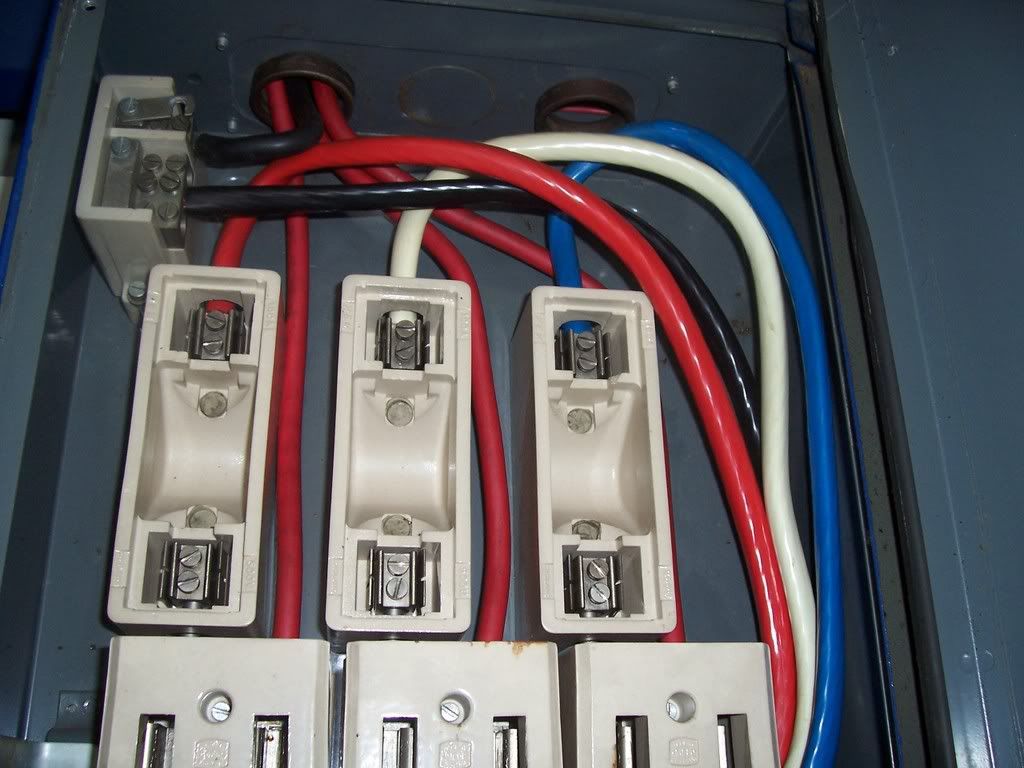
Although I've spent nearly 20 years with R,Y,B the new colours are growing on me :D
 

If you need to find a tradesperson to get your job done, please try our local search below, or if you are doing it yourself you can find suppliers local to you.

Select the supplier or trade you require, enter your location to begin your search.


Are you a trade or supplier? You can create your listing free at DIYnot Local

 
Back
Top