80A PME Fuse

Joined
18 Nov 2008
Messages
1,943
Reaction score
348
Location
Surrey
Country
United Kingdom
Fellow DIY NOT people

We're thinking of going fully electric car wise sometime in the future, we currently have an 80A fuse on a PME supply.

Today we had our faulty Smart meter replaced by Octopus Energy, the chap even fitted a Dual pole Isolator! He mentioned to my wife we should contact the DNO to get this upgraded to 100A Fuse if we're looking to do that.

Three Bed Semi. Gas Combi boiler for two showers. Two Ring Finals - Sockets up & Down, One for kitchen, plus one radial for some down sockets. We do have a Garden Room fed from a separate Board via a Henley block and also another board for two brick sheds.

Thoughts on whether a 100A DNO fuse is required & Electric car too? After all most of any charging will take place at night with minimal power apart from freezers and a few bits & bobs with minimal consumption.
 
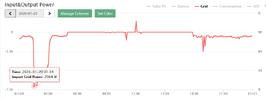
I am sure, like me, you know what you are using when. 1768953692670.png So I know I use 7 kW overnight on a regular basis. So I know I would be using 60 amps on a regular basis, so would be a bit risky for me.

However, when my son got an EV from Octopus, he had no options as to the fitting of the charging module, the installers had strict instructions as what they could do, and unless you do not want to use the offer of 6p/kWh when all done by Octopus, then you don't have an option, you have to just stand back and let them do as they want.
 
We're thinking of going fully electric car wise sometime in the future, we currently have an 80A fuse on a PME supply. .... He mentioned to my wife we should contact the DNO to get this upgraded to 100A Fuse if we're looking to do that. .... Thoughts on whether a 100A DNO fuse is required & Electric car too?
There's obviously no electrical downside to upgrading to a 100A fuse/supply, so it really comes down to whether there are any significant financial issues. I imagine it varies between DNOs, but it seems with mine ("National Grid") that, provided their supply has adequate capacity and one's installation has 25mm² tails, they will usually upgrade to 100A for little or no charge. One can but ask!
 
Last edited:
I can’t see the point. 80 A is more than enough as long as your sheds aren’t used for growing things all year
 
If your cooking and heating are all gas then 80A is plenty. Even if you have an electric cooker and shower I suspect 80A will still be fine in most cases. If you start getting into electic for space heating then things could get tighter.

If you are worried about load, and the DNO won't upgrade the supply, many EV chargers nowadays have a grid limit feature, so they will reduce/stop charging if there is too much other load.
 
Some DNOs won't supply more than 80A any more, I've read. No harm in asking them though.

My DNO has a form: https://www.ukpowernetworks.co.uk/i-already-have-electricity-domestic/adding-more-power/fuse-upgrade
Check out what your DNO site says.

All modern smart EVSEs have house load monitoring and the ability to limit the car charging current (it's part of the Industry / Govt spec to do that among other things).

DNO will need notifying when fitting a EVSE anyways.

SpeakEV is a useful forum, although the resident EVSE electrical installation expert flounced off in a huff due to the site owners use of an AI bot.

EDIT Don't forget that the days of super cheap overnight EV charging seem numbered. Prices are rising and hours being restricted.
 
Some DNOs won't supply more than 80A any more, I've read. No harm in asking them though.
There appears to be a lot of variation between DNOs (and probably not too much consistency within DNOs!) - so, as I wrote, one needs to 'ask'.

Not too long ago, I inherited a share of a house which, at the time, had an electric shower and electric cooking, and we were considering the possibility of having EV charging installed at some point, and it transpired that the installation had a 60A fuse at that time. Since that felt a bit marginal, I spoke to the DNO (SSE) about an upgrade. They said that (for whatever reason!) they no longer 'upgrade to 80A', but agreed that we could probably do with more than 60A and said that they would be happy to upgrade to 100A, at no charge, if we wished.
All modern smart EVSEs have house load monitoring and the ability to limit the car charging current (it's part of the Industry / Govt spec to do that among other things).
That's true - but if the supply is 'small enough' and/or other loads 'large enough', that could result in EV charging taking longer than one would like.
 
I spoke to the DNO (SSE) about an upgrade. They said that (for whatever reason!) they no longer 'upgrade to 80A', but agreed that we could probably do with more than 60A and said that they would be happy to upgrade to 100A, at no charge, if we wished.
Not all rules always make sense every time - Sailor Vee Del Boy
 
Not all rules always make sense every time - Sailor Vee Del Boy
Quite so -and, as I've said, there often seems to be inconsistency within DNOs (just as between BCOs!) - I've certainly heard of, and actually experienced, situations in which two or more people from the same DNO have said different and contradictory things - so it's not just as simple as 'rules' (which presumably are the same for everyone!)
 
I am sure the reason I have 60 amps, is historic, my fuse box had a 60 amp main switch, I have seen a CU where the total of the MCB's on one RCD exceeds the value of the RCD but does not exceed the value of DNO fuse, so OK, but if lifting the value of the DNO fuse means the RCD is too small, they should refuse.

I see there is a move to 3 phase, not sure how that works, as can't get a 3 phase consumer unit, or one rated over 125 amps, if they did, then simply not a consumer unit. So, not sure today what is allowed? Never found the regulation saying must use a consumer unit in a domestic install where the distribution unit can be accesses by an ordinary person. The problem is 7 kW x 5 = 35 kWh, but many EV units are over that size.

This is the problem with an EV, if you travel too few or too many miles the cost per mile sores, they give you the range, but not the range on 5 hours charge, which matters. So either static battery so you can draw more than 7 kW on off-peak, or three-phase.

But the vehicle charge point normally has a CT so will turn down charge rate if it is likely to exceed value of DNO fuse, so can't really see a problem.
 
That's true - but if the supply is 'small enough' and/or other loads 'large enough', that could result in EV charging taking longer than one would like.
I think, realistically this is only likely to be an issue if the property relies on electricity for space heating *and* has a 60A fuse. Loads like cookers, showers and white goods just don't draw power for long enough to have a meaningful impact on EV charging.
 

If you need to find a tradesperson to get your job done, please try our local search below, or if you are doing it yourself you can find suppliers local to you.

Select the supplier or trade you require, enter your location to begin your search.


Are you a trade or supplier? You can create your listing free at DIYnot Local

 
Back
Top