ABS waste branch in walls?

  • Thread starter Thread starter NotSureAboutDIY
  • Start date Start date
OK back to my question :-)

the pipe is ABS marked en 1455 its 40mm waste pipe solvent welded.
its got a requirement to run a short distance (<1m) flush in an interior breeze block cavity wall.

Whats the advice on burying it good bad ugly, what would you use to bury it in etc....
 
You can't chase it into the wall, the wall will fall down (maybe).

If it's a kitchen run it behind the appliances.
 
It will weaken the structure on the building, building control would not be happy, but what the heck chop it out and cover it up quick, the building is unlikely to fall down as a result.
 
so the original 32mm copper waste that runs for over 1.5m is installed inncorrectly?
what as a hypothetical now that we're saying its unsound practice should you infill around ABS pipe with (would brick mortar be OK) obviously any larger infill would need to be with hard stuff...
 
Get a bag of "carlite" bonding. :roll: from your builders merchant
 
out of curiosity, if chasing waste into a wall is against building regs (Ive seen it done many times in older properties) what do you plumbers do these days?
especially in kitchens around washing machines...

cheers for the tip on "carlite bonding" now called "thistle bonding" its a type of plaster according to the www?
 
What size ABS waste pipe would you like DIA?
Cheaper than uPVC. Can't use it outside unless it's painted, but you can solvent weld it unlike polypropylene.

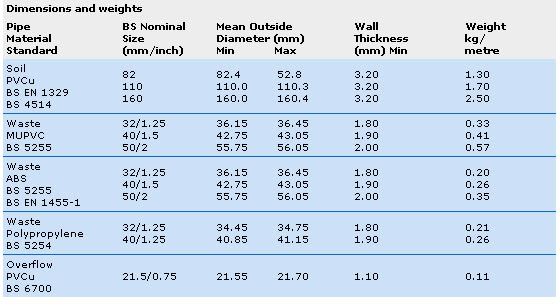
Waste-pipes.jpg


And if you want to show off that you can use google to find what it stands for, get the spelling right!

The thermal coefficient of expansion, at 70 - 90 x 10^-6, is something like ten times a metal's. If you chuck a pan of boiling water down the sink a 1 meter length would grow by about half a centimeter, which will pop your lightweight, exfoliated vermiculite( :wink: ) plaster off the wall nicely, unless you give it plenty of room. Or it'll break the joints, and you'll have a leak inside the wall, nice.
 
ChrisR said:
What size ABS waste pipe would you like DIA?
Cheaper than uPVC. Can't use it outside unless it's painted, but you can solvent weld it unlike polypropylene.

Waste-pipes.jpg


And if you want to show off that you can use google to find what it stands for, get the spelling right!

The thermal coefficient of expansion, at 70 - 90 x 10^-6, is something like ten times a metal's. If you chuck a pan of boiling water down the sink a 1 meter length would grow by about half a centimeter, which will pop your lightweight, exfoliated vermiculite( :wink: ) plaster off the wall nicely, unless you give it plenty of room. Or it'll break the joints, and you'll have a leak inside the wall, nice.

Cheers for this chrisR, thermal expansion of plastics is a very very good point. I had considered that a bit, I would have a 2m run before the waste pipe enters the wall so I would assume very high temperature water from the sink will have lost some of its energy to the rest of the run, but I'll have a good look at your chart to see if I need to re think.
At the point where the washing machine waste enters the pipe I would be careful to leave a suitable gap for expansion as Im sure washing machine waste can be rather hot.

Thanks again, as I say Im interested in what plumbers do these days to tuck (kitchen sink/washing machine) waste pipes away....
 
I would assume very high temperature water from the sink will have lost some of its energy to the rest of the run
If you check the sums you'll see I have made an allowance for that. Don't forget it'll be quite a good insulator, so where will the heat be lost to?
 
ChrisR said:
I would assume very high temperature water from the sink will have lost some of its energy to the rest of the run
If you check the sums you'll see I have made an allowance for that. Don't forget it'll be quite a good insulator, so where will the heat be lost to?

well going back to basic physics, if its a great insulator then it wouldnt tend to take on the heat of the water as it runs through and therefore wouldnt expand as suggested unless I ran boiling hot water through my waste continuously, which is why Im more concerned about the section where my washing machine is fitted as opposed to the sink.

Expansion only occurs with heat (energy) transfer, heat transfer would suggest that energy has passed from the heat source (water) - to the pipe work, i.e. the temperature of the water must have dropped!

as I say there must be a standard work around that most people use these days Id be interested to hear what plumbers are suggesting for waste, are they just telling people to put appliances next to the stack? If not whats the prefered methods of running waste?
 
I find it odd that no one has a standard practice answer for consealing waste pipes in kitchens.
 
I find it odd that no one has a standard practice answer for consealing waste pipes in kitchens.
One has - they are concealed by being boxed-in, or run behind cupboards.

You're confusing heat capacity and conductivity. The pipe will heat up quickly, but the energy will not conduct through it very well so the water, and the whole pipe length, gets pretty hot.
 
ChrisR said:
I find it odd that no one has a standard practice answer for consealing waste pipes in kitchens.
One has - they are concealed by being boxed-in, or run behind cupboards.

You're confusing heat capacity and conductivity. The pipe will heat up quickly, but the energy will not conduct through it very well so the water, and the whole pipe length, gets pretty hot.

OK but I dont think I'm mixing those up.

I'd say the act of the pipe getting hot is the energy transfer (i.e. pipe gets hot, water gets cooler - which would involve capacity but we dont need to get into it because)

whilst ABS does expand at a far greater rate than copper (per degree that it is raised in temperature) due to its much higher co efficent of expansion,
it has a far lower thermal conductivity (usually denoted as K) which means it takes a longer time than copper to raise its temperature the same amount.


http://www.3d-cam.com/materials/abs_molded.asp
gives the thermal conductivity of ABS
0.888-1.32

http://en.wikipedia.org/wiki/Thermal_conductivity
gives the thermal conductivity of copper
385 - 401

I believe its a ratio so although they use different units it should be OK to compare.
this to me says that it takes over 10 times the sustained exposure to the same temperature gradient for ABS to raise it the same amount in temperature as copper.

In other words to get my ABS up to 70degrees C
I'd really really have to go for it.

Whilst heat capacity and the pipeworks ability to store heat may be relevant for how long the pipe work stays at an expanded level, surely if expansion is given per degree, its purely thermal conductivity and time of heat gradient exposure we'd be interestead in. Actually what with the flow of water and the change from surrounded by air vs in wall its the sort of engineering problem Ive not looked at since I was in uni and reminds me why I left :-)

Cheers for the info ChrisR, Im suprised about the answer boxing or cupboards, but can see the advantage of being able to get to and inspect the waste system, still it must ruin many a kitchen design...[/b]
 
its the sort of engineering problem Ive not looked at since I was in uni and reminds me why I left
its the sort of engineering problem I have looked at since I was in uni
and can do the little bit of calculus to work it out if I need to.

I've also watched plastic plumbing pipes I've installed grow when you put a kettle of water through them and measured the temperature profile along the length of the exterior, and of the water coming out of the end.

Give it room, or regret not doing so!
 
Point taken Chris, however there are a lot of plastic pipes on the market that are marked ABS when in fact they are PP.

The polypipe and Hep in the link for example are both pp and not abs as stated
 

If you need to find a tradesperson to get your job done, please try our local search below, or if you are doing it yourself you can find suppliers local to you.

Select the supplier or trade you require, enter your location to begin your search.


Are you a trade or supplier? You can create your listing free at DIYnot Local

 
Back
Top