
- Joined
- 7 Sep 2025
- Messages
- 305
- Reaction score
- 18
- Country

but what temprature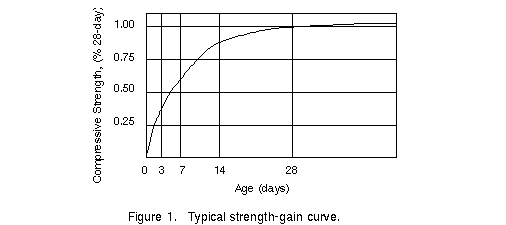
After 2 days you could probably still scratch into it with a stick.

but what temprature
After 2 days you could probably still scratch into it with a stick.

Dunno. Off t'internet somewhere.
If there's no urgency then give it a couple of weeks. There are tower blocks that have fallen down where the builders have removed formwork and supports too soon.
I don't think there's too much difference with modern cement. I concreted a patch this year, I could rub the surface off with my boot a few days later.
Do you think the amount of water will make any differance?Modern cements are finer ground than in times of yore. This means that in a given volume of concrete there are a greater number of particles of cement which are therefore closer together. The setting process is the growth of dendrites (finger like structures) which interlock binding the mass together so the smaller gaps mean that the dendrrites interlock sooner.
Hard to tell because ballast can be bone dry or soaking wet.Do you think the amount of water will make any differance?
Yes. Simplictically more water = less strength.Do you think the amount of water will make any differance?

Before I tell you that's nonsense, I'd like you to define "stronger"Less water = stronger mix.

Workability - yes. As said, too much water encourages 'dusting', when it lies on the surface. Unless you are building the Hoover dam, don't worry too much about strength, as long as you mix the product well and are no weaker than 6:1.Do you think the amount of water will make any differance?
are they doing it on weight or volume?Hard to tell because ballast can be bone dry or soaking wet.
Interestingly in winter you tend to get less in your bulk bag than in the summer…..you are paying for water in the winter months
I know some one that made the mix dry and relied on rain waterYes. Simplictically more water = less strength.
The hydration process needs about 20% of the weight of cement any water above this makes the mix more fluid but has to go somewhere. Some of it will rise to the surface dragging cement particles with it leaving a soft dust surface (bleeding) and some will just form water pockets weakening the finished product.
Or run off the top if you'd finished it properly.I know some one that made the mix dry and relied on rain water
I have done one drum the other day, came back after the heavey rain and there was no rain water sittig on the top so must of gone straight though
I wouldn'tI know some one that made the mix dry and relied on rain water

If you need to find a tradesperson to get your job done, please try our local search below, or if you are doing it yourself you can find suppliers local to you.
Select the supplier or trade you require, enter your location to begin your search.
Are you a trade or supplier? You can create your listing free at DIYnot Local


