
Battery location, seems where mine are is no longer allowed?

Joined
27 Jan 2008
Messages
29,713
Reaction score
3,679
Location
Llanfair Caereinion, Nr Welshpool
Country
United Kingdom
I stopped them being fitted in the loft, and they were instead fitted next to the kitchen to outside door in the flat, under main house, where above is a veranda so not directly below the house, but they fall foul of the 1 meter rule to door or window.

I like the idea they are not under main house, to move them further into the house seems wrong, just spent a lot of time and energy making outside into a patio, so to move outside would mean at least 3 meters maybe 4 meters, and it would need a building to put them in, clearly not wooden, so looking at a lot of expense.

It seems existing can remain, but we had intended to up the size from 6.4 kWh to possibly double that size, this was always our plan, they come in 3.2 kWh blocks.

So it seems, we can't upgrade any more to a larger battery. Without a massive expense at least, so we are stuck with 6.4 kWh.

For the British Summer Time part of the year they are ample, it is the UTC part of the year which presents a problem. From sun set to off-peak is too long.

In the main it is not too much of a problem, it means paying 30p/kWh from between 3 pm and half past midnight on bad solar days, on good days we still make it to off-peak start.

However it means these 1792673999590.pngmay now have some use to extend the time batteries last for?
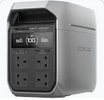
But how to use, are these under the same rules as static batteries? The ideal place would be outside the front kitchen window, to power the freezers, but although my son says he will pass on the old copy of BS 7671, the rules are in the new one, so where can a portable battery be placed?
 
1792696641899.png

I would need to make a unit to take batteries, and lift the slabs to thread cables, making the move rather a big thing.

So the question is how these rules effect a portable battery? My thoughts are if I run the three freezers from a portable battery, this will remove enough load to make existing batteries last out the evening in winter, and would be available in summer to take with me to recharge e-bikes etc.
 
Last edited:
Is there a legal definition of "portable"?

I'm just thinking of the fact that for planning purposes, that as well as some pretty large maximum dimensions, "mobile homes" only have to be capable of being moved. That you might need a huge crane, a multi-wheel low loader and road closures to actually move one is of no relevance.

So if a "portable" battery only has to have the capability of being moved by a fork-lift....
 
Is there a legal definition of "portable"?
Not quite, but in the main under 18 kg or on wheels. So the concrete batching plant I worked on, although it needed 22 tractor units to move it, since it had wheels, was portable, try PAT testing them for £2 each?

But without wheels, 18 kg is really the limit, and clearly can't screw them to floor or wall.
 
Do you have a modular system? In that case you might be able to get away with it. I've looked at this when I expanded my battery capacity and I am glad I did this some time ago and not now. My system was installed (in loft) even before the current rules were just a guidance. My MCS does not mention the batteries, so a long as you don't need a qualified spark to rewire anything you might be OK as it would not be deemed to be a change to the system. Well, at least not something that can be evidenced, if your MCS does not specify how many modules / battery capacity you have installed.

It's a shame they could not come up with another way. Basically all terraced houses in big cities are now are excluded, and it was already difficult to start with due to lack of roof space+orientation.
 
But without wheels, 18 kg is really the limit,

Well - where does that come from? Wiring Regs no good - no matter how small and light it is a solar battery could never be Mobile Equipment.

HSE guidelines could allow 25kg.

23kg is a common limit for airline checked-in suitcases, but some allow 30kg. I've lugged a 30kg case - not something I'd willingly do again, but it was do-able.

Does something portable have to be able to be ported by one person?

When solar batteries are delivered, how do they get from the truck to wherever they are installed?


and clearly can't screw them to floor or wall.

I can't see why something portable cannot be restrained whilst in use. If it's outside, call it an anti-theft measure.
 
Last edited:
so a long as you don't need a qualified spark
Slight problem there, I can't claim no qualified spark when I hold a degree.
@morqthana does make some good points, and yes ask AI and it says
⚡ Electrical Equipment (PAT Testing)

In the UK and Europe, electrical safety regulations for Portable Appliance Testing (PAT) class an item as portable if it is under 18 kg (approx. 40 lbs) and can be easily moved while in use or from one place to another (e.g., a toaster, kettle, or microwave).
But as you say, the coal man would carry 110 lbs in every sack.
 
⚡ Electrical Equipment (PAT Testing)

In the UK and Europe, electrical safety regulations for Portable Appliance Testing (PAT) class an item as portable if it is under 18 kg (approx. 40 lbs) and can be easily moved while in use or from one place to another (e.g., a toaster, kettle, or microwave).

Mobile equipment (portable equipment (deprecated)). Electrical equipment which is moved while in operation or
which can easily be moved from one place to another while connected to the supply.

And no mention of weight limits, or, for the first part of the definition, how many people have to be needed, whether lifting is involved, whether powered assistance is allowed, in fact no reference to ease whatsoever.
 

If you need to find a tradesperson to get your job done, please try our local search below, or if you are doing it yourself you can find suppliers local to you.

Select the supplier or trade you require, enter your location to begin your search.


Are you a trade or supplier? You can create your listing free at DIYnot Local

 
Back
Top