• Looking for a smarter way to manage your heating this winter? We’ve been testing the new Aqara Radiator Thermostat W600 to see how quiet, accurate and easy it is to use around the home. Click here read our review.

CH Energy Requirements Estimate

Joined
28 Jan 2011
Messages
60,892
Reaction score
4,685
Location
Buckinghamshire
Country
United Kingdom
I’m currently trying to renovate a long-neglected house that I have inherited.

It’s late Victorian (about 130 years old), a large 3-storey mid-terraced house, with a total floor area of about 1,200 ft² (about 110 m²). Other than for the pitched roof, it’s poorly insulated, with solid 9” brick external walls, single-glazed wooden-framed windows and a suspended wooden ground floor.

It currently has no heating system, so I’ve started thinking about what would be required (in ball-park terms), initially by doing some very rough ‘back of a fag packet’ calculations of the amount of heat energy required (initially just for ‘space heating’).

To do that, I’ve attempted to produce an estimate of the heat energy that would be required to maintain all of the rooms at about 22 ⁰C above outside temp, with halls/landings about 17 ⁰C above outside temp and assuming that the adjacent (terraced) properties would have inside temps around 3 ⁰C lower than in my house.

Those calculations suggest a total heat energy requirement (for space heating alone) of around 11 kW, with even the largest room (about 183 ft², 17 m², with one outside wall and a sizeable window) requiring less than 1.5 kW.

These estimates seemed surprisingly low to me, but I suppose I am not very used to seeing figures for a terraced house - all the rooms in the house concerned have at most one outside wall (albeit usually with a sizeable single-glazed window), with the other walls all being party walls or interior walls, will little or no assumed temp difference across them.

So, my question is whether the figures I’ve arrived at sound reasonably credible for this terraced house (or whether I need to re-visit my calculations for possible ‘flaws’ :-) ) ?

Kind Regards, John
 
1. What basis / method have you used for your calculations?
2. Have you made adjustments for initial warm up from cold and air changes?
3. How have you calculated the thermal conductivity of the walls, windows doors, ceilings, floors?
 
Oh, what a tangled web you weave. The question is all about recovery time. To maintain the temperature is very different to the time it takes to re-heat after heating has been turned off.

With a non-efficient home, we have to consider re-heating time after we have been to work. With the use of programmable TRV heads, we can select which room is heated first. So selecting kitchen, then dinning, then living and finally bedrooms we can reduce the boiler size.

So the "the thermal conductivity of the walls, windows doors, ceilings, floors" is not really an issue, it is how fast one can reheat rooms.

The whole idea of geofencing is dependent on speed, and to be frank with my home, too slow.

Last house had in living room a 3 kW fan assisted radiator, a 4 kW standard radiator and a 4 kW gas fire, so recovery time was down to 20 minutes for main room. This house we are looking at hours not minutes to reheat rooms.
 
1. What basis / method have you used for your calculations?
2. Have you made adjustments for initial warm up from cold and air changes?
3. How have you calculated the thermal conductivity of the walls, windows doors, ceilings, floors?
Thanks for your interest. As I said, I was, at this stage, only trying to achieve a very rough ball-park figure, to assist in thinking/planning about the various options there are to be considered. In answer to your specific questions:

1... Basic Physics
2... My calculations included provision for air changes, but nothing specifically ion relation to 'warm-up-time.
3... By utilising published data for U-values of the various structural elements concerned.

However, as I said, I am not seeking to get accurate figures at this time - I was just seeking reassurance (or the opposite) that my estimnates were credible for a terraced house, since they seemed low in relation to the figures for deteched and semi-detached houses I am much more uswed to seeing.

Kind Regards, John
 
Oh, what a tangled web you weave. The question is all about recovery time. To maintain the temperature is very different to the time it takes to re-heat after heating has been turned off. ....With a non-efficient home, we have to consider re-heating time after we have been to work.
That's all theoretically true, but I think there is a limit to how far one should sensibly go down that route of thinking. If one want's very rapid warm-up ('from cold') one will end up with a seriously over-powered system, both in terms of numbers of radiators and the size/capacity of the heat source. If one does feel the need for very rapid warm-up, then it's probably better to achieve that with brief use of something like fan heaters whilst a more modest heating system was 'getting up to speed'.

Having said that, the need for 'warm up' is not usually that excessive, even in a house which is only modestly (or even poorly) insulated house (like mine). In my house, we do not heat anything 'overnight' but the indoor temp in the morning rarely gets below about 16-17 °C, even when the outdoor temp is 'sub-zero'.
 
In the main, you may need larger radiators, but not really the boiler, as one can heat in sequence.
This is all pretty tangential to the question I asked (and to which I would welcome replies) but ....

..... I am personally far less concerned about 'heating up' and 'warm up time' than you (and others) seem to be.

For a start, as I've said, the amount of 'warming up' required after a period of say 8-10 hours without heating is,, at least in my experience, less than you seem to be implying. Secondly, loss of heat to outside of the building, and heating of the fabric of the building, are processes which take appreciable time, whereas heating air is much quicker., Those other 'usages of heat' are therefore less important during the period of initial heating of air within the room/building - so that initial heating of air happens more rapidly than one might expect.

What does rather surprise me is the number of people who seem to heat their domestic residences as if they were 'hotels', with ever room in the house being heated to some desired temp (often controlled by 'simple'/dumb TRVs) whenever 'the heating is on', whereas in reality they may well rarely need more than 2 or 3 rooms heated at any one time.

I accept that it is an unusual situation but, as a fairly extreme example, if I were to take that approach in my seriously-oversized house, it would rapidly 'break the bank' in terms of running costs,. I have the 'simple' (dumb) TRVs on radiators, but the rooms are split into 6 zones, controlled by motorised valves, and it is relative rare for us to need more than one zone 'on' at a time (other than for very brief 'overlap' periods) In these days of 'gadget obsession', I presume that the same could be achieved (at much greater capital cost) by having 'smart' TRVs on each of the radiators.
 
If you google "what size boiler do I need" the calculator tables seem to show similar results to yours.
 
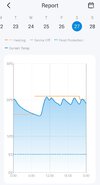
For me, with a non condensing, non modulating oil boiler, it does not matter if I use on/off zone valves (digital), or up/down TRV's (anagoge), the boiler will switch on/off, so the temperature will always form a sine wave. Report full day.jpgAs one can see from the TRV report. I also turn off heating at night, and you can see how the temperature has dropped during the early hours. If I had a gas modulating boiler, then I would have a far smoother day temperature.

The whole idea with a modulating boiler is to slowly open or close the water supply to each radiator and for the boiler to match the demand. However, unless the TRV's are linked, there is a problem, the boiler will never shut off. So we fit a thermostat in a room on a lower floor, as heat rises, in a room kept cool, as on a fine day the heating will turn off, with no outside doors of course, and also no alternative heating, of my 14 heated areas, non-fit the requirements as the sample room for the wall thermostat.

So as with most homes we go for a compromise, and in my case it has failed, it worked A1 with late mother's house, we had a TRV and wall thermostat in the hall, and when front door opened the TRV would open and ensure rapid reheating, and as the temperature set was approached it would close slightly before the wall thermostat temperature was reached, unless on a warm day. So the boiler modulated as it was designed to do. However, it is not the heating which is the problem, it is the cooling.

My hall cools too slowly, so the living room got cold before the wall thermostat in the hall reactivated, I say "got" in past tense, as we have fitted new double glazing, so this may not now be the case. But the type of boiler does not help, if the boiler modulated then it may have still worked?

If there is still a problem, I will fit a second thermostat in parallel to ensure the boiler runs if living room cool. I was conned, the TRV said it worked with my Nest thermostat, it seems when Google took over Nest it stopped working with Energenie, not that it would have done much anyway, as it worked the wrong way around. The wall thermostat told the TRV what to do, rather than the TRV telling the wall thermostat what to do.

But my main problem is doors. The last house was open plan, and my wife has got use to not closing doors, and even if she does, the cats complain and dig at carpets, so the door with raising butt hinges has a gnome to stop it fully closing. How much the cat flap will alter hall temperature, I don't know? They are free to go out when they want, and the chip means they should be only animals which can come in, however today we found a bird in wife's bedroom, I assume it was carried in by a cat, but seems odd as sticking out of the mouth would not have thought it would have triggered the flap.
 
I'm afraid I haven't tried it, but it is often recommended on this forum, to pay the small fee for the single survey on https://heat-engineer.com/home

As a Victorian mid-terrace dweller, I can say that my heat demand isn't huge - around 3400kWh last year (4600kWh including water heating and cooking).
With both neighbouring houses occupied, 2/3 of my walls have perfect, or better than perfect insulation.
 
I'm afraid I haven't tried it, but it is often recommended on this forum, to pay the small fee for the single survey on https://heat-engineer.com/home

As a Victorian mid-terrace dweller, I can say that my heat demand isn't huge - around 3400kWh last year (4600kWh including water heating and cooking).
With both neighbouring houses occupied, 2/3 of my walls have perfect, or better than perfect insulation.

Mid terrace is good unless neighbours are a nuisance somehow. First floor in three storey buildings better still.

That's not what the op wants however.

Heat-Engineer and use the estimator not the in-depth survey option.

Close enough or if the ceilings are not too high use L x B x 100 = watts
 
If you google "what size boiler do I need" the calculator tables seem to show similar results to yours.
I've done that and, as you say, some produce similar figures to mine, but there is a lot of variation (presumably due to varying 'assumptions'; about the actual situation).
 
11kw sounds massively out
In which direction? What ballpark would you have guessed (for space heating only)? As I wrote, the figures seemed low to me, but I ended up concluding that this was probably due to the fact that it was a terraced house, with little/no temperature difference across the majority of walls of the rooms.
 
I'm afraid I haven't tried it, but it is often recommended on this forum, to pay the small fee for the single survey on https://heat-engineer.com/home
That's obviously a way of getting a fairly accurate figure, although (arrogant though it may sound!) I would like to think I am probably as capable as any 'surveyor' of undertaking the required calculations, as accurately as is wanted. However, as I've said, I'm at the stage of wanting just the roughest of ball-park figures, to assist in my think/planning in relation to the various options.
As a Victorian mid-terrace dweller, I can say that my heat demand isn't huge - around 3400kWh last year (4600kWh including water heating and cooking).
With both neighbouring houses occupied, 2/3 of my walls have perfect, or better than perfect insulation.
It's over 50 years since I last lived in a terraced house, so I suppose I don't think too much about them but, as I've said, when I reflected I came to the conclusion that the terraced nature might well explain the 'low' figures I calculated. That's particularly true of the property in question,which is quite 'narrow' but very 'deep' (front-to-back), so has relatively little in the way of 'external walls' - most of the 'boundary' wall area being party walls, with little or no temp difference across them.

It's obviously difficult to say much about the about CH capacity required just from the energy usage over time. Yoiur3,400 kWh per year is a bit less than 10 kWh per day, hence less than one hour/day of 'full blast' operation at even the 11 kW I calculated.

Kind Regards, John
 

If you need to find a tradesperson to get your job done, please try our local search below, or if you are doing it yourself you can find suppliers local to you.

Select the supplier or trade you require, enter your location to begin your search.


Are you a trade or supplier? You can create your listing free at DIYnot Local

 
Back
Top