
Choosing sufficient size and thickness of aluminium angle iron

Joined
21 Nov 2024
Messages
52
Reaction score
1
Country
United Kingdom
Hope this is the correct section of the forum to post this. I'm constructing something within a home studio to suspend acoustic panels from - they'll be right over my head, so want to make sure I'm choosing a sufficient thickness of aluminium angle iron!

For multiple reasons, I cannot suspend them from the ceiling, so I am planning to use two lengths of angle aluminium, mounted in parallel spanning the width of the room, and attached to the walls on either side (just below the coving) with heavy duty L-brackets (brackets screwed into wall plugs, angle aluminium bolted to brackets, laying flat with vertical legs facing upwards)

Each length of angle aluminium will be 3.1 metres long (i.e. the width of the room), and they'll be mounted about 60cm apart (and at equal height). The acoustic panels weigh 6kg each, and will be suspended near the middle of this length. So collectively these two lengths of parallel angle aluminium need to support 12kg.

I'm looking at custom lengths of angle aluminium (Grade 6082) from "The Metal Store" and have asked AI to calculate the lightest size necessary to safely suspend 6kg from the middle of a 3.1m length (as weight should be distributed roughly equally between the two beams, this keeps things simpler) - it's using a safety factor of "FS=2" (as minimum) for the load bearing capacity, and also taking into account "acceptable deflection".

It tells me that 1 x 1 inch, 3/16th inch thick is the best option. 1.25 x 1.25 inches, 1/8th thick would also be sufficient, but for only a slight increase in weight, the former option gives me a better safety margin, and the smaller leg size keeps it all neater.

So... does this sound about right, given what I've described? The AI provided me with all sorts of complicated formulae and calculations to show how it reached this recommendation, but I'm not too keen to trust my safety to AI alone!! I've never worked with angle iron before, so could anyone who has let me know if this size should be strong enough? (in 6082 grade aluminium)

Have attached some sketched plans to flesh out my description of the setup.
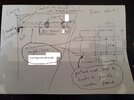
 

Attachments

  • studio cloud plans.jpg
    studio cloud plans.jpg
    171 KB · Views: 51
I’m going to try to work this out properly largely to see how good your “AI” answer is…

I’ll try to work out the deflection. My starting point is normally Engineering Toolbox; it’s great, though it does suffer from non-SI units in places, and even the SI units often involve scale factors e.g. lengths in mm not m. Anyway:


Scroll down to “Single Center Load Beam Calculator - Metric Units”.

You need to know:

1. The load. 12 kg = 120 N (on earth). (Or is it half that?)
2. The length. 3100 mm.
3. The “moment of inertia” for the cross section (see below).
4. The modulus of elasticity for the material.
5. I think the y value is probably zero, hmm.

Ignore the horizontal part of the angle and compute the moment of inertia for the vertical part according to “Solid Rectangular Cross Section” at https://www.engineeringtoolbox.com/area-moment-inertia-d_1328.html . The equation is Ix = b h3 / 12 . b is the thickness and h is the height. So for your AI-generated answer, b = 3/16*25 and h = 25, so I = 3/16 * 25^4 / 12 = 6100.

The modulus of elasticity for aluminium is shown at https://www.engineeringtoolbox.com/properties-aluminum-pipe-d_1340.html - it’s about 70 GPa; GPa = 10^9 N/m^2, but the calculator wants N/mm^2, which is 70,000 (right?).

The answer it gives me is a deflection of 174 mm.

I can believe that (intuitively), and it seems like quite a lot to me. I think I’d want something bigger. As the moment increases with the cube of the height, you can reduce the deflection to one eighth (i.e. about 20mm) by doubling the size to 50mm.

Note that “real” beam calculations involve more than just deflection. You need to consider whether the beam will twist, for example. Why are you using an angle section, rather than a tube or a I-beam?

You could also calculate the stress in the beam and compare that to aluminium’s elastic limit, but I think you will reach unacceptable deflection long before it actually fails - and the failure mode would be more complex anyway.
 
I’m going to try to work this out properly largely to see how good your “AI” answer is…

I’ll try to work out the deflection. My starting point is normally Engineering Toolbox; it’s great, though it does suffer from non-SI units in places, and even the SI units often involve scale factors e.g. lengths in mm not m. Anyway:


Scroll down to “Single Center Load Beam Calculator - Metric Units”.

You need to know:

1. The load. 12 kg = 120 N (on earth). (Or is it half that?)
2. The length. 3100 mm.
3. The “moment of inertia” for the cross section (see below).
4. The modulus of elasticity for the material.
5. I think the y value is probably zero, hmm.

Ignore the horizontal part of the angle and compute the moment of inertia for the vertical part according to “Solid Rectangular Cross Section” at https://www.engineeringtoolbox.com/area-moment-inertia-d_1328.html . The equation is Ix = b h3 / 12 . b is the thickness and h is the height. So for your AI-generated answer, b = 3/16*25 and h = 25, so I = 3/16 * 25^4 / 12 = 6100.

The modulus of elasticity for aluminium is shown at https://www.engineeringtoolbox.com/properties-aluminum-pipe-d_1340.html - it’s about 70 GPa; GPa = 10^9 N/m^2, but the calculator wants N/mm^2, which is 70,000 (right?).

The answer it gives me is a deflection of 174 mm.

I can believe that (intuitively), and it seems like quite a lot to me. I think I’d want something bigger. As the moment increases with the cube of the height, you can reduce the deflection to one eighth (i.e. about 20mm) by doubling the size to 50mm.

Note that “real” beam calculations involve more than just deflection. You need to consider whether the beam will twist, for example. Why are you using an angle section, rather than a tube or a I-beam?

You could also calculate the stress in the beam and compare that to aluminium’s elastic limit, but I think you will reach unacceptable deflection long before it actually fails - and the failure mode would be more complex anyway.
Thanks for this - and for the engineering toolbox link!

Yes, the AI... I was actually just logging back on to say I'd double checked the AI's answer by initiating a separate "conversation" (with the same AI model) and asking the same question. And got a totally different answer... So tried a third time, and got yet another different answer! All presented with great confidence, and pages of calculations... but obviously at least two answers are wrong, and very likely all three... A good reminder really that AI is currently just a well-programmed language model, not some sort of super computer for complex problem solving.

btw, it's 6kg per beam (assuming each beam will share equal load, which they should as the panels, of 6kg each, will be suspended at equally measured symmetrical points under the two beams)

And yes, intuitively I'd been thinking 50mm x 50mm, thickness of around 5mm would be more like it. But again, I have no technical engineering knowledge, so need to make sure before I suspend this thing over my head :) I'll see if the supplier can advise, but if not, any other resources I could use to try and figure this out myself? Will have a closer look at the engineering toolbox link tomorrow to see if I can make any sense of the calculations needed. In your calculations above, I'm not sure if you've taken into account the grade of aluminium, or the combined effect of the horizontal as well as the vertical section of the L shaped beam?

As for why I'm not using a tube (presumably square cross section?) or i-beam, I figured an L shape would provide enough structural integrity while not adding much weight to the overall setup. BUT if another type of beam is more suitable than L-shaped angle aluminium then I am open to suggestions. i.e. if the size of angle beam needed would end up being heavier than a smaller but stronger square tube perhaps? Or if another shape is better suited to carrying a fairly light load but in the middle of quite a long beam?
 
Last edited:
Any reason not to use 2 lengths of 3x2 CLS, painted silver if necessary?
 
What are the acoustic panels made from?
If you were to screw them into the aluminium along their length, that would add rigidity.
 
In your calculations above, I'm not sure if you've taken into account the grade of aluminium

Their elastic moduli don’t differ by much.

or the combined effect of the horizontal as well as the vertical section of the L shaped beam?

You can neglect the contribution of the horizontal leg for bending in the vertical plane. (You can’t ignore it for other modes.)
 
Any reason not to use 2 lengths of 3x2 CLS, painted silver if necessary?
My original plan was to use wood - but after exploring options I concluded this would be heavier, more bending (so more strain on wall plugs) and just less reliable over time than metal. But change my mind! Wood would be easier overall to work with.
 
As for why I'm not using a tube (presumably square cross section?) or i-beam, I figured an L shape would provide enough structural integrity while not adding much weight to the overall setup. BUT if another type of beam is more suitable than L-shaped angle aluminium then I am open to suggestions. i.e. if the size of angle beam needed would end up being heavier than a smaller but stronger square tube perhaps? Or if another shape is better suited to carrying a fairly light load but in the middle of quite a long beam?

L angles are complex because they will twist under load into ^ shapes or V shapes, which are weaker.

A round tube is still a round tube whem twisted, so it won’t twist. A square won’t rotate to a diamond because the diamond is actually stronger (I think).

For a given weight-per-unit-length, a square box section has the same strength as an L angle in a simple deflection analysis, but has the benefit of not twisting.
 
Angle will twist under load due to its shape. 3m span 25deep beam = mahoosive deflection without analysis.

If you must use ally then go for a box section
Have been reading up on this, and have indeed concluded that box section tube is more suitable! Which kind of makes the title of this thread redundant, should probably start a new one... But could you recommend what sort of thickness and cross-sectional size would work for this? (3.1m span, 6kg suspended from middle of span)
 
L angles are complex because they will twist under load into ^ shapes or V shapes, which are weaker.

A round tube is still a round tube whem twisted, so it won’t twist. A square won’t rotate to a diamond because the diamond is actually stronger (I think).

For a given weight-per-unit-length, a square box section has the same strength as an L angle in a simple deflection analysis, but has the benefit of not twisting.
Makes sense. Will change plans to use box section. Any thoughts on what dimensions/thickness I'd need? Just called "The Metal Store" for advice, but they apparently have no technical knowledge of their products: "we're just a retailer"...

As you said before, I think deflection is the main factor - too much deflection, and it's going to put strain on the brackets and the wall plugs. Increased weight of beams is probably less likely to be a strain on the fixings, so I suppose best to go with a larger size if in doubt.
 
How much deflection would you consider acceptable?
The AI was saying around 8mm max, and this at least it was consistent about in it's different answers. Would be good if someone could confirm this sounds reasonable though. Visually I don't really care if it's more - but I suppose the main consideration is that too much deflection would pull on the wall plugs of the mounting brackets.
 

If you need to find a tradesperson to get your job done, please try our local search below, or if you are doing it yourself you can find suppliers local to you.

Select the supplier or trade you require, enter your location to begin your search.


Are you a trade or supplier? You can create your listing free at DIYnot Local

 
Back
Top