• Looking for a smarter way to manage your heating this winter? We’ve been testing the new Aqara Radiator Thermostat W600 to see how quiet, accurate and easy it is to use around the home. Click here read our review.

Connecting New WC Pan To Old Cast Iron Soil Pipe

Joined
13 Sep 2010
Messages
10,693
Reaction score
3,251
Location
Wrong side of The Channel
Country
United Kingdom
Got a wc pan that needs replacing as it's cracked and where it joins the cast soil socket - it's leaking too. The toilet is upstairs and the CI stack is outside - other side of wall from bathroom. The CI pipe for wc comes horizontally through wall. It's all over 60 years old.

I'm going to need to cut the CI socket off that the pan joins onto. I was planning to use a chain cutter as grinder is messy and limited access for reciprocating saw. Will old cast pipe cut successfully with a chain cutter? Or is it likely to have rusted internally and be fragile (ie. not cut cleanly)?

Also, I was planning on joining the new pan to the cast soil pipe using a McAlpine Mac-1. What will the internal surfaces of the CI pipe be like after more than 60 years? I'm thinking that if it's likely to be rough/scaled or corroded then the rubber seals on the pan connector may not seal properly inside the CI pipe.


Or would it be better to cut the CI soil pipe back a bit further and use a Fernco rubber coupling to connect a short length of pvc soil pipe between the soil pipe and pan connector?

 
Last edited:
OP,
Why not post pics showing the bathroom soil pipe, and the external soil pipe from where it leaves the bathroom wall to connect to the soil stack Tee?
The problem with a Chain Cutter is that it might crush a fragile CI pipe, and the best place to cut the soil pipe stub is flush with the wall? A 9" angle grinder works best for me when close cutting.
Have you decided on a new WC - or is it a pan only?
How come both the pan spigot & the soil pipe came to be cracked?
 
Cast inside the property may have fared better than that externally as it's protected from the elements. Any internal corrosion should be fairly easy to remove with a suitable wire brush, to allow a suitable fit for the Pan Connector. I've seen cast water main cut ok with a chain cutter, after many years buried in the ground, so don't think you'd have an issue.

You're confident its cast? Some Plumbers fitted a Lead section from the pan to the junction on the stack, which makes life a bit more interesting....

I'd also (if you haven't already) offer the new pan (or the dimensions at least) to what you have already, the old P Trap outlets don't always line up with the modern Horizontal Outlets, so may need to cut the soil pipe further back to the wall and use a pan connector extension (or similar method) to extend the pipe back and get the right height.
 
OP,
Why not post pics showing the bathroom soil pipe, and the external soil pipe from where it leaves the bathroom wall to connect to the soil stack Tee?
The problem with a Chain Cutter is that it might crush a fragile CI pipe, and the best place to cut the soil pipe stub is flush with the wall? A 9" angle grinder works best for me when close cutting.
Have you decided on a new WC - or is it a pan only?
How come both the pan spigot & the soil pipe came to be cracked?

Thanks for your reply. I'll try to post some pics.

Just a pan only. Cistern was replaced with new old stock Twyfords earlier this year. It doesn't have to be too pretty as whole house is due for refurb in not too distant future.

Apologies if my description was a bit ambiguous. The pan spigot and soil pipe aren't cracked. The pan has a crack down the front, but no leak there yet - as well as lots of minor cracking where the seat bolts mount. The CI stack and pipe connecting to pan are in very good shape. It's just the original seal (poss lead??) between pan spigot and socket on CI pipe that is leaking. Guessing after 60 years of use it has caused slight movement that has disturbed the seal. Unlike modern plastic/rubber pan connectors, old sealing methods don't allow for any movement, which obviously leads to losing the seal over time.
 
Last edited:
You're confident its cast? Some Plumbers fitted a Lead section from the pan to the junction on the stack, which makes life a bit more interesting....

I'd also (if you haven't already) offer the new pan (or the dimensions at least) to what you have already, the old P Trap outlets don't always line up with the modern Horizontal Outlets, so may need to cut the soil pipe further back to the wall and use a pan connector extension (or similar method) to extend the pipe back and get the right height.

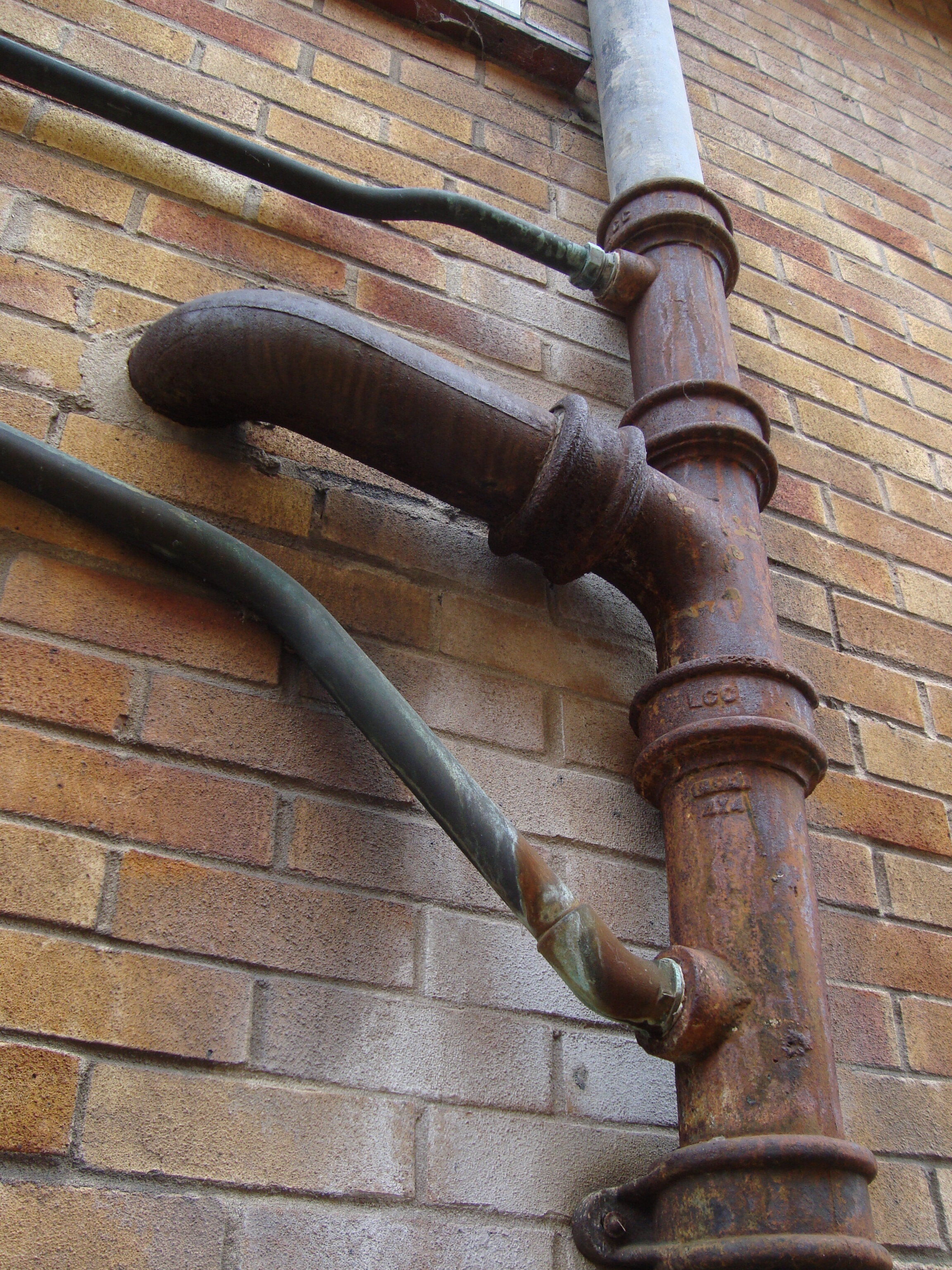
Yes, definitely cast. No doubt. Got 4" and "LCC" embossed into it (same as on other CI pipes in the stack) and you can see a slight seam/ridge running down the outside where it was cast.

Do you know how far out in height the outlet will be between old P trap and a new close coupled pan's outlet? Millimeters or inches? Not sure if an offset connector will be any help.

Thanks for the info, Mr Jaleak. ;)
 
Last edited:
OP,
Why not post pics showing the bathroom soil pipe, and the external soil pipe from where it leaves the bathroom wall to connect to the soil stack Tee?


The first photo of the pipe where it goes into pan looks worse than it is. There's Denso tape around the pipe to pan joint which solved the leak for a while, but not any more.

The water marks on wall are because the cistern overflow was just by the window sill that can be seen in top of picture. Other marks on the stack are rust marks from decades of rain running down the outside of it. Stack doesn't leak.
 
Last edited:
OP,
Thanks for the quick replies and pics.
Best practice, esp given you have a refurb looming up is to do as I suggested in my post above: cut the CI stub off at the wall. This will give you breathing space for later options.
From your pics there is plenty of room to use an 9" angle grinder, which is what I prefer - or a recip saw.
 
That was a decent quality install for the time, threaded bosses for the wastes, and all cast. The outlet spigot on the new Horizontal Outlet pans are lower than the older P Trap types, so unlikely the new pan would meet the existing connection without raising it. I cant recall the exact distance but its enough to cause a headache.

You may well have to cut the cast back to allow room to get a Pan Connector Extension into the Soil Pipe then a normal Pan Connector on the pan into the extension piece.
 
Poster #9,
You cut through what in 30 seconds? Your leg? Well done.
Dont feel bad, many inexperienced DIY'ers tend to stop their attempt to use an angle grinder at the first hint of sparks.
Naughty angle grinder - reminds me of that old saying about blaming the tool.
 
That was a decent quality install for the time, threaded bosses for the wastes, and all cast. The outlet spigot on the new Horizontal Outlet pans are lower than the older P Trap types, so unlikely the new pan would meet the existing connection without raising it. I cant recall the exact distance but its enough to cause a headache.

You may well have to cut the cast back to allow room to get a Pan Connector Extension into the Soil Pipe then a normal Pan Connector on the pan into the extension piece.

Yes, looking at the old stack, that must have been a really hard day's work, lugging heavy CI pipe around, cutting it, fixing it to wall, bending big bore copper waste pipe, sealing CI joints with lead. Then they had to install heavy cast iron baths that weigh a ton. We don't know we're born with lightweight, pushfit plastic pipework.

That could be a problem if new toilets have lower outlet spigots - though I suppose I could pack the pan up slightly with some ply under the base. Last thing I want is the pipe from pan to wall running up hill.

There is a low level pan called a Twyford classic that seem to have a P trap. Wondering if the outlet spigot may be higher as I'm guessing this pan is aimed at older installs. The spigot height (floor to centre line of spigot) is 190mm in the link below. Will have to have a measure.

 
Last edited:
poster #10.

I have never used a reciprocating saw to cut through cast iron. I have however used an angle grinder, including a cast iron bath that I could not smash with a sledge hammer.

An angle grinder generates a lot of dust, which goes rusty when it gets wet. If I ever need to cut cast iron again, I will follow @HERTS P&D 's advice.
 
"There is a low level pan called a Twyford classic that seem to have a P trap. Wondering if the outlet spigot may be higher as I'm guessing this pan is aimed at older installs. The spigot height (floor to centre line of spigot) is 190mm in the link below. Will have to have a measure".

Yes, some P traps do vary from manufacturer to manufacturer and some measure at 185mm. But that is doable with that length of CI protruding in your photo. Cut the CI close to the wall and with modern connector fittings, you will still have a fall from a 185mm pan outlet. The Multiquik range have got me out of trouble more times that I can remember over the years
 

If you need to find a tradesperson to get your job done, please try our local search below, or if you are doing it yourself you can find suppliers local to you.

Select the supplier or trade you require, enter your location to begin your search.


Are you a trade or supplier? You can create your listing free at DIYnot Local

 
Back
Top