
creaky floorboards - are any of these screws okay?

Joined
22 Aug 2024
Messages
107
Reaction score
5
Country
United Kingdom
Hi.
Kinda on a tight budget at the moment.

Were currently redoing the back bedroom and half of the room (The back half) is creaky as hell. It seems like the 'nails' that were used have come loose. I was planning on screwing them down/removing some of the looser nails and replacing them with screws. The back half of the room has no pipes or electrics under the floorboards. The boards are T&G.
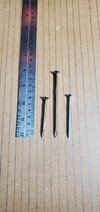
I think it would take about 20-30 screws to quiet it down a bit. I currently have quite a few of these screws. Could I get away with using these? If not, can anybody recommend some that aren't really expensive? I have seen another post on here linking a box of 500 screws for £30 lol. <3 Ty in advance.
 

Attachments

  • WhatsApp Image 2026-09-06 at 11.17.47 PM.jpeg
    WhatsApp Image 2026-09-06 at 11.17.47 PM.jpeg
    305 KB · Views: 27
assuming 20/22mm flooring 2.5 times flooring thickness so 50 to 60mm
you should automatically make sure you stand or place weigh as you drive in the screw even retracting mostly then re screwing if you suspect lifting to avoid or reduce jacking out where the screw pushes the flooring away from the joists
 
Last edited:
Look fine to me. You want to go through the floorboard (18mm?) and maybe 30mm into the joist, so a 50mm long screw would be fine. You can get screws for floorboards with small heads that are less obtrusive, but they aren’t essential if e.g. you’re going to carpet over it. You might also prefer screws where thr bottom half is threaded and the top half isn’t, so that it pulls the floorboard down onto the joist. But I guess what you have will work.

Is there some underlying issue that has caused this?
 
I'd use the ones on the left of your picture. Middle too long (harder to drive) and the right don't look like a normal woodscrew: more a self tapper.
 
I'd use the ones on the left of your picture. Middle too long (harder to drive) and the right don't look like a normal woodscrew: more a self tapper.
i think the rh screw is just a basic silver twin thread screw[cheap as chips] but without ribs/chisel points so more likly to "jack out" but iff money is more important than extra time spent driving and redriving then fine

as an aside the way these things work
a simple screw [ twin thread silver]will go through the flooring it will then hit the joist and because there is no chisel point to ease entry it may require more load to help it to dig in so start to lift the flooring [jack up]now iff the shaft is mostly threaded it probably will not pull the board tight as that requires the thread to let go on the board
this is why i say redriving because once the point makes entry to the joist it then has a firm hold so by withdrawing the screw to just within the flooring will allow any gap to drop and give full contact and with the weight applied to the floor the screw point will enter the joist and pull tight

another point iff you choose to drill with a say 3 or 3.5mm/1/8 inch[3.2mm] countersink bit any no8/10 screw 4 or 4.5mm screw will not jack out with enough load to loose contact the joists
 
Last edited:
If you drill a 5mm clearance hole first you will not need to worry about the boards trying to push up from the joist. A counter sink will help to keep the head flush.

I am old school, I know that many screws are now designed to reduce jacking, but I would rather pre-drill. Sure, it takes longer but you don't have do worry about screwing in, releasing slightly and screwing back down.

The old nails- removing them will be a pig. I would screw next to them and ignore them.
 

If you need to find a tradesperson to get your job done, please try our local search below, or if you are doing it yourself you can find suppliers local to you.

Select the supplier or trade you require, enter your location to begin your search.


Are you a trade or supplier? You can create your listing free at DIYnot Local

 
Back
Top