

Good afternoon all,
I'm looking at having an ev charging point installed at home and have a question regarding CT clamp placement, I think I'm right in what I'm about to say but would like to double check.
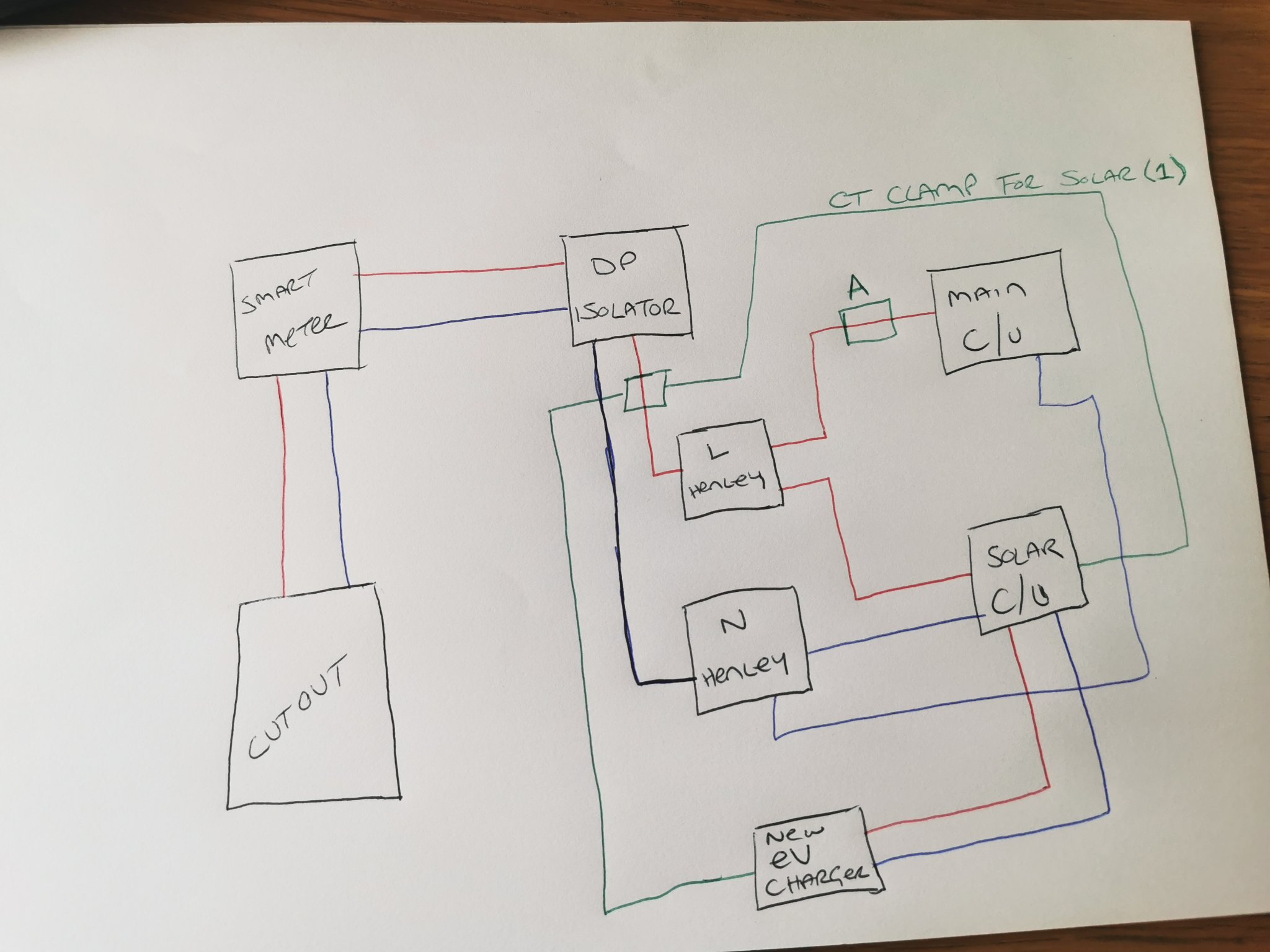
So currently I've a consumer unit that feeds the house and a seperate consumer unit that feeds our solar/battery install.
The diagram above shows our current layout and the proposed ev charger is added, I know the ev charger can go in the spare way in the solar cu I discussed this with the solar installer and he agreed to fit the bigger cu and 25mm tails I supplied at the time knowing I'd be getting an ev.
The ev charger requires a CT clamp fitting so it can control the charging rate if consumption gets near the rating of the cutout fuse.
My understanding is this CT clamp needs to go on the line meter tail before the solar otherwise the ev charger will drain our storage batteries as the solar will see the ev charger as a drain, so the question is am I correct in saying the solar clamp needs moving to the line tail in position A so it only monitors the house consumption and then the new ev charger CT clamp will go where the solar one was originally so on the line tail before it reaches the henley blocks?
Thanks,
Chris.
I'm looking at having an ev charging point installed at home and have a question regarding CT clamp placement, I think I'm right in what I'm about to say but would like to double check.
So currently I've a consumer unit that feeds the house and a seperate consumer unit that feeds our solar/battery install.
The diagram above shows our current layout and the proposed ev charger is added, I know the ev charger can go in the spare way in the solar cu I discussed this with the solar installer and he agreed to fit the bigger cu and 25mm tails I supplied at the time knowing I'd be getting an ev.
The ev charger requires a CT clamp fitting so it can control the charging rate if consumption gets near the rating of the cutout fuse.
My understanding is this CT clamp needs to go on the line meter tail before the solar otherwise the ev charger will drain our storage batteries as the solar will see the ev charger as a drain, so the question is am I correct in saying the solar clamp needs moving to the line tail in position A so it only monitors the house consumption and then the new ev charger CT clamp will go where the solar one was originally so on the line tail before it reaches the henley blocks?
Thanks,
Chris.


