
Damp under patio door (Ed.)

Joined
4 Feb 2025
Messages
3
Reaction score
0
Country
United Kingdom
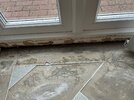
We were in the process of replacing our LVT when we noticed this near our patio door.

Looking at it there appears to be no DPC under the door but it’s present around the rest of the building. The patio doors don’t sit on the exterior brickwork they appear to be sitting on spacers with expendable foam filling in the gap and the existing screed it touching the outer brickwork and drawing moisture in.

Does anyone have any suggestions how we can rectify the issue? Any help would be appreciated.
 

Attachments

  • IMG_0326.jpeg
    IMG_0326.jpeg
    498.1 KB · Views: 88
Is you house cavity wall construction?

If so, what has happened to the cavity where the door sits - usually the doors sits on the outside skin and the cavity is filled with concrete to allow the tiles to run across.

You need to chop out the screed by the door to see what’s going on, if there is no Damp Proof Membrane there, then you need to put in a vertical DPC so the screed doesn’t touch the external skin.

The lack of a DPC under the doors isn’t the problem, they are upvc doors and can’t suck up the moisture…..so it’s not much of a deal.
 
Yes it cavity wall as for what’s happened I have no idea!

How far back should I chisel the screed out?
 
Yes it cavity wall as for what’s happened I have no idea!

How far back should I chisel the screed out?
In theory there should be a damp proof membrane across the whole floor which then goes up the wall until it meets the Damp Proof Course, where in a new built extension it would join it in the wall going across the inner block work.

So ideally you should have a damp proof membrane under the screed, and it should run to the external brickwork under the door then return upwards against the door threshold, then the screed finishes to it and the excess gets cut off.

So you just need to chop out a few inches first and see if you can find some DPM, in which case you can tape some new to it....which might mean taking out a bit more screed to achieve

Without knowing ways been done in terms of DPM and filling the cavity it's hard to know....in a modern build it would have insulation under the screed so easy to sort out.

Screed is just cement and sharp sand, mixed very dry soyou could do quite easily, if you used mapei topcem instead of cement it would cure in 24hrs. You might have an issue with the new screed to old screed join being weak you might need a mechanical fastening to join them.
 
There is no dpm under the screed but there is one under the concrete floor. The screed shown on the picture was only added for the purpose of the LVT and it’s this which is touching the outer brickwork.
 

If you need to find a tradesperson to get your job done, please try our local search below, or if you are doing it yourself you can find suppliers local to you.

Select the supplier or trade you require, enter your location to begin your search.


Are you a trade or supplier? You can create your listing free at DIYnot Local

 
Back
Top