I just moved into this house and can't determine which system I have. When I moved in, the programmer (I have no thermostat) was set to pumped, the CH button did nothing at all, the HW was the only button that worked heating both. I have a pump on the line coming out of the oil boiler, an unvented cylinder in a closet upstairs which from googling appears to mean I have a pumped system, I also have a single two port motorised valve that the previous owners seemingly disconnected and removed the motorised section leaving it on the ground (shown in picture at the bottom), I was initially thinking this was an S-plan system but now I'm unsure?



You are using an out of date browser. It may not display this or other websites correctly.
You should upgrade or use an alternative browser.
You should upgrade or use an alternative browser.
Do I have a gravity system or pumped & is it C/S plan?
- Thread starter m1k326
- Start date

That was a normal S plan, which is all pumped. It's also reasonably modern, so forget about gravity/C plan/other, as that's all irrelevant and obsolete.I was initially thinking this was an S-plan system but now I'm unsure?
Two 2-port valves, one located towards the front of the hot water cylinder, and the heating one has been removed, disconnected from the wiring and left laying on the floor.
Given someone has obviously tampered with it by removing parts and there is evidence of a water leak on the floor in front of the cylinder, the whole lot needs to be looked at, the valve(s) replaced, a room thermostat installed and the wiring sorted so it works as originally intended.
I'm confident the valve in the garage is the one I've highlighted but there should be a second 2-port motorised valve connected to the cylinder? The drain-off valve looks to be directly above the water damaged part of the wood panel, this looks to be quite old and hasn't leaked since we moved in.That was a normal S plan, which is all pumped. It's also reasonably modern, so forget about gravity/C plan/other, as that's all irrelevant and obsolete.
Two 2-port valves, one located towards the front of the hot water cylinder, and the heating one has been removed, disconnected from the wiring and left laying on the floor.
Given someone has obviously tampered with it by removing parts and there is evidence of a water leak on the floor in front of the cylinder, the whole lot needs to be looked at, the valve(s) replaced, a room thermostat installed and the wiring sorted so it works as originally intended.
There is, it's in the 2nd photo with your original post, it has a yellow electric shock label.but there should be a second 2-port motorised valve connected to the cylinder?

- Joined
- 5 Nov 2024
- Messages
- 5,968
- Reaction score
- 2,849
- Country

Might be worth getting a G3 registered engineer to have a look as the cylinder thermostat has been removed.
Sorry, that picture isn't the best, I think (from a quick google) this is the thermostat, it's on the bottom right of the cylinder but the original picture was quite dark?Might be worth getting a G3 registered engineer to have a look as the cylinder thermostat has been removed.
If that is the thermostat, and I do have a two port valve on the cylinder, am I right in thinking if I get the valve repaired/replaced in the garage I should be able to independently turn on HW and CH? The controller is another problem, I suspect it's not wired correctly, I've added an image of that here?
This is the hot water valve:

The other black box with the rotary knob is the thermostat.
However on it's own that means nothing, as there is no way to know from that photo where the other ends of those wires are connected.
The 'L' terminal also looks to be burnt/overheated, so that is something else that requires investigation.
There is also the possibility that the controller itself is damaged either due to age or because the previous persons tampering has shorted something out and destroyed parts of it.
Therefore:
The other black box with the rotary knob is the thermostat.
Yes, but the wiring to the other items will also need to be checked/replaced.am I right in thinking if I get the valve repaired/replaced in the garage I should be able to independently turn on HW and CH?
There are wires in the terminals that would be expected, those being the L&N supply and the two switched outputs to heating and hot water.The controller is another problem, I suspect it's not wired correctly,
However on it's own that means nothing, as there is no way to know from that photo where the other ends of those wires are connected.
The 'L' terminal also looks to be burnt/overheated, so that is something else that requires investigation.
There is also the possibility that the controller itself is damaged either due to age or because the previous persons tampering has shorted something out and destroyed parts of it.
Therefore:
the whole lot needs to be looked at, the valve(s) replaced, a room thermostat installed and the wiring sorted so it works as originally intended.
I had a plumber around, they replaced the motorised valve in the garage, they're having an electrician around next week due to the following:
When CH is requested:
- Oil Boiler does not start
- Pump does not start
- Replaced CH motorised valve is powered and opens
When HW is requested:
- Replaced CH motorised valve is not powered and remains closed (as expected)
- Oil Boiler starts
- Pump starts
However what I have found is that the motorised valve on the cylinder appears to be exclusively controlled by the cylinder thermostat which I can "turn off" with the switch on the wall beside the cylinder (image attached), it does not cut power to the thermostat or valve though, I have no idea what the second switch to the left does (perhaps immersion heater, though if that's the case its never come on even when the HW is cold).
I'm going to turn on the HW and see when the temp is reach does that shut off the boiler to see if there is any connection at all between these (I don't believe it does but I haven't confirmed.
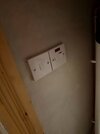
When CH is requested:
- Oil Boiler does not start
- Pump does not start
- Replaced CH motorised valve is powered and opens
When HW is requested:
- Replaced CH motorised valve is not powered and remains closed (as expected)
- Oil Boiler starts
- Pump starts
However what I have found is that the motorised valve on the cylinder appears to be exclusively controlled by the cylinder thermostat which I can "turn off" with the switch on the wall beside the cylinder (image attached), it does not cut power to the thermostat or valve though, I have no idea what the second switch to the left does (perhaps immersion heater, though if that's the case its never come on even when the HW is cold).
I'm going to turn on the HW and see when the temp is reach does that shut off the boiler to see if there is any connection at all between these (I don't believe it does but I haven't confirmed.
- Joined
- 5 Nov 2024
- Messages
- 5,968
- Reaction score
- 2,849
- Country
The switch is likely for the immersion heater(s)
That'd be another thing I'll need the electrician to look at then as both those switches were turned on when we moved in and the hot water went cold while we were waiting for an oil delivery.
Another thing, now that the motorised valve has been installed, regardless of the wiring at this stage the radiators should not be heating when HW is on unless that valve is open, however of the thirteen radiators nine have warm pipes on the inlet side with four being fully heated. The valve on the cylinder works, it closes when I reduce the temperature on the cylinder or turn the switch on the right to the off position.
Another thing, now that the motorised valve has been installed, regardless of the wiring at this stage the radiators should not be heating when HW is on unless that valve is open, however of the thirteen radiators nine have warm pipes on the inlet side with four being fully heated. The valve on the cylinder works, it closes when I reduce the temperature on the cylinder or turn the switch on the right to the off position.
The valve on the cylinder does not operate at all when those switches are turned off, specifically the right switch, there is still power going to the both of them, if I turn them off, turn HW on via the programmer and increase the cylinder temp until I hear it click the valve does nothing, only when that switch is on does the valve open when upping the cylinder temp, this is a mess.

- Joined
- 27 Jan 2008
- Messages
- 29,708
- Reaction score
- 3,677
- Location
- Llanfair Caereinion, Nr Welshpool
- Country
Oh, it does sound like my house when I moved in. I have a C Plan, no question, it is a C Plan, but two pumps and two motorised valves, not tank thermostat for the central heating, and I have an immersion heater which is controlled by how much solar I am getting.
So C Plan means the domestic hot water (DHW) is heated using thermo-syphon not a pump, but the central heating still needs a pump. It seems it was a preferred method with oil boilers, as it allowed the boiler to cool by heating the DHW.
However in summer is causes a problem, as if you leave the boiler on, it fires on a regular basis, and so wastes energy, so the C Plan was altered to include a tank thermostat for summer use, this allows you to leave the boiler on, and ensure the water is hot enough to stop legionnaires. Personally I would use an immersion heater.
The C Plan was further modified to reduce the stored water temperature in the winter, with a motorised valve, but this was a bit pointless, as it removed the whole point of the boiler being able to cool by heating the DHW. However this means we have three basic wiring diagrams for the C Plan.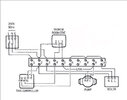
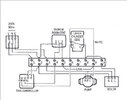
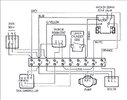 as the idea progressed.
So first the immersion heater, I had solar panels fitted, and a special unit to use excess solar to heat DHW, how it works at this point does not matter, but what is also does is give me a display to tell me how much energy is being used to heat DHW, and this is around a tenth of the energy used when using oil, so even when oil is cheaper to electric, using the immersion heater in summer is clearly the way to go.
I found the idea that turn off the pump, and the central heating will not work idea is flawed, once the flow is started, up-stairs radiators can continue to heat, since I don't use oil for DHW in the summer, this is no longer a problem. Also the whole idea of turning off a pump did not work with two zones, the zone with pump turned off just got a backwards flow.
I still have the Nest Gen 3 connected up, so I can in an emergancy use the oil for DHW, it also means if the Drayton Wiser thermostat fails, (discharged battery for example) I have a back-up.
But I never set it up to heat DHW with the oil boiler, but it does heat the DHW as can't turn the function off, however, it seems likely you have a S Plan, but can't be 100% sure without being there working out which pipes get warm when.
For a non modulating oil boiler, the Y Plan is likely the best, it allows individual control, but default is DHW, so boiler can cool by heating DHW, once we move to modulating boilers, be it oil or gas, the whole idea of how to control changes, and the TRV (thermostatic radiator valve) is King.
The problem I found as an electrician, was to work out what I am working with, the boilers where the pump etc, was built in the boiler, made it so much easier. The heating engineer may know which boilers need a delay to cool down, as an electrician I don't have a clue, the reverse with plumber, he is also like the electrician only knows half of the system, so as a pair we could work it out, but for someone to know the whole system, we need a heating engineer, and an engineer means someone with a degree, so they want paying for their skill.
I was lucky, I knew the electrical side, so only needed a plumber, I thought, but then he called in the heating engineer, and between the three of us, we got it sorted.
It is not perfect, most central heating works on the near enough engineering idea, to make it perfect costs too much, so you want someone with experience, so he knows how far to go, but not someone with the attitude I have always done it this way, so will continue doing it this way. Central heating has evolved, and what was done 50 years ago may not work today.
My parents central heating was used to warm the house before they got up and lit the fire, it did not run all day, we tend to forget that. Where I volunteer we still have central heating which uses a boiler, i.e. steam not water, and a one pipe system, where the steam is vented to atmosphere at the last carriage. Really cold carriages if diesel hauled, as no steam for the heaters.
We simply forget such systems ever existed, but oil boilers last a lot longer than gas ones, so with oil we see some antiquated systems.
So C Plan means the domestic hot water (DHW) is heated using thermo-syphon not a pump, but the central heating still needs a pump. It seems it was a preferred method with oil boilers, as it allowed the boiler to cool by heating the DHW.
However in summer is causes a problem, as if you leave the boiler on, it fires on a regular basis, and so wastes energy, so the C Plan was altered to include a tank thermostat for summer use, this allows you to leave the boiler on, and ensure the water is hot enough to stop legionnaires. Personally I would use an immersion heater.
The C Plan was further modified to reduce the stored water temperature in the winter, with a motorised valve, but this was a bit pointless, as it removed the whole point of the boiler being able to cool by heating the DHW. However this means we have three basic wiring diagrams for the C Plan.
as the idea progressed.So first the immersion heater, I had solar panels fitted, and a special unit to use excess solar to heat DHW, how it works at this point does not matter, but what is also does is give me a display to tell me how much energy is being used to heat DHW, and this is around a tenth of the energy used when using oil, so even when oil is cheaper to electric, using the immersion heater in summer is clearly the way to go.
I found the idea that turn off the pump, and the central heating will not work idea is flawed, once the flow is started, up-stairs radiators can continue to heat, since I don't use oil for DHW in the summer, this is no longer a problem. Also the whole idea of turning off a pump did not work with two zones, the zone with pump turned off just got a backwards flow.
I still have the Nest Gen 3 connected up, so I can in an emergancy use the oil for DHW, it also means if the Drayton Wiser thermostat fails, (discharged battery for example) I have a back-up.
But I never set it up to heat DHW with the oil boiler, but it does heat the DHW as can't turn the function off, however, it seems likely you have a S Plan, but can't be 100% sure without being there working out which pipes get warm when.
For a non modulating oil boiler, the Y Plan is likely the best, it allows individual control, but default is DHW, so boiler can cool by heating DHW, once we move to modulating boilers, be it oil or gas, the whole idea of how to control changes, and the TRV (thermostatic radiator valve) is King.
The problem I found as an electrician, was to work out what I am working with, the boilers where the pump etc, was built in the boiler, made it so much easier. The heating engineer may know which boilers need a delay to cool down, as an electrician I don't have a clue, the reverse with plumber, he is also like the electrician only knows half of the system, so as a pair we could work it out, but for someone to know the whole system, we need a heating engineer, and an engineer means someone with a degree, so they want paying for their skill.
I was lucky, I knew the electrical side, so only needed a plumber, I thought, but then he called in the heating engineer, and between the three of us, we got it sorted.
It is not perfect, most central heating works on the near enough engineering idea, to make it perfect costs too much, so you want someone with experience, so he knows how far to go, but not someone with the attitude I have always done it this way, so will continue doing it this way. Central heating has evolved, and what was done 50 years ago may not work today.
My parents central heating was used to warm the house before they got up and lit the fire, it did not run all day, we tend to forget that. Where I volunteer we still have central heating which uses a boiler, i.e. steam not water, and a one pipe system, where the steam is vented to atmosphere at the last carriage. Really cold carriages if diesel hauled, as no steam for the heaters.
We simply forget such systems ever existed, but oil boilers last a lot longer than gas ones, so with oil we see some antiquated systems.

DIYnot Local
Staff member
If you need to find a tradesperson to get your job done, please try our local search below, or if you are doing it yourself you can find suppliers local to you.
Select the supplier or trade you require, enter your location to begin your search.
Please select a service and enter a location to continue...
Are you a trade or supplier? You can create your listing free at DIYnot Local
Similar threads


- Replies
- 1
- Views
- 1K
